

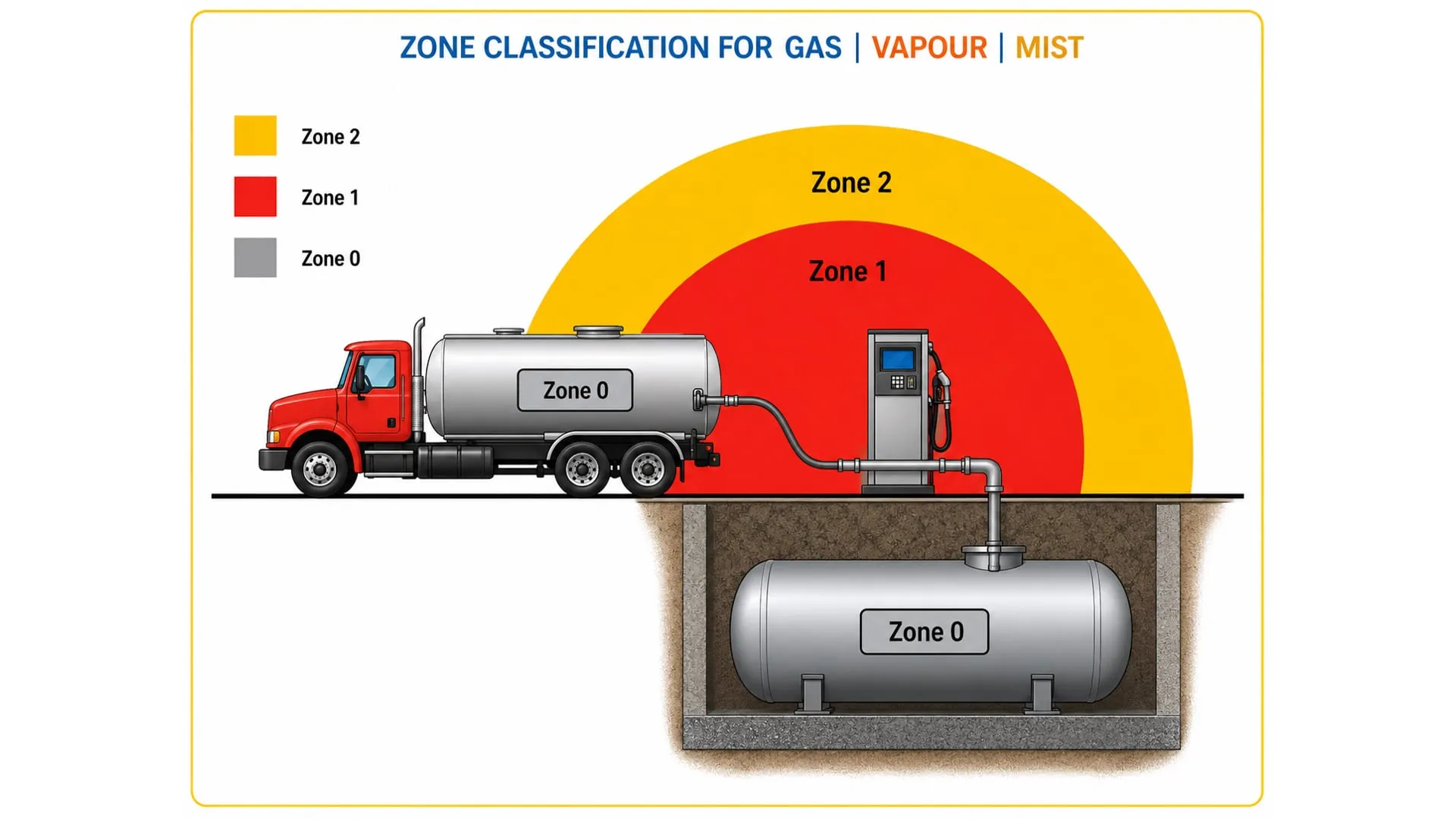
ATEX / IEC 60079 Hazardous Area Classification
Zone 0, 1, 2 and Zone 20, 21, 22 classification using a release-source, ventilation/dilution, material-property, and equipment-layout basis that supports IEC design and ATEX workplace documentation.
HazBasis performs Zone-based Hazardous Area Classification for projects using IEC 60079 and for facilities that need area-classification support within an ATEX workplace framework. For gas and vapor hazards, the technical methodology is based on IEC 60079-10-1. For combustible dust hazards, the current IEC 60079-10-2 methodology is applied.
The study identifies where explosive atmospheres can occur, how often they can be expected, how far they may extend, and what gas/dust group or temperature-related information must be carried forward into equipment selection and installation design.
Need to convert an old Zone drawing, update a classification after process changes, or support an ATEX/IEC equipment project?
ATEX and IEC Are Related—but They Are Not the Same Thing
This distinction is important for technically correct project documentation. ATEX is the European regulatory framework for explosive atmospheres; IEC 60079 is a family of technical standards used internationally for explosion-protected electrical systems and area classification.
| Framework | Primary Role | HAC Relevance |
|---|---|---|
| ATEX Workplace Directive 1999/92/EC | Employer/workplace obligations for worker protection from explosive atmospheres. | Risk assessment, classification of places into zones, organizational/technical controls, and explosion-protection documentation under national implementation. |
| ATEX Product Directive 2014/34/EU | EU requirements for equipment and protective systems intended for potentially explosive atmospheres. | Equipment category/conformity framework; classification information helps specify appropriate equipment. |
| IEC 60079-10-1 | Technical standard for classification of areas with explosive gas atmospheres. | Release source, grade of release, release characteristics, ventilation/dilution, zone type and extent. |
| IEC 60079-10-2 | Technical standard for classification of areas with explosive dust atmospheres and combustible dust layers. | Dust source of release, cloud/layer behavior, zone type and extent. |
Current technical basis verified August 2026: IEC 60079-10-1:2020 is the current gas/vapor area-classification edition; IEC 60079-10-2:2026 was published June 29, 2026 for explosive dust atmospheres. Project-specific EN adoptions, national transposition of ATEX, owner standards, and authority requirements must also be confirmed.
IEC Zone Classification at a Glance
| Hazard | Zone | General Presence of Explosive Atmosphere | Typical Use |
|---|---|---|---|
| Gas / vapor | Zone 0 | Present continuously, for long periods, or frequently | Inside equipment or spaces where explosive gas atmosphere is persistent/frequent |
| Gas / vapor | Zone 1 | Likely to occur occasionally in normal operation | Around primary-grade release sources |
| Gas / vapor | Zone 2 | Not likely in normal operation; if it occurs, persists only for a short period | Around secondary-grade release sources or abnormal-release areas |
| Dust | Zone 20 | Explosive dust atmosphere present continuously, for long periods, or frequently | Often inside dust-handling equipment |
| Dust | Zone 21 | Likely to occur occasionally in normal operation | Around normal dust-release points |
| Dust | Zone 22 | Not likely in normal operation; if it occurs, persists only for a short period | Around abnormal or infrequent dust-release points |
IEC 60079-10-1 Methodology — Explosive Gas Atmospheres
IEC 60079-10-1 is not simply a Zone-definition table. The classification is developed from the relationship between the source of release, the release conditions, and the ability of ventilation or dilution to control the resulting flammable cloud.
1. Identify flammable substances and process states — Compile flammable gas/vapor properties and actual operating temperature, pressure, composition, phase behavior, and containment conditions.
2. Identify sources of release — Locate points from which flammable gas or vapor can be released to atmosphere, including vents, seals, sampling points, drains, open transfers, relief outlets, equipment openings, and credible leakage sources.
3. Assign grade of release — Classify the source as continuous, primary, or secondary based on how often and under what operating conditions release is expected.
4. Determine release characteristics — Evaluate or calculate the release rate/characteristic using pressure, temperature, opening geometry, fluid properties, evaporation/flashing behavior, and other scenario-specific parameters.
5. Evaluate ventilation and dilution — Assess air movement, enclosure, natural/mechanical ventilation, dilution capability, ventilation availability, and locations where gas/vapor can accumulate.
6. Determine zone type — Use the grade of release together with ventilation/dilution performance to determine whether the resulting location is Zone 0, Zone 1, Zone 2, or potentially non-hazardous under the documented basis.
7. Determine zone extent — Establish the horizontal and vertical extent based on the release characteristic, gas/vapor behavior, ventilation, obstacles, openings, and geometry.
8. Carry forward equipment-selection data — Document gas group, temperature-related information, and other classification notes needed by the electrical/equipment design team.
Grades of Release — Why They Matter
| Grade of Release | General Meaning | Examples to Evaluate |
|---|---|---|
| Continuous | Release is continuous, expected for long periods, or occurs frequently. | Open process surfaces or continuously vented spaces where flammable atmosphere is inherent to operation. |
| Primary | Release can be expected periodically or occasionally during normal operation. | Routine venting, sampling, draining, filling, or process operations that intentionally release flammable material. |
| Secondary | Release is not expected in normal operation and, if it occurs, is expected to be infrequent and short. | Seal leakage, gasket failure, abnormal hose leakage, or similar credible abnormal releases. |
Ventilation and Dilution Are Part of the Classification — Not Afterthoughts
A Zone boundary can change significantly depending on whether the release occurs outdoors, inside a well-ventilated building, within a partially enclosed skid, below grade, or near a ceiling where a light gas can collect. HazBasis documents the ventilation assumptions that support the classification rather than treating “indoors” or “outdoors” as sufficient engineering conclusions.
- Natural vs. mechanical ventilation and its availability.
- Local exhaust and capture effectiveness near the release source.
- Room volume, obstructions, equipment congestion, pits/trenches, roof pockets, and enclosed skids.
- Gas/vapor density and buoyancy behavior.
- Potential background concentration when multiple or persistent release sources exist.
- Failure modes of mechanical ventilation where classification depends on ventilation.
IEC 60079-10-2 Methodology — Explosive Dust Atmospheres
IEC 60079-10-2 addresses explosive dust clouds and combustible dust layers. These are related but different hazards. A layer can create a hot-surface/fire hazard and can become a secondary source of dust cloud if disturbed; the area-classification review should therefore evaluate both cloud-release behavior and layer accumulation.
1. Confirm combustible dust hazard — Identify the powder/dust and establish whether it can form an explosive dust atmosphere under relevant process conditions.
2. Identify sources of dust release — Map normal and abnormal release points at mills, mixers, sieves, dryers, collectors, transfers, bag dumps, discharge points, packaging, conveying, and access openings.
3. Assign grade of dust release — Classify sources based on whether dust release is continuous/frequent, primary during normal operation, or secondary under abnormal/infrequent conditions.
4. Evaluate cloud formation and dispersion — Assess dustiness, release quantity, drop height, transfer energy, local exhaust, enclosure, air movement, and the likelihood that a dispersed dust cloud can reach an explosible concentration.
5. Evaluate dust layers separately — Assess where dust can settle, layer thickness/extent, housekeeping, elevated surfaces, cable trays, equipment ledges, and whether layers can be disturbed into a cloud.
6. Determine Zone 20/21/22 — Assign the Zone based on the likelihood and persistence of explosive dust atmospheres and the release-source basis.
7. Establish zone extent — Determine the boundary around the dust release source or equipment based on dispersion, containment, ventilation/air movement, housekeeping, and physical geometry.
8. Document dust group and temperature inputs — Provide the dust group and ignition-temperature information needed for downstream equipment selection and maximum surface-temperature evaluation under the applicable installation/product standards.
Dust Groups Under the IEC Framework
| Group | General Material Type | Why It Matters |
|---|---|---|
| IIIA | Combustible flyings | Equipment suitability and protection requirements differ from fine dust hazards. |
| IIIB | Non-conductive combustible dust | Common organic/polymeric dust category for equipment marking and design. |
| IIIC | Conductive combustible dust | Requires equipment suitable for conductive dust hazards; many metal dusts fall into this category. |
ATEX Workplace Zoning and Equipment Categories
For EU/EEA projects, workplace zoning under Directive 1999/92/EC supports the employer’s explosion-risk controls and Explosion Protection Document. The equipment placed on the market is addressed separately by Directive 2014/34/EU. The Zone classification therefore becomes a key input to selecting equipment with an appropriate ATEX category and explosion-protection marking.
| Workplace Zone | Typical ATEX Equipment Category Relationship* | Engineering Note |
|---|---|---|
| Zone 0 / Zone 20 | Category 1 | Highest level of protection for equipment intended for these continuously/frequently hazardous locations. |
| Zone 1 / Zone 21 | Category 1 or 2 | Equipment category must be appropriate to gas/dust hazard and intended use. |
| Zone 2 / Zone 22 | Category 1, 2 or 3 | Selection still requires correct gas/dust group, temperature and protection concept. |
*Simplified relationship for non-mining equipment; final equipment selection must follow the applicable ATEX/EN/IEC product and installation requirements, certification/marking, and national implementation.
Gas Group, Dust Group, Temperature and EPL/Category Coordination
The Zone number alone is not enough to specify equipment. A complete classification basis should carry forward the material group and temperature information required for the electrical/equipment design team.
- Gas/vapor group (for example IIA, IIB, IIC as applicable).
- Dust group (IIIA, IIIB, IIIC as applicable).
- Temperature class or maximum permissible surface-temperature basis as required by the applicable equipment/installation standard.
- Zone designation and extent.
- Equipment Protection Level (EPL) / ATEX category coordination where relevant to the project basis.
- Any special environmental, ingress, or process conditions that affect equipment suitability but are outside the zone designation itself.
Typical IEC / ATEX Classification Scenarios
| Scenario | Likely Framework Focus | Critical Inputs | Common Error to Avoid |
|---|---|---|---|
| Hydrogen release | IEC 60079-10-1 | Release rate, buoyancy, ceiling/roof geometry, ventilation, source grade | Using a generic radius without checking accumulation at high points |
| Solvent transfer / tank vent | IEC 60079-10-1 | Vapor pressure, temperature, filling/vent rate, vapor density, ventilation | Ignoring heated operation or intermittent normal releases |
| Dust collector / filter | IEC 60079-10-2 | Internal dust cloud, filter integrity, discharges, clean/dirty side, layer accumulation | Classifying only inside the collector and ignoring credible external releases |
| Bag dump / powder addition | IEC 60079-10-2 | Frequency, dustiness, local exhaust, quantity, enclosure, housekeeping | Assuming local exhaust eliminates zoning without verifying capture and availability |
| Hybrid gas + dust process | Both 10-1 and 10-2 | Independent gas/dust release sources and overlapping extents | Selecting equipment for only one of the hazards |
What HazBasis Delivers for IEC / ATEX Projects
- IEC / ATEX Hazardous Area Classification report with standard basis, process description, material properties, release-source methodology, ventilation/dilution assumptions, zone decisions, and limitations.
- Gas/vapor and/or dust release-source schedule showing source grade, zone classification, extent, and material-group information.
- Zone drawings showing Zone 0/1/2 and/or Zone 20/21/22 plan and elevation boundaries.
- Technical inputs to the Explosion Protection Document or project explosion-protection basis, where that support is within scope.
- Equipment-selection basis inputs for coordination with the electrical engineer, Ex equipment specialist, EPC, manufacturer, and owner.
- Reviewer, client, insurer, or authority comment support.
When Testing Is Needed
IEC classification quality depends on reliable material data. Published data may be adequate for a pure substance, but custom mixtures, process intermediates, proprietary powders, or material that changes through drying/milling can require testing.
Electrostatic: charge-decay, resistivity, liquid conductivity, FIBC classification, or other electrostatic data when separate ignition-source evaluation is required.
Gas/vapor: flash point, LFL/UFL, autoignition temperature, vapor pressure or other physical-property data where needed.
Dust: explosibility screening, MIE, minimum ignition temperature of dust cloud/layer, resistivity/conductivity, particle size and moisture where relevant.
FAQ
Is ATEX the same as IEC 60079?
No. ATEX is an EU regulatory framework. IEC 60079 is a family of technical standards. IEC/EN standards are commonly used to provide the technical basis for explosion-protected design, but the legal obligations come from ATEX as implemented in the relevant country.
What is the difference between Zone 0, 1 and 2?
They represent decreasing likelihood/persistence of an explosive gas atmosphere: Zone 0 for continuous/long/frequent presence, Zone 1 for occasional presence in normal operation, and Zone 2 for infrequent/short abnormal presence.
What is the difference between Zone 20, 21 and 22?
They are the analogous dust-atmosphere zones: Zone 20 for continuous/long/frequent presence, Zone 21 for occasional presence in normal operation, and Zone 22 for infrequent/short abnormal presence.
What changed with IEC 60079-10-2:2026?
The 2026 edition is now the current IEC dust-area classification publication. HazBasis uses the current project-applicable edition and documents the standard basis rather than relying on legacy 2015 references.
Does a Zone classification automatically tell me which equipment to buy?
No. Zone is one input. Equipment selection also depends on gas/dust group, equipment protection level or category, temperature limits, protection concept, certification/marking, installation standard, and environmental/process conditions.
Can the NEC Zone system be used in the United States?
The NEC recognizes Zone-based systems for certain hazardous locations, but whether they are appropriate for a project depends on the adopted NEC edition, project design basis, owner requirements, and AHJ acceptance. HazBasis confirms that basis before using it.
Do dust layers matter if a dust cloud is not normally present?
Yes. Dust layers can create thermal/fire hazards and can become sources of secondary dust clouds when disturbed. IEC dust classification treats dust clouds and combustible dust layers as separate but related considerations.
Can HazBasis support both ATEX zoning and equipment manufacturers?
Yes. HazBasis can provide the area-classification basis and coordinate the resulting Zone/group/temperature information with equipment manufacturers and electrical engineers. Product certification itself remains a separate conformity-assessment scope.