

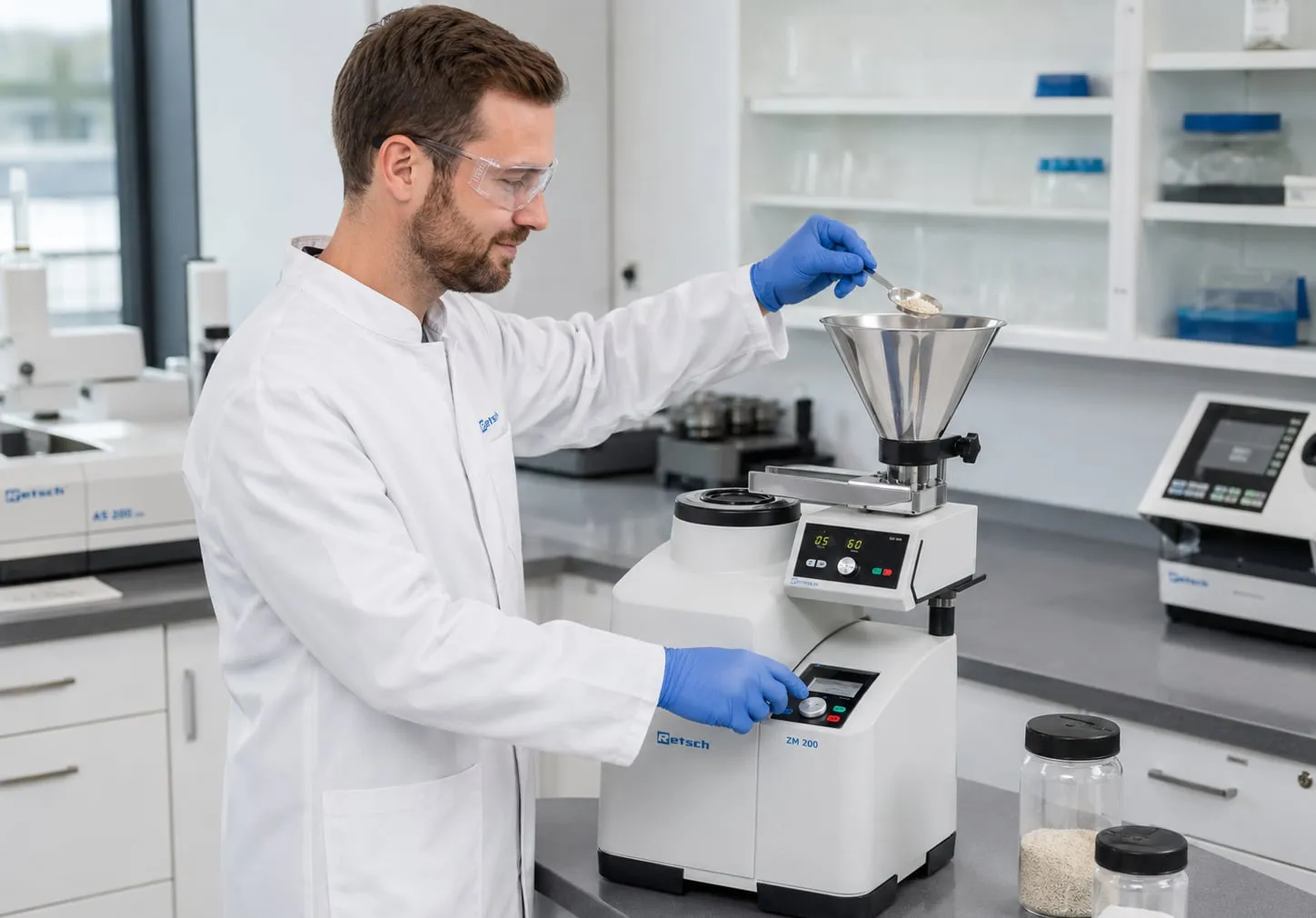
What Cryogenic Grinding Answers
This process reduces particle size while limiting heat buildup, softening, volatilization, smearing, or degradation in temperature sensitive materials. The result applies to the submitted sample, preparation, conditioning, and test conditions stated in the report. As with any single lab value, we’re careful not to generalize it as a universal property of the material, since particle size, moisture, temperature, pressure, geometry, and formulation can all shift the outcome.
Not sure if your material needs cryogenic preparation? Reach out and we’ll help you scope it.
Test Method and Standard
The sample is cooled to an embrittled state, commonly with liquid nitrogen, then milled under controlled conditions. The prepared fraction can be sieved, characterized, and used for subsequent explosibility or ignition testing. Preparation follows a controlled laboratory procedure defined in the test scope, or an agreed project specific method, and the quotation identifies the governing approach before work begins.
What You Receive
- A prepared sample meeting the agreed size objective
- Documented preparation and handling conditions
- Optional sieve distribution and moisture characterization
How the Data Supports Decisions
This preparation step helps determine whether a worst case fine material should be evaluated, informs how polymers, elastomers, foods, or other heat sensitive products should be prepared for testing, and clarifies how the preparation method may affect the relevance of downstream test results.
When to Order This Test
- The material is elastic, waxy, fibrous, or heat sensitive
- Ambient grinding causes melting, smearing, or decomposition
- A defined fine fraction is needed for conservative hazard testing
Sample Submission Guidance
Required mass depends on the downstream test program and grinding yield. Submit enough material to cover preparation losses, characterization, and all planned repeats. Include the SDS, composition or trade name information, physical form, process description, and whether the sample should be tested as received or prepared to a different condition.
Why Choose HazBasis
- A lot of materials worth testing this way (elastomers, waxes, certain polymers) simply can’t be ground at ambient temperature without changing what you’re actually measuring, since heat from the milling process itself alters the sample before it ever reaches the hazard test. Cryogenic grinding exists specifically to avoid that problem.
- We prepare the sample in house and characterize it before it moves to explosibility or ignition testing, so the two steps use a sample we already understand rather than handing off a black box between labs.
- If the goal is a conservative worst case fine fraction rather than a representative average, we confirm that target with you before grinding, since the two objectives call for different preparation decisions.
FAQ
What does Cryogenic Grinding testing measure?
Reduces particle size while limiting heat buildup, softening, volatilization, smearing, or degradation of temperature-sensitive materials.
Which standard will be used?
Controlled laboratory preparation procedure defined in the test scope. The final method depends on the sample, project objective, and any customer or regulatory requirements.
Does cryogenic grinding always represent the process material?
No. It is a preparation tool. The project should clearly distinguish as-received testing from deliberately prepared worst-case testing and explain which condition supports the safety decision.