

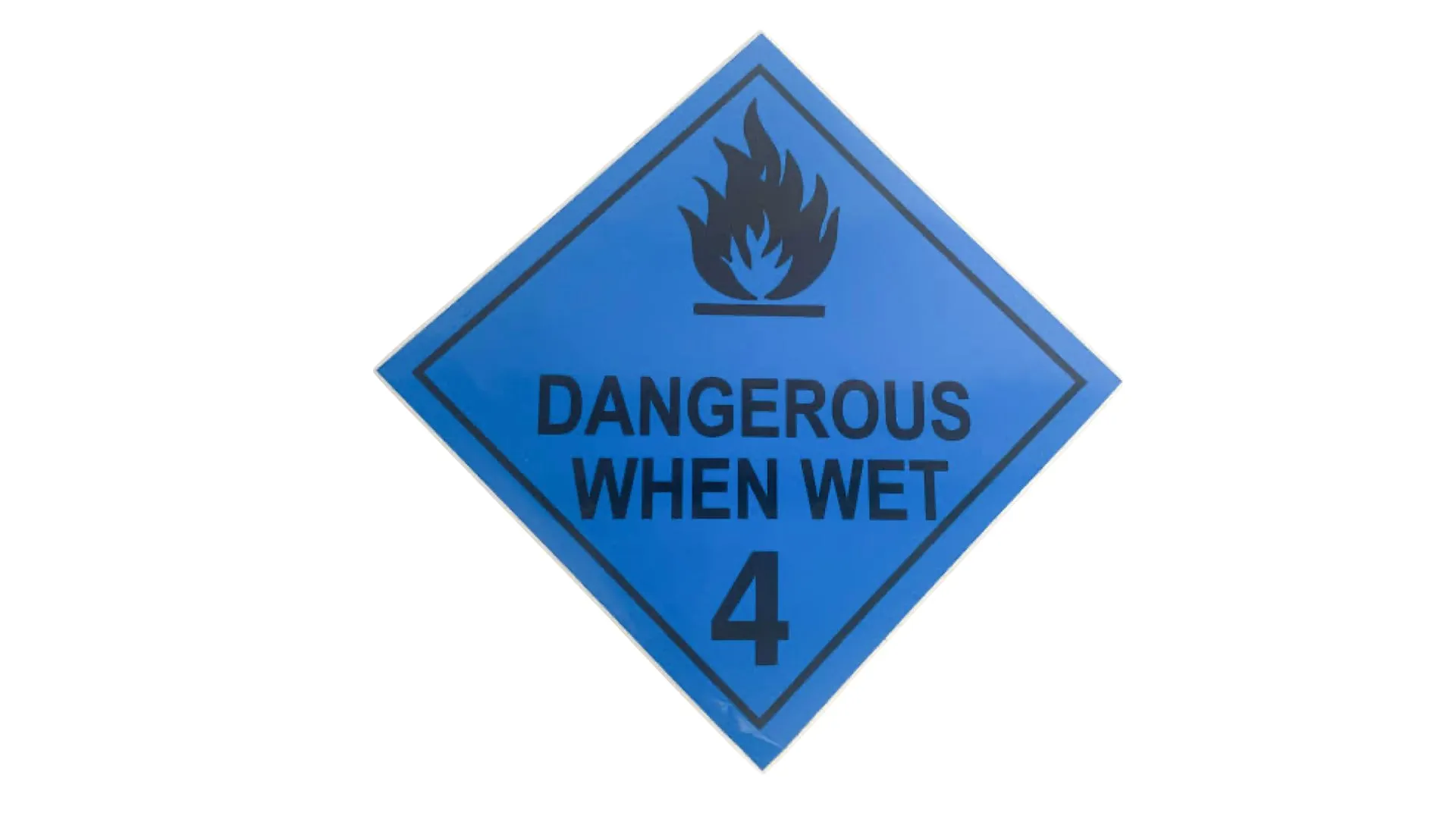
What Dangerous When Wet Testing Answers
This test determines whether contact with water causes spontaneous ignition or generates flammable gas at a rate relevant to Division 4.3 classification. The result applies to the submitted sample, preparation, conditioning, and test conditions stated in the report. As with any single lab value, we’re careful not to generalize it as a universal property of the material, since particle size, moisture, temperature, pressure, geometry, and formulation can all shift the outcome.
Not sure if your material needs this testing? Reach out and we’ll help you scope it.
Test Method and Standard
A staged screening sequence brings the material into controlled contact with water while observing heat, gas evolution, and ignition. When screening alone doesn’t establish the classification, gas generation is measured quantitatively to determine the maximum evolution rate. Testing follows UN Manual of Tests and Criteria Test N.5 or an agreed project specific method, and the quotation identifies the governing method before work begins.
What You Receive
- Observations of reaction, ignition, and gas evolution
- Measured flammable gas evolution rate when required
- Division 4.3 and packing group support based on the applicable criteria
How the Data Supports Decisions
This result informs water exclusion and emergency response precautions, packaging, labeling, and transport classification, and storage compatibility and firefighting strategy for the material.
When to Order This Test
- The material contains reactive metals, hydrides, or moisture sensitive components
- An SDS or shipping classification indicates possible water reactivity
- A formulation or supplier change may affect how the material reacts with water
Sample Submission Guidance
Approximately 100 g is typically requested; HazBasis will confirm the exact amount after reviewing expected reactivity and the required classification stage. Include the SDS, composition or trade name information, physical form, process description, and whether the sample should be tested as received or prepared to a different condition.
Why Choose HazBasis
- Water reactivity testing carries real risk if it’s rushed or handled without the right controls, so the staged screening approach exists specifically to identify a dangerous reaction early, before committing to quantitative gas measurement.
- We report the reaction behavior in enough detail to distinguish a borderline result from a clear one, since packing group often comes down to reaction severity and rate, not just a pass or fail.
- If the result changes your storage, labeling, or emergency response planning, we can carry that interpretation through rather than leaving you to translate a UN test result into a facility procedure on your own.
FAQ
What does Dangerous When Wet testing measure?
Determines whether contact with water causes spontaneous ignition or generates flammable gas at a rate relevant to division 4.3 classification.
Which standard will be used?
UN Manual of Tests and Criteria, Test N.5. The final method depends on the sample, project objective, and any customer or regulatory requirements.
What result can trigger Division 4.3 classification?
Spontaneous ignition during the procedure or flammable-gas evolution above the applicable UN threshold can support classification. Packing group depends on reaction severity and rate.