

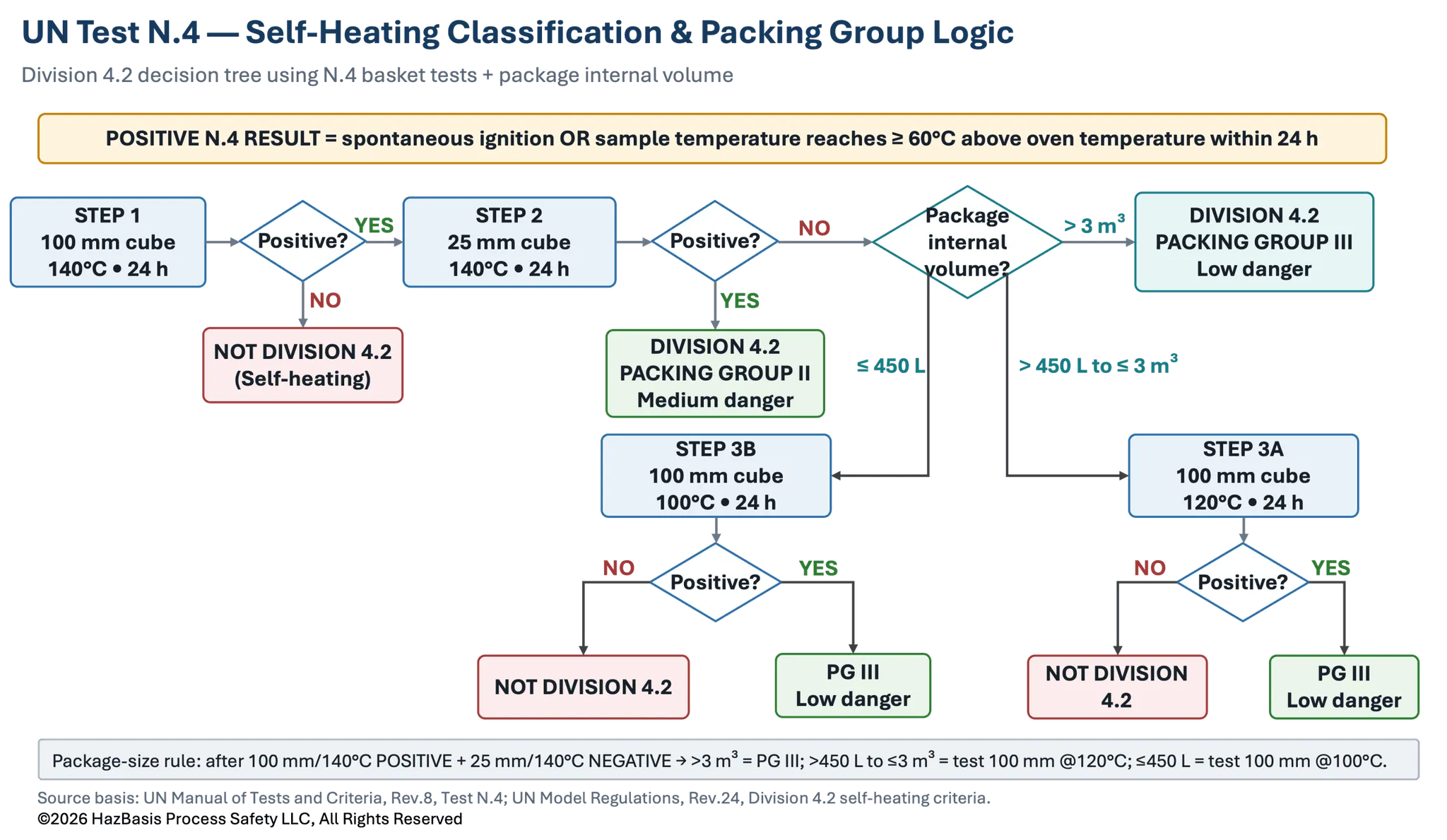
Can your solid self-heat enough during transport to trigger Division 4.2 classification?
UN N.4 testing evaluates the tendency of a solid to undergo oxidative self-heating under prescribed test conditions. HazBasis performs the UN N.4 test sequence using wire-mesh sample cubes and controlled oven temperatures to support Division 4.2 self-heating classification and packing-group evaluation.
Need a defensible transport-classification test program?
Why UN N.4 testing matters
Self-heating can develop without a spark, flame, or hot surface. A material may slowly react with oxygen and generate heat. If heat generation exceeds heat loss, the bulk temperature can rise, accelerate the reaction, and eventually lead to self-ignition. Transport classification therefore considers not only whether a material can burn, but whether it can accumulate heat under specified package-size and temperature conditions.
Under U.S. DOT rules, a self-heating material is within Division 4.2 when it meets the applicable UN Manual test criteria. The regulations also use results from different sample-cube sizes and temperatures to assign Packing Group II or III and to account for package volume. That makes accurate N.4 testing and documentation particularly important for materials shipped in drums, bags, FIBCs, or larger bulk packages.
UN N.4 test method overview
The UN N.4 method uses a controlled hot-air oven and wire-mesh sample cubes. Testing is conducted in the prescribed sequence using 25 mm and/or 100 mm cubes at specified temperatures. A test is considered against the method’s defined temperature-rise / ignition criteria over the prescribed exposure period. Depending on the initial result and intended package volume, additional test temperatures may be needed to determine whether the material is Division 4.2 and, where applicable, whether Packing Group II or III applies.
For U.S. DOT packing-group assignment, a positive result in the 25 mm cube at 140 °C supports Packing Group II. Packing Group III criteria use combinations of negative 25 mm / 140 °C results and positive 100 mm results at 140 °C, 120 °C, or 100 °C depending on packaging volume. HazBasis will define the minimum test sequence needed for the actual shipping configuration.
When to order UN N.4 testing
- A powder, granule, porous solid, biomass, chemical intermediate, catalyst, pigment, carbonaceous material, or formulated product has shown unexplained warming during storage or shipping.
- The material oxidizes slowly in air or contains components known to self-heat.
- You are shipping the material in bags, drums, FIBCs, IBCs, or bulk packaging and need to determine Division 4.2 applicability.
- An existing SDS lists “spontaneously combustible” or “self-heating” without current supporting test data.
- A formulation, moisture content, particle size, drying step, residual solvent, impurity profile, or supplier change could affect self-heating behavior.
- You need to distinguish transport N.4 classification from broader process-scale self-heating risk in silos, dryers, hoppers, bins, or bulk storage.
What you receive
- UN N.4 method identification and sample preparation / conditioning documentation.
- Temperature-time data for the sample and oven.
- Observed self-heating, ignition, smoking, discoloration, decomposition, or other relevant behavior.
- Result for each cube size / oven temperature tested.
- Division 4.2 and packing-group support based on the applicable UN/DOT criteria and stated packaging assumptions.
- Clear recommendation for additional N.4 steps when package size or an intermediate result requires further testing.
UN N.4 transport testing vs. process self-heating testing
| Question | UN N.4 transport classification | Process self-heating / scale-up |
|---|---|---|
| Primary purpose | Determine whether the material meets transport self-heating criteria and packing-group conditions. | Estimate safe storage / handling conditions, onset behavior, scale effects, and risks in process equipment. |
| Typical apparatus | UN-prescribed wire-mesh cubes in a controlled oven. | Basket tests, Grewer oven, air-over-layer, bulk powder, aerated powder, or other thermal-stability methods. |
| Decision supported | Division 4.2 / packing group and transport documentation. | Operating limits, storage temperature, bulk scale-up, drying / aeration hazards, and process safeguards. |
| Best practice | Use N.4 for the shipping question. | Use scale-up testing when the facility question extends beyond transportation. |
Sample submission guidance
Provide the SDS, material name, composition if available, physical form, particle size, moisture / solvent condition, shipping temperature, planned package type and volume, and any history of warming, smoking, odor, discoloration, or self-ignition. Because N.4 testing may require multiple cube sizes, repeats, and temperatures, HazBasis will confirm the required sample mass after reviewing the intended transport configuration.
Why Choose HazBasis
- Classification-focused scoping: the objective is not simply to “run a test,” but to determine which test sequence answers the shipping question.
- Process-safety context: when transport behavior points to a broader combustible-dust, self-heating, reactive-chemical, or fire hazard, the same technical team can help connect the result to facility risk management.
- Clear reporting: sample condition and test basis are documented so the result can be traced to the material actually tested.
- Practical communication: reports are written for EHS, R&D, product stewardship, logistics, dangerous-goods, and regulatory stakeholders—not only for laboratory specialists.
FAQ
What does UN N.4 test?
UN N.4 evaluates the ability of a solid to undergo oxidative self-heating under controlled conditions specified in the UN Manual of Tests and Criteria.
Is UN N.4 the same as a basket self-heating test?
No. UN N.4 is a transport-classification method. Basket / scale-up testing is typically used to investigate process and storage self-heating behavior across different scales. The two can complement each other but answer different questions.
Why do package size and test cube size matter?
Self-heating is a heat-generation versus heat-loss phenomenon. Larger packages generally lose heat less effectively. The UN/DOT criteria therefore use different cube-size and temperature results together with package volume for classification and packing-group decisions.
What packing groups can apply to self-heating materials?
Under U.S. DOT criteria, self-heating Division 4.2 materials can be assigned Packing Group II or III depending on the N.4 results and packaging volume. Pyrophoric Division 4.2 materials are a different hazard and are assigned Packing Group I.
Can a negative N.4 result prove there is no process self-heating hazard?
No. A transport N.4 result should not be treated as a universal process-safety conclusion. Storage geometry, bulk size, temperature, aeration, residence time, contamination, and process history can create different self-heating conditions.
What information should I provide for a quote?
Send the SDS, sample description, physical form, moisture / solvent condition, intended package type and volume, transport temperature, and any known self-heating history.