

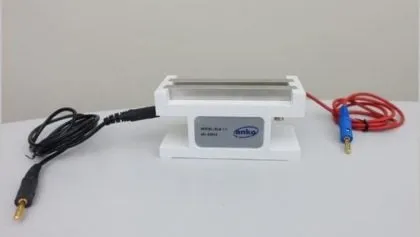
What Volume Resistivity Testing Answers
This test measures a material’s resistance to electrical current through its bulk, and helps assess its ability to dissipate or retain electrostatic charge. The result applies to the submitted sample, preparation, conditioning, and test conditions stated in the report. As with any single lab value, we’re careful not to generalize it as a universal property of the material, since particle size, moisture, temperature, pressure, geometry, and formulation can all shift the outcome.
Not sure if your material needs resistivity testing? Reach out and we’ll help you scope it.
Test Method and Standard
The conditioned sample is placed in a guarded electrode test cell with controlled geometry. A defined voltage is applied, and current is measured after the specified electrification time to calculate volume resistivity. Testing follows ASTM D257 and IEC 61340-2-3 where applicable, along with NFPA 77 guidance, or an agreed project specific method, and the quotation identifies the governing method before work begins.
What You Receive
- Volume resistivity under documented conditioning and voltage
- An electrification time and measurement condition record
- Interpretation for electrostatic charge dissipation
How the Data Supports Decisions
This result helps determine whether a solid behaves as conductive, dissipative, or insulating for your specific application, informs grounding and material selection strategy, and clarifies whether humidity control, antistatic additives, or additional charge decay testing is needed.
When to Order This Test
- Powders, plastics, liners, coatings, or solids in your process may retain charge
- A change in humidity or formulation may affect conductivity
- You’re qualifying materials for use in a flammable atmosphere
Sample Submission Guidance
Sample geometry and quantity depend on whether the material is a powder, sheet, molded part, or coating. Provide dimensions and application details with your inquiry. Include the SDS, composition or trade name information, physical form, process description, and whether the sample should be tested as received or prepared to a different condition.
Why Choose HazBasis
- A resistivity value from a datasheet is often measured at different humidity or geometry than what you’re dealing with, and resistivity can shift by orders of magnitude with humidity alone, so we condition and document those parameters explicitly rather than reporting a bare number.
- Conductive, dissipative, and insulating aren’t just labels, they carry real implications for grounding design, and we connect the measured value to which category actually applies for your equipment rather than leaving that classification to you.
- When a borderline result shows up, we’ll say so directly and recommend whether charge decay testing adds real clarity before you commit to a material or grounding strategy based on resistivity alone.
FAQ
What does Volume Resistivity testing measure?
Measures a material’s resistance to electrical current through its bulk and helps assess its ability to dissipate or retain electrostatic charge.
Which standard will be used?
ASTM D257 and IEC 61340-2-3 as applicable; NFPA 77 guidance. The final method depends on the sample, project objective, and any customer or regulatory requirements.
Why must conditioning be reported?
Electrical resistance can change substantially with humidity, temperature, compaction, and electrification time. Results are meaningful only when the test conditions are documented.