

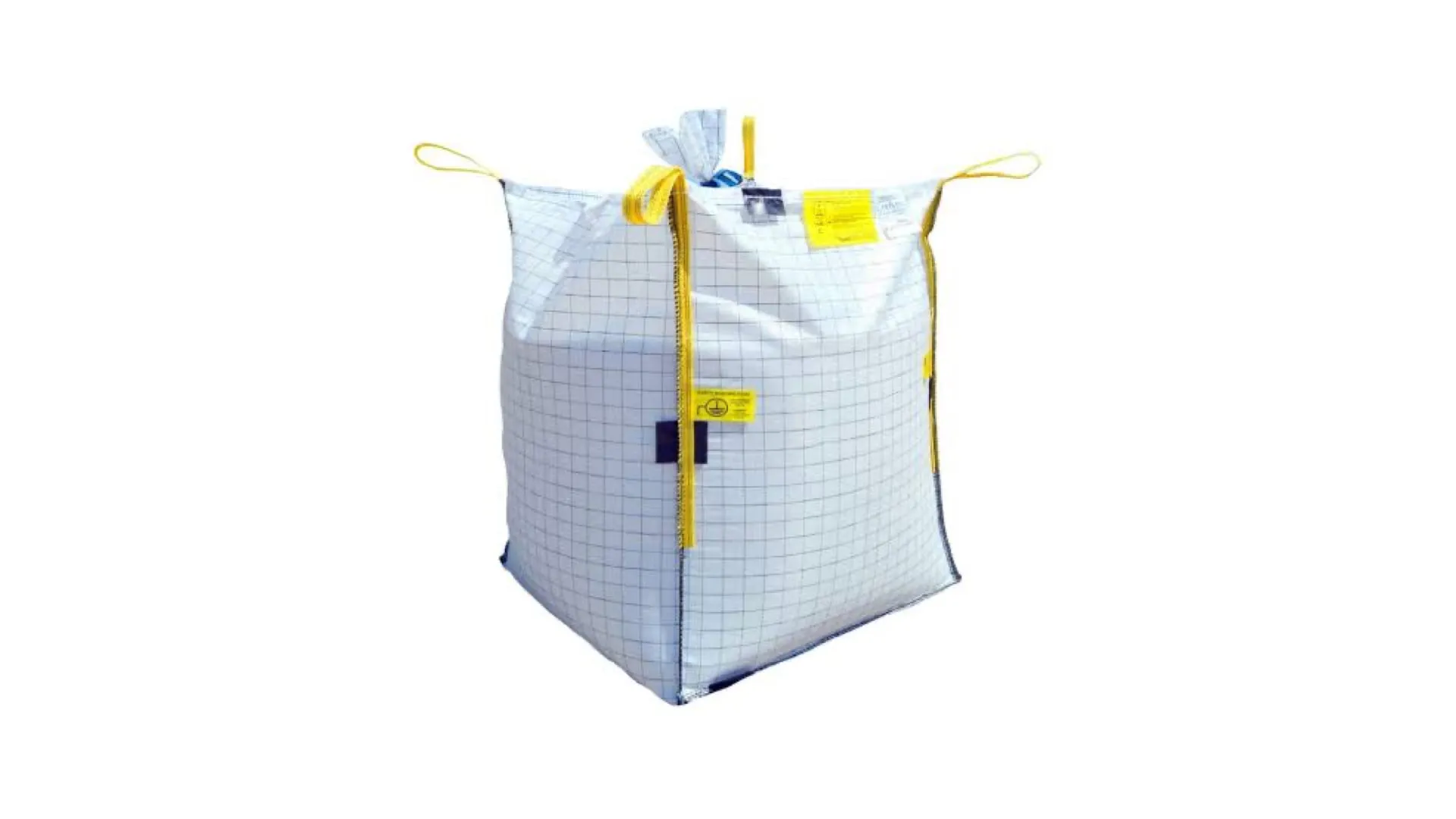
What This Test Answers
This test evaluates flexible intermediate bulk containers and liners for electrostatic performance in potentially explosive atmospheres. The result applies to the submitted sample, preparation, conditioning, and test conditions stated in the report. As with any single lab value, we’re careful not to generalize it as a universal property of the material, since particle size, moisture, temperature, pressure, geometry, and formulation can all shift the outcome.
Not sure what FIBC classification your operation needs? Reach out and we’ll help you scope it.
Test Method and Standard
The test program is selected based on the intended FIBC type and construction. Depending on scope, it may include resistance to ground, charging current tests, breakdown voltage of insulating layers, charge transfer measurements, or ignition testing with a defined flammable atmosphere. Testing follows IEC 61340-4-4 or an agreed project specific method, and the quotation identifies the governing method before work begins.
What You Receive
- Test results for the applicable FIBC type and components
- Construction, liner, label, grounding, and conditioning documentation
- A classification oriented report identifying pass or fail criteria and limitations
How the Data Supports Decisions
This program supports qualification of Type B, C, or D FIBCs and liners, defines grounding and handling requirements, and confirms compatibility of the FIBC with your dust or gas/vapor hazard zone.
When to Order This Test
- A new bulk bag or liner design is being introduced
- A supplier, fabric, coating, or construction change has occurred
- An existing FIBC program needs verification or incident follow-up
Sample Submission Guidance
Full FIBCs and representative liners or components are normally required. HazBasis defines the number of specimens, conditioning, filling material, and any destructive testing before shipment. Include the SDS, composition or trade name information, physical form, process description, and whether the sample should be tested as received or prepared to a different condition.
Why Choose HazBasis
- FIBC type isn’t a single property, it’s a bundle of construction details, and a supplier changing fabric, coating, or stitching without telling you can quietly move a bag out of the classification you think it’s still in. We scope testing around the actual current construction, not the spec sheet from when the bag was first qualified.
- Type B, C, and D each carry different grounding and handling requirements, so the report ties the classification result directly to what your operators need to do differently on the floor, not just a letter grade.
- If this testing is happening because of an incident or a near miss involving an FIBC, we build the program around understanding what actually failed, not just re-running a generic qualification sequence.
FAQ
What does FIBC testing measure?
Evaluates flexible intermediate bulk containers and liners for electrostatic performance in potentially explosive atmospheres.
Which standard will be used?
IEC 61340-4-4. The final method depends on the sample, project objective, and any customer or regulatory requirements.
Can an FIBC type be selected from the dust MIE alone?
No. Selection also depends on the surrounding atmosphere, charging process, grounding reliability, liner construction, and compliance with the applicable FIBC requirements.