

VDI Dust Explosion & EN 15188 Self-Heating Standards
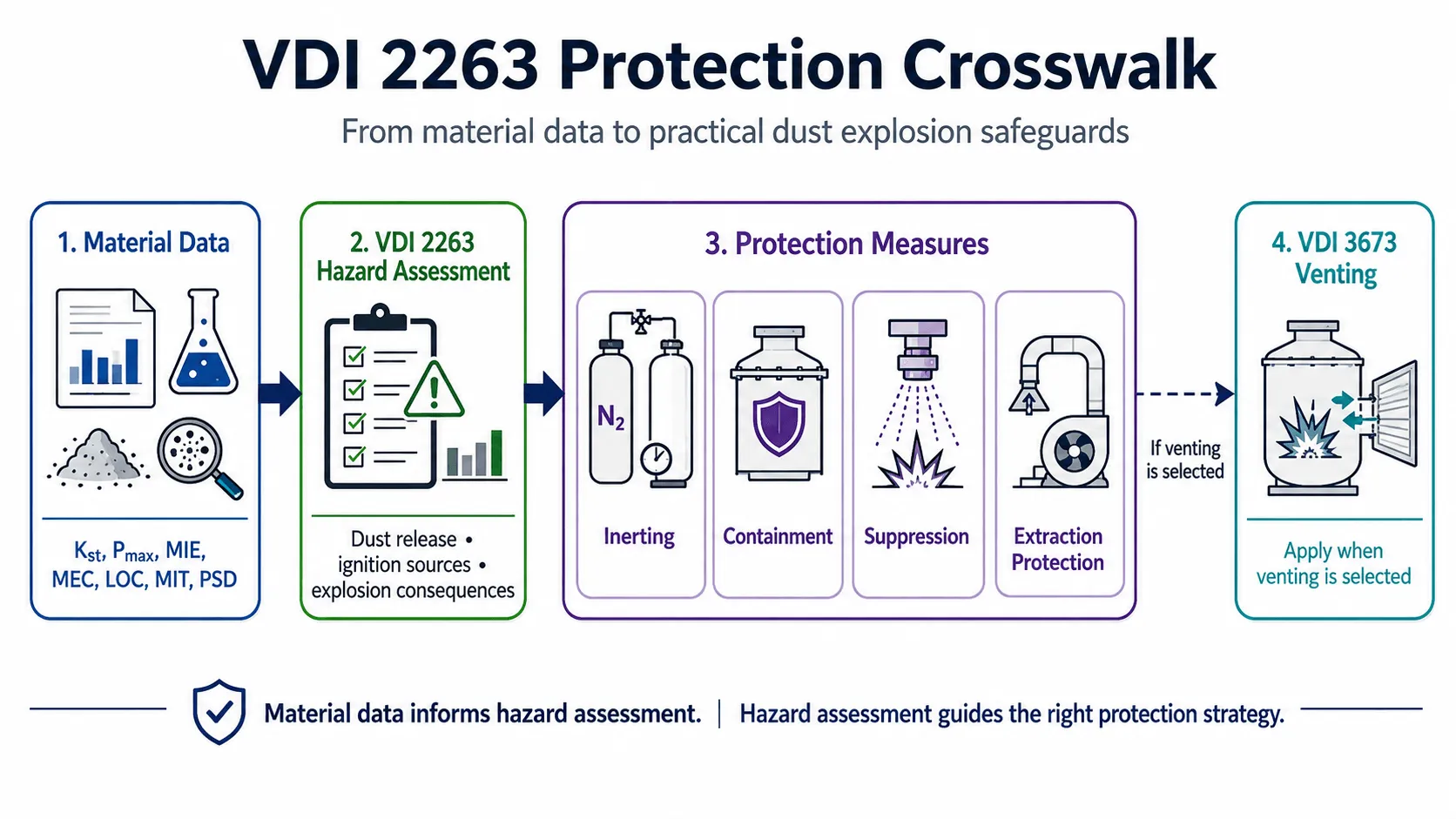
Use material safety data to move from dust hazard assessment into prevention, containment, suppression, extraction protection, venting and safe bulk-storage decisions.
Need to connect dust test data to a protection or storage decision? Reach out and we’ll help.
VDI 2263: from dust properties to a protection strategy
VDI 2263 addresses dust fires and dust explosions, including hazard assessment and safety/protective measures. Its practical value is the connection between safety-related material characteristics and the engineering measures used to prevent fires/explosions or limit their consequences.
For HazBasis, that makes VDI 2263 an excellent standards hub for Kst/Pmax, MIE, MEC, LOC, ignition temperature, dust release, ignition sources, inerting, containment, suppression, dust extraction systems and equipment-specific protection.
VDI 3673: dust explosion venting when venting is the selected strategy
VDI 3673 Part 1 provides requirements for the design of explosion venting systems for dust explosions. Explosion venting is one of several possible protection strategies and should be selected based on the specific combustible dust hazard, process conditions, and explosion characteristics.
The selection process should begin with the material and process hazard assessment. Where explosion venting is identified as the appropriate protection measure, VDI 3673 Part 1 can then be applied to the design and sizing of the venting system.
EN 15188: self-heating and self-ignition scale-up for dust accumulations
EN 15188 specifies hot-storage procedures for analysing and evaluating the self-ignition temperature (TSI) of combustible dusts or granular materials as a function of accumulation volume. Multiple basket sizes are used to establish how self-ignition temperature changes with scale, allowing the data to support larger storage or accumulation assessments within the method’s assumptions and uncertainty framework.
This makes EN 15188 especially relevant for silos, hoppers, FIBCs, drums, bulk storage and warm product discharged from drying or thermal processes. The page should explicitly distinguish EN 15188 hot-storage basket testing from tests intended to represent strongly aerated powder conditions.
Important EN 15188 limitation
EN 15188 is not a substitute for aerated-powder or fluid-bed-type self-heating testing. If hot air flows through the powder bed, the heat/mass-transfer condition is different and a test representing that aerated condition may be more appropriate.
| Standard / guideline | Focus | Best HazBasis use |
|---|---|---|
| VDI 2263 | Dust fires and dust explosions – hazard assessment and safety measures | Overall dust hazard assessment and selection of prevention/protection measures |
| VDI 2263 Part 1 | Safety-related parameters of bulk goods | Connects representative material testing with fire/explosion hazard decisions |
| VDI 2263 Parts 5/5.1 | Fluidized-bed dryer explosion protection | Useful for equipment-specific dryer hazard and protection review |
| VDI 2263 Parts 6/6.1 | Dust extraction installations | Dust collector/extraction fire and explosion protection |
| VDI 2263 Parts 7/7.1 | Spraying and drying integrated equipment | Process-specific fire/explosion protection examples |
| VDI 3673 Part 1 | Pressure venting of dust explosions | Venting design/assessment when venting is selected as the protection measure |
| EN 15188 | Spontaneous ignition behavior of dust accumulations | TSI versus accumulation size; self-heating scale-up for storage and bulk solids |
EN 15188: from basket data to plant-scale storage
1. Test representative material in multiple mesh basket volumes under controlled hot-storage conditions.
2. Determine the size-dependent self-ignition temperature (TSI) for each evaluated basket size.
3. Evaluate the relationship between TSI and accumulation size/geometry using the method appropriate to the standard and project.
4. Translate the results to the intended drum, FIBC, hopper, silo or other bulk-storage configuration with explicit assumptions.
5. Set a plant operating/storage basis only after considering uncertainty, duration, boundary conditions, abnormal operation and an engineering safety margin.
Related HazBasis testing: Basket Self-Heating & Scale-Up Testing
Related HazBasis testing hub: Self-Heating & Thermal Instability Testing
Related HazBasis consulting: Dust Hazard Analysis
FAQ
What is VDI 2263 used for?
VDI 2263 addresses dust fire and explosion hazards, hazard assessment and protective measures. It is particularly useful for linking measured dust properties with prevention and mitigation strategy.
Is VDI 3673 always required for combustible dust?
No. VDI 3673 addresses pressure venting. Venting is one possible explosion-protection strategy and should be selected based on the hazard, equipment, process and project basis.
What does EN 15188 measure?
EN 15188 evaluates spontaneous self-ignition behavior of dust or granular-material accumulations using hot-storage tests and multiple volumes to establish a scale-dependent TSI relationship.
Can EN 15188 data be used for a silo?
The multi-volume data can support scale-up to larger storage configurations within the method’s assumptions. Geometry, bulk density, heat transfer, storage duration and uncertainty need to be considered.
Is EN 15188 appropriate for a fluid-bed dryer?
Not as a substitute for a test representing strongly aerated powder. Aerated conditions can require a different self-heating test configuration.