

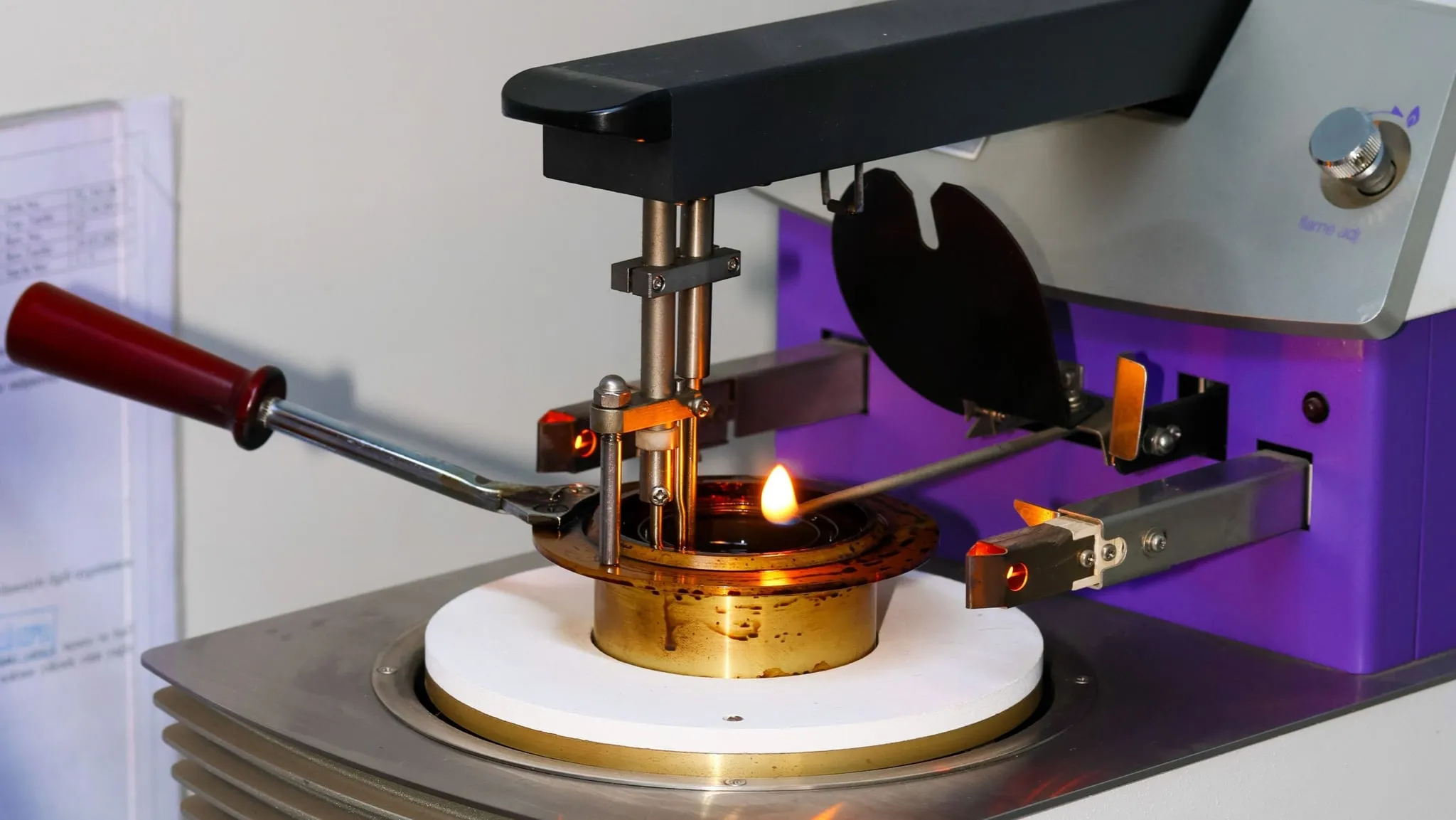
What Flash Point and Fire Point Testing Answer
Flash point testing determines the lowest temperature at which vapors ignite under the selected closed cup or open cup method, and, when required, the fire point as well. The result applies to the submitted sample, preparation, conditioning, and test conditions stated in the report. As with any single lab value, we’re careful not to generalize it as a universal property of the material, since particle size, moisture, temperature, pressure, geometry, and formulation can all shift the outcome.
Not sure which flash point method applies to your liquid? Reach out and we’ll help you scope it.
Test Method and Standard
The sample is heated at a controlled rate in the selected apparatus. At prescribed temperature intervals, an ignition source is applied and the first qualifying flash, and for open cup methods, sustained burning, is recorded. Testing follows ASTM D93 / ISO 2719, ASTM D3828, or ASTM D92 as appropriate, or an agreed project specific method, and the quotation identifies the governing method before work begins.
What You Receive
- Flash point and/or fire point by the specified method
- Test method, pressure, sample condition, and observations
- Interpretation for classification and handling
How the Data Supports Decisions
This result supports flammable and combustible liquid classification and SDS data, informs storage, ventilation, and ignition control requirements, and allows comparison across formulations, contaminants, or process streams.
When to Order This Test
- A new liquid or mixture requires classification
- Composition changes may have shifted the flash point
- Process, shipping, or customer documentation needs measured data rather than an estimate
Sample Submission Guidance
Sample quantity depends on the selected apparatus, expected range, viscosity, and repeat requirements. Submit the sample in a compatible, tightly sealed container with composition and hazard information included. Include the SDS, composition or trade name information, physical form, process description, and whether the sample should be tested as received or prepared to a different condition.
Why Choose HazBasis
- Closed cup and open cup methods can give genuinely different results for the same liquid, since the vapor is contained differently, so we confirm which method your classification or regulatory requirement actually calls for before testing rather than defaulting to whichever is faster.
- Flash point is one of the more common values estimated from a similar product rather than measured, and small composition changes can shift it more than people expect. We flag when a reformulation or contamination event is worth re-testing rather than assuming the old number still holds.
- Where the result is close to a classification threshold, we say so directly, since a borderline flash point changes handling and storage requirements in ways worth knowing before the number gets locked into an SDS.
FAQ
What does Flash & Fire Point testing measure?
Determines the lowest temperature at which vapors ignite under the selected closed-cup or open-cup test method and, when required, the fire point.
Which standard will be used?
ASTM D93 / ISO 2719, ASTM D3828, or ASTM D92 as appropriate. The final method depends on the sample, project objective, and any customer or regulatory requirements.
Why can different flash-point methods give different results?
Closed-cup and open-cup methods have different vapor containment and ignition conditions. The method must match the regulatory or engineering purpose, and results should always identify the method.