

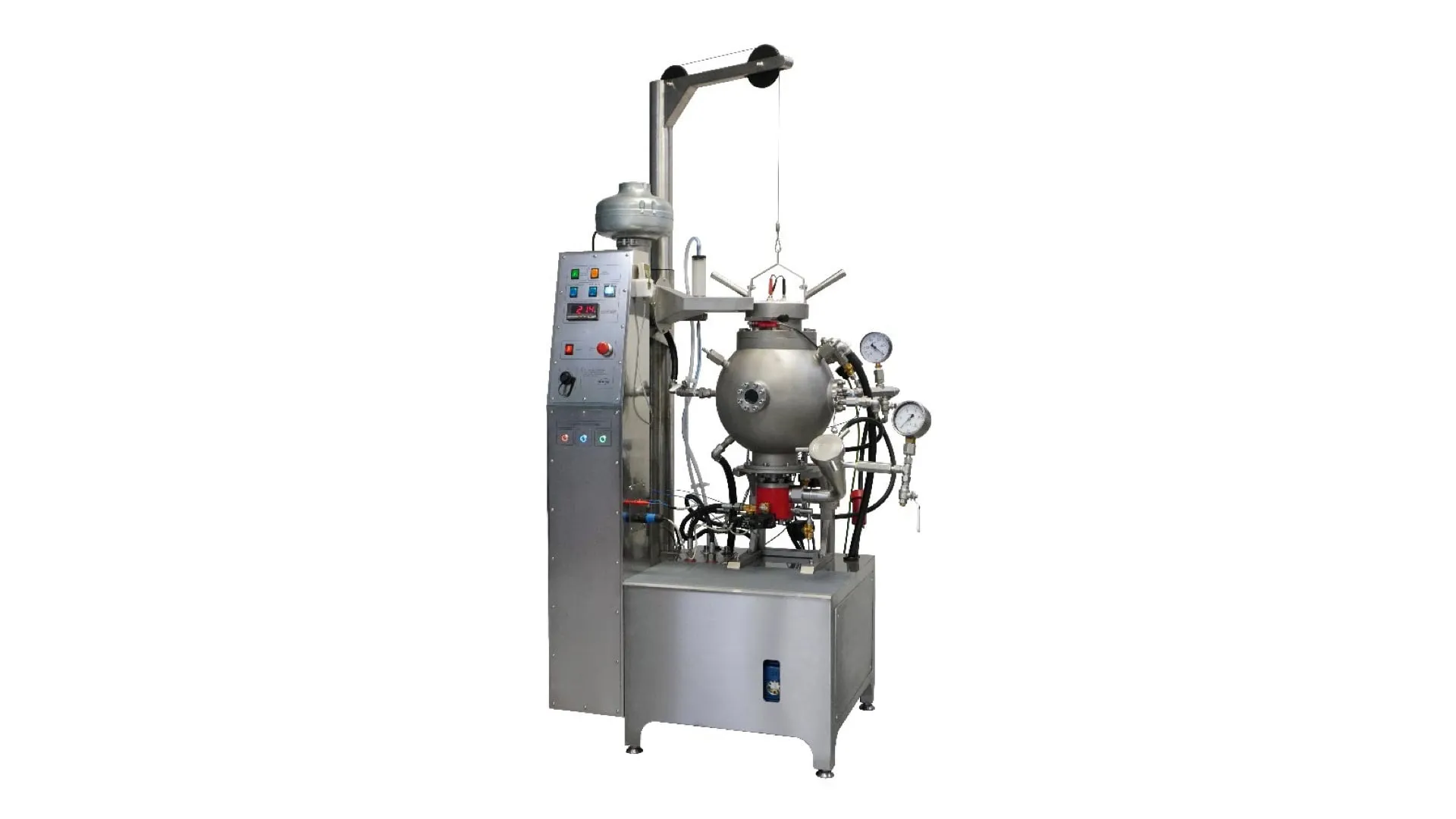
What Dust Explosion Severity Testing Answers
This test quantifies the maximum explosion pressure and maximum rate of pressure rise of an explosible dust cloud. The result applies to the submitted sample, preparation, conditioning, and test conditions stated in the report. As with any single lab value, we’re careful not to generalize it as a universal property of the material, since particle size, moisture, temperature, pressure, geometry, and formulation can all shift the outcome.
Not sure if you need Kst/Pmax testing yet? Reach out and we’ll help you scope it.
Test Method and Standard
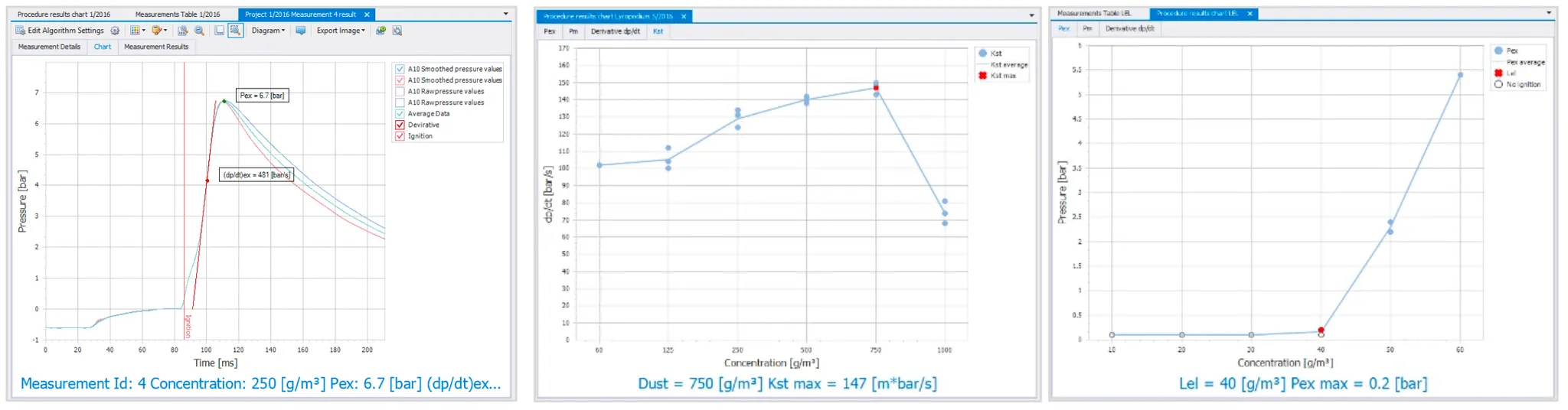
A series of dust concentrations is dispersed and ignited in a standardized closed vessel. Pressure time histories are collected over multiple trials to identify the concentration that produces the highest Pmax and normalized deflagration index Kst. Testing follows ASTM E1226, EN 14034-1 and EN 14034-2, or an agreed project specific method, and the quotation identifies the governing method before work begins.
What You Receive
- Pmax, (dP/dt)max, and Kst
- Dust explosion class St 1, St 2, or St 3
- Concentration response data and test condition documentation
How the Data Supports Decisions
This result forms the basis for explosion venting, suppression, isolation, and containment design, supports relative severity comparison between materials or process conditions, and feeds directly into DHA safeguards and equipment protection strategy.
When to Order This Test
- A Go screening result has confirmed the dust is explosible
- Explosion protection equipment needs to be designed or verified
- Particle size, formulation, or a supplier change may have altered severity
Sample Submission Guidance
Sample quantity depends on bulk density, concentration range, repeat series, and preparation, so HazBasis confirms the required mass after the test scope is defined. Include the SDS, composition or trade name information, physical form, process description, and whether the sample should be tested as received or prepared to a different condition.
Why Choose HazBasis
- A literature Kst value can support preliminary screening, but Kst is sensitive to particle size, moisture, composition, and test conditions in ways that make it a poor substitute for project specific data once you’re actually designing protection equipment. We’ll tell you plainly when literature data is good enough and when it isn’t.
- Multiple trials across a concentration series are run to find the true governing case, not just a single point that happens to look conservative.
- Results are documented in a form your equipment protection design can use directly, whether that’s a vent panel supplier, a suppression system integrator, or your own engineering team.
FAQ
What does Kst & Pmax testing measure?
Quantifies the maximum explosion pressure and maximum rate of pressure rise of an explosible dust cloud.
Which standard will be used?
ASTM E1226; EN 14034-1 and EN 14034-2. The final method depends on the sample, project objective, and any customer or regulatory requirements.
Can literature Kst values replace testing?
Literature values can support preliminary screening, but Kst is sensitive to particle size, moisture, composition, and test conditions. Project-specific testing is generally preferred for design.