

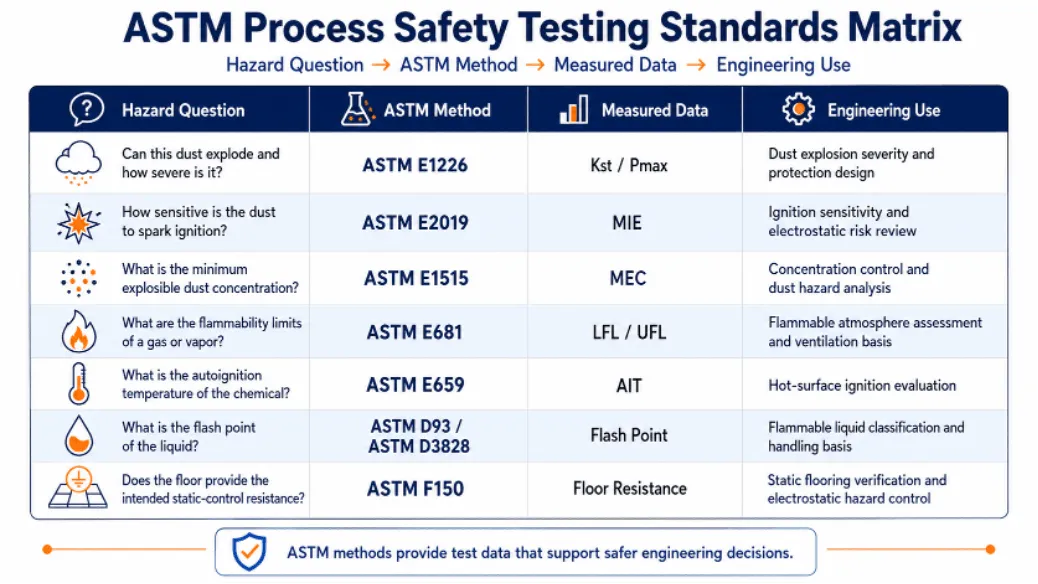
ASTM methods turn hazard questions into measurable data
A code or hazard analysis often identifies the question; an ASTM method can provide the test data needed to answer it. For process safety, that may mean determining dust explosibility and severity, ignition sensitivity, gas/vapor flammability, autoignition, flash point or electrical resistance.
The test number alone is not the engineering conclusion. Results should be tied to the submitted sample, conditioning, particle size, moisture, temperature, pressure, test geometry and intended process condition.
Need help choosing the ASTM test method? Reach out and we’ll help.
Combustible dust ASTM standards
| ASTM standard | What it measures | Why it matters | HazBasis path |
|---|---|---|---|
| ASTM E1226 | Explosibility of dust clouds; explosion pressure/rate data | Kst, Pmax and dP/dt basis used in dust explosion severity and protection decisions | Dust Explosion Severity Testing |
| ASTM E1515 | Minimum explosible concentration | Lowest tested concentration that supports a qualifying dust explosion under the method | MEC Testing |
| ASTM E2019 | Minimum ignition energy of a dust cloud in air | Electrostatic/spark ignition sensitivity | MIE Testing |
| ASTM E1491 | Minimum autoignition temperature of dust clouds | Hot-surface / heated-atmosphere ignition sensitivity for dispersed dust | MAIT Testing |
| ASTM E2021 | Hot-surface ignition temperature of dust layers | Dust-layer ignition on heated surfaces | LIT Testing |
| ASTM E2931 | Limiting oxygen concentration of combustible dust clouds | Inerting / oxygen-reduction basis | Dust LOC Testing |
Gas, vapor and liquid flammability ASTM standards
| ASTM standard | Test focus | Process-safety use | HazBasis path |
|---|---|---|---|
| ASTM E681 | Lower and upper concentration limits of flammability for vapors and gases | Defines LFL/UFL under the specified test conditions | LFL/UFL Testing |
| ASTM E659 | Autoignition temperature of chemicals | Supports evaluation of hot-surface and elevated-temperature ignition hazards | AIT Testing |
| ASTM E2079 | Limiting oxygen concentration in gases and vapors | Supports inerting and oxygen-control studies | Gas/Vapor LOC Testing |
| ASTM E582 | Minimum ignition energy and quenching distance in gaseous mixtures | Ignition sensitivity and flame-quenching characterization for applicable mixtures | Project-specific gas ignition testing |
| ASTM D93 | Pensky-Martens closed-cup flash point | Common closed-cup flash-point method for applicable petroleum and other liquids | Flash Point Testing |
| ASTM D3828 | Small-scale closed-cup flash point | Low sample volume and rapid flash/no-flash or flash-point determination for applicable liquids | Flash Point Testing |
| ASTM D3278 | Small-scale closed-cup flash point of liquids | Another closed-cup option for applicable products and temperature ranges | Flash Point Testing |
| ASTM E502 | Selection/use of ASTM closed-cup flash-point methods | Helps select the appropriate ASTM flash-point procedure for the chemical/material | Method selection / scoping |
ASTM F150 floor resistance testing — high-intent static-safety content
ASTM F150 is a particularly strong SEO and commercial topic for HazBasis because it directly matches an existing field-testing service. The current ASTM title is Standard Test Method for Electrical Resistance of Conductive and Static Dissipative Resilient Flooring.
The method covers electrical conductance or resistance of resilient flooring in tile or sheet form for environments where personnel-generated static electricity is a concern. For an installed floor, the engineering objective is not simply to produce an ohm value. The result must be interpreted against the intended static-control function, grounding path, floor construction, site condition and the broader electrostatic hazard basis.
Technical scope caution
Do not describe ASTM F150 as a universal test for every floor material or every complete personnel-footwear-floor system. ASTM F150 specifically addresses conductive and static-dissipative resilient flooring. Confirm method applicability before testing non-resilient systems or before making broader ESD-performance claims.
Dedicated HazBasis page: ASTM F150 Floor Resistance Testing
Related consulting: Electrostatic Hazard Analysis
Other ASTM electrical resistance / resistivity methods relevant to static evaluation
| ASTM standard | Primary focus | Static-hazard relevance |
|---|---|---|
| ASTM D257 | DC resistance/conductance of insulating materials | Surface/volume resistance or resistivity of electrical insulating materials; useful when material behavior is highly resistive |
| ASTM D4496 | D-C resistance/conductance of moderately conductive materials | Designed for materials that are neither good insulators nor good conductors and fall within the method’s conductivity/resistivity range |
| ASTM D991 | Volume resistivity of electrically conductive and antistatic rubber products | Useful for applicable rubber materials used in conductive or antistatic applications |
| ASTM F150 | Electrical resistance of conductive/static-dissipative resilient flooring | Directly relevant to conductive or static-dissipative resilient flooring installations and products |
Choosing the ASTM method by the process-safety question
- Can the dust explode? → ASTM E1226 screening/severity basis.
- How sensitive is the dust to a spark? → ASTM E2019 MIE.
- How lean can the dust cloud be and still explode? → ASTM E1515 MEC.
- Can a hot surface ignite the dust cloud or layer? → ASTM E1491 / ASTM E2021.
- How much oxygen is needed to sustain the dust explosion? → ASTM E2931.
- What are the vapor/gas flammability limits? → ASTM E681.
- What is the chemical autoignition temperature? → ASTM E659.
- Which flash-point method should be used? → select among applicable ASTM methods based on material and project basis.
- Does a conductive/static-dissipative resilient floor meet the intended resistance basis? → ASTM F150, with site-specific electrostatic interpretation.
FAQ
What is ASTM F150?
ASTM F150 is a test method for electrical resistance of conductive and static-dissipative resilient flooring.
Is ASTM F150 the same as a complete electrostatic hazard assessment?
No. Floor resistance is one part of the static-control system. The overall assessment can also involve personnel, footwear, grounding, charge generation, process materials and the ignition sensitivity of the atmosphere.
Which ASTM standard measures LFL and UFL?
ASTM E681 is a widely used method for concentration limits of flammability of vapors and gases under its specified conditions.
Which ASTM standard measures autoignition temperature?
ASTM E659 addresses autoignition temperature of chemicals; dust cloud ignition uses different methods such as ASTM E1491.
Which ASTM standard gives Kst and Pmax?
ASTM E1226 is the core combustible-dust explosibility/severity method used to determine pressure and rate-of-pressure-rise data from which Kst is derived.