

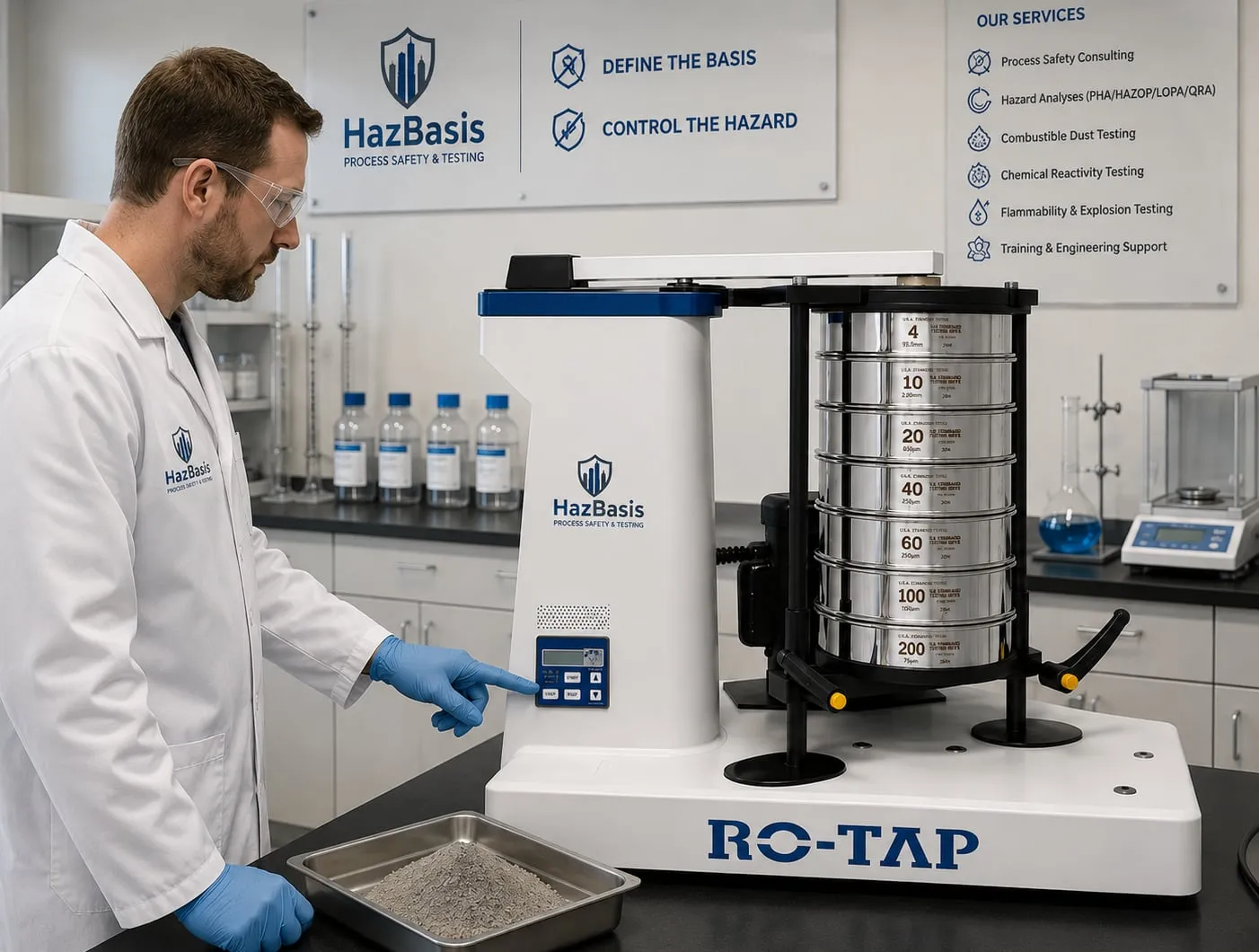
What Particle Sieve Analysis Answers
This test characterizes the mass distribution of a powder across defined sieve sizes, and supports representative sample preparation for hazard testing. The result applies to the submitted sample, preparation, conditioning, and test conditions stated in the report. As with any single lab value, we’re careful not to generalize it as a universal property of the material, since particle size, moisture, temperature, pressure, geometry, and formulation can all shift the outcome.
Not sure if your sample needs sieve analysis first? Reach out and we’ll help you scope it.
Test Method and Standard
A representative mass is placed in a calibrated stack of progressively smaller test sieves. After controlled agitation, the mass retained on each sieve is measured and converted into a cumulative particle size distribution. Testing uses ASTM E11 compliant test sieves and a project specific sieving procedure, or an agreed alternative method, and the quotation identifies the governing method before work begins. ASTM E11 itself specifies requirements for the sieve cloth and sieves, not a full sieving procedure, so the sample mass and method are defined specifically for your material and objective.
What You Receive
- Percent retained and percent passing by sieve size
- A particle size distribution table and curve
- A recommendation on whether as-received or prepared material is appropriate for hazard testing
How the Data Supports Decisions
This result helps determine whether a sample actually reflects the process dust or needs preparation before hazard testing, how a particle size change might affect explosibility and ignitability, and supports quality control or supplier comparison decisions.
When to Order This Test
- Your sample contains a broad or visibly variable size distribution
- Combustible dust testing requires documented sample condition
- You need to compare as-received and fine fraction behavior
Sample Submission Guidance
Required mass depends on maximum particle size, sieve stack, and material density. Submit a representative composite sample whenever possible. Include the SDS, composition or trade name information, physical form, process description, and whether the sample should be tested as received or prepared to a different condition.
Why Choose HazBasis
- Combustible dust properties like Kst and MIE are sensitive to particle size, so a sieve analysis often comes first specifically to confirm a sample represents a credible worst case before we run more expensive hazard testing on it.
- We’ll tell you plainly when a supplied sample doesn’t look like a representative composite, rather than running the full distribution and letting a bad sample produce a misleading curve.
- Where the result points toward testing a fine fraction rather than the as-received material, we handle that preparation in house, so the hazard testing that follows is working from a sample we already understand.
FAQ
What does Sieve Analysis testing measure?
Characterizes the mass distribution of a powder across defined sieve sizes and supports representative sample preparation.
Which standard will be used?
ASTM E11-compliant test sieves; project-specific sieving procedure. The final method depends on the sample, project objective, and any customer or regulatory requirements.
Is ASTM E11 itself a particle-size test method?
ASTM E11 specifies requirements for test sieve cloth and test sieves. The actual sieving procedure and sample mass should be defined for the material and project objective.