
Area classification and ignition source analysis solve different parts of the problem
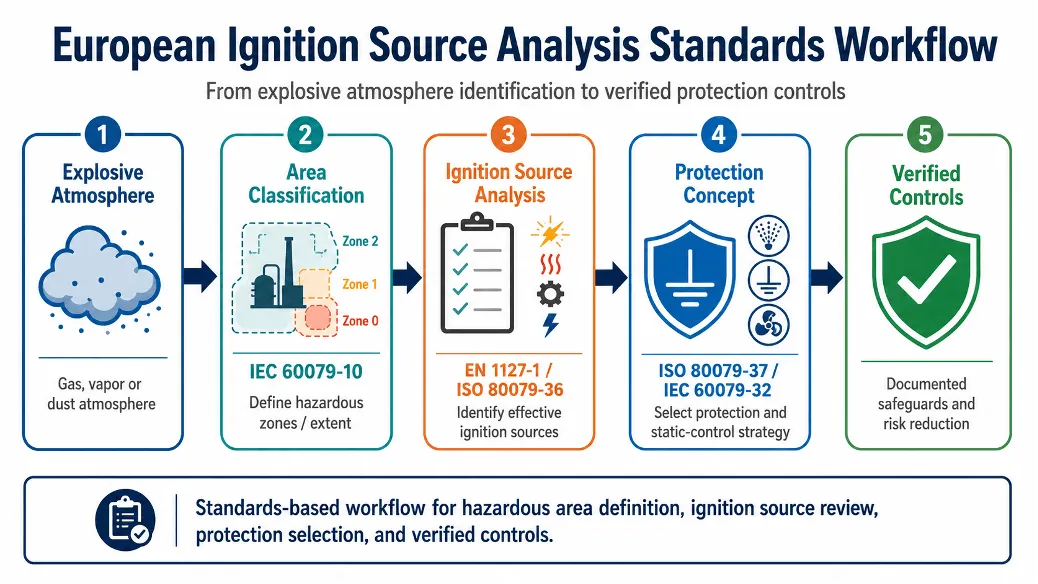
Hazardous Area Classification identifies where an explosive gas, vapor or dust atmosphere can occur and supports equipment selection. Ignition Source Analysis evaluates whether the equipment, process or failure modes in that area can create an effective ignition source. For many European and international projects, IEC 60079, EN 1127-1 and ISO 80079 work together to establish that technical basis.
Need an ignition source review for European or international equipment? Reach out and we’ll help.
Core ignition source analysis standards
| Standard | Primary role | How it supports ignition source analysis |
|---|---|---|
| EN 1127-1 | Explosion prevention and protection – basic concepts and methodology | Systematic identification and assessment of hazardous situations that can lead to explosion; basis for risk reduction and ignition source control |
| ISO 80079-36 | Non-electrical equipment for explosive atmospheres – basic method and requirements | Ignition hazard assessment and requirements for non-electrical Ex equipment with its own potential ignition sources |
| ISO 80079-37 | Non-electrical protection types “c”, “b” and “k” | Constructional safety, control of ignition sources and liquid immersion protection concepts for non-electrical equipment |
| IEC TS 60079-32-1 | Electrostatic hazards – guidance | Guidance for controlling static electricity in equipment, products and processes and for electrostatic risk assessment |
| IEC 60079-32-2 | Electrostatic hazards – test methods | Test methods for properties such as surface resistance, earth leakage resistance, powder resistivity, liquid conductivity, capacitance and discharge incendivity |
Hazardous area classification standards
| Standard | Focus | Practical relationship |
|---|---|---|
| IEC 60079-10-1 | Explosive gas atmospheres | Classifies areas where flammable gas or vapor hazards may arise and supports design, equipment selection, operation and maintenance |
| IEC 60079-10-2 | Explosive dust atmospheres | Classifies areas where explosive dust atmospheres and combustible dust layers may occur; current IEC edition updated in 2026 |
| IEC 60079-14 | Electrical installation design, selection and installation | Applies Ex installation requirements after the area classification basis is established |
A practical ignition source analysis workflow
- Define the flammable gas/vapor/dust atmosphere and the hazardous area basis.
- Identify equipment and process conditions inside or connected to the classified area.
- Identify credible mechanical, thermal, electrical, electrostatic and process-related ignition mechanisms.
- Evaluate normal operation, foreseeable malfunction and relevant failure modes.
- Compare potential source temperature/energy with the ignition sensitivity of the actual material or atmosphere.
- Evaluate prevention and protection features, monitoring, interlocks, grounding, inerting, maintenance and inspection.
- Document whether each source is credible, adequately controlled or requires additional risk reduction.
Current standards note
ISO 80079-36:2016 remains current. ISO 80079-37:2016 is current while a second edition is under development. IEC 60079-10-2 was updated in 2026. Avoid hard-coding edition numbers in page titles so the SEO page remains durable; instead show a visible “Last reviewed” date and verify editions in the technical table.
Related HazBasis service: Ignition Source Analysis
Related HazBasis service: Hazardous Area Classification – IEC
Related HazBasis service: Electrostatic Hazard Analysis
Related HazBasis testing: Integrated Electrostatic Discharge Testing
FAQ
What standard is used for ignition source analysis?
EN 1127-1 provides a broad explosion-prevention methodology, while ISO 80079-36 and ISO 80079-37 are especially important for non-electrical equipment in explosive atmospheres.
Is ignition source analysis the same as hazardous area classification?
No. Classification identifies where an explosive atmosphere may occur. Ignition source analysis evaluates whether equipment and operations can create effective ignition sources in those locations.
Does ISO 80079 apply only to electrical equipment?
ISO 80079-36 and -37 specifically address non-electrical equipment for explosive atmospheres.
Which IEC document covers electrostatic hazards?
IEC TS 60079-32-1 provides guidance, and IEC 60079-32-2 provides associated electrostatic test methods.
Can this support ATEX or IECEx work?
The technical analysis can support design and documentation, but formal product certification or conformity assessment must follow the applicable certification route.