

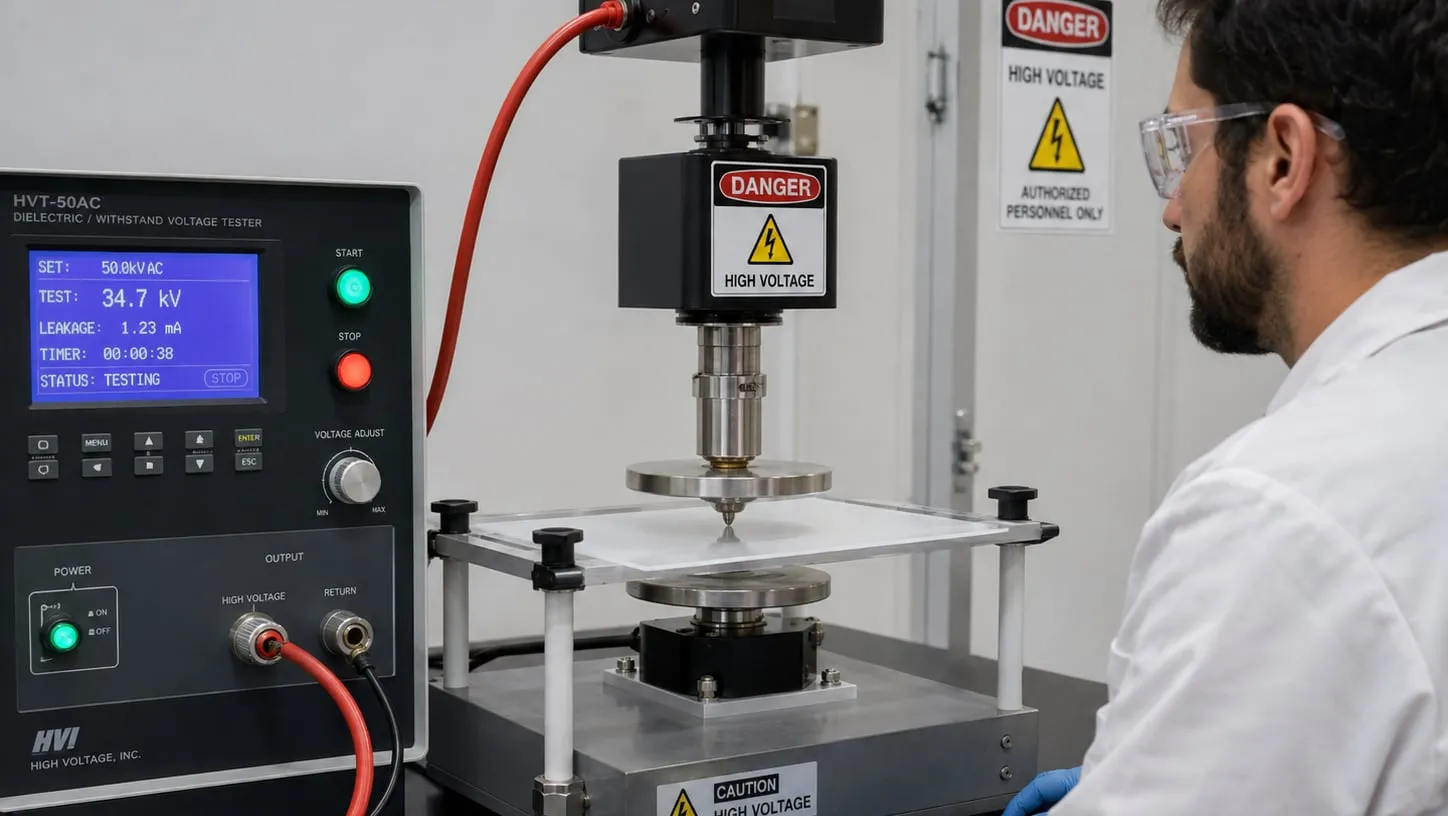
What Breakdown Voltage Testing Answers
This test determines the voltage at which an insulating material electrically breaks down, under a defined electrode geometry and rate of voltage rise. The result applies to the submitted sample, preparation, conditioning, and test conditions stated in the report. As with any single lab value, we’re careful not to generalize it as a universal property of the material, since particle size, moisture, temperature, pressure, geometry, and formulation can all shift the outcome.
Not sure if your liner or FIBC needs breakdown testing? Reach out and we’ll help you scope it.
Test Method and Standard
A representative specimen is placed between specified electrodes. Voltage is increased in a controlled manner until electrical breakdown occurs, with thickness and environmental conditioning documented throughout. Testing follows IEC 60243-1 and IEC 61340-4-4 requirements where applicable, or an agreed project specific method, and the quotation identifies the governing method before work begins.
What You Receive
- Breakdown voltage and, when appropriate, dielectric strength
- Specimen thickness, electrode geometry, conditioning, and observed failure mode
- Interpretation for liners, films, insulation, or FIBC components
How the Data Supports Decisions
This result supports qualification of insulating liners and films, informs assessment of propagating brush discharge potential, and allows comparison across material formulations or thicknesses.
When to Order This Test
- A thin insulating layer is used in a flammable atmosphere
- FIBC or liner classification requires a breakdown voltage criterion
- Material thickness, formulation, or construction is changing
Sample Submission Guidance
Flat specimens with known thickness are preferred. Multiple coupons are normally required to obtain repeat measurements and account for specimen variability. Include the SDS, composition or trade name information, physical form, process description, and whether the sample should be tested as received or prepared to a different condition.
Why Choose HazBasis
- Breakdown voltage is one of the key inputs to whether a thin insulating layer can support a propagating brush discharge, one of the more severe electrostatic ignition scenarios, so we tie this result explicitly back to that risk rather than reporting it as an isolated material property.
- Thickness variability between coupons can shift the result meaningfully, so we run enough repeats to give you a defensible number rather than a single measurement that happened to land where it did.
- Where this test is part of an FIBC or liner qualification, we scope it alongside the other criteria that classification actually requires, so you’re not left running it in isolation and reassembling the full picture yourself.
FAQ
What does Breakdown Voltage testing measure?
Determines the voltage at which an insulating material electrically breaks down under a defined electrode geometry and rate of voltage rise.
Which standard will be used?
IEC 60243-1; IEC 61340-4-4 requirements where applicable. The final method depends on the sample, project objective, and any customer or regulatory requirements.
Does higher breakdown voltage always mean safer electrostatic performance?
No. High breakdown strength can allow charge separation and energetic discharges in some configurations. The result must be interpreted with thickness, resistivity, grounding, and the discharge mechanism.