Hazardous Area Classification Services
Define where flammable gas, vapor, mist, combustible dust, or ignitable fibers can create a classified location—and give your electrical and project teams a defensible basis for design, equipment selection, permitting, and review.
HazBasis Process Safety performs Hazardous Area Classification (or Electrical Area Classification) studies for existing facilities, new process installations, equipment packages, laboratories, pilot plants, and industrial expansions. We evaluate the process conditions that can create an explosive atmosphere, determine the applicable classification framework, establish hazardous-area boundaries, and document the engineering basis in drawings and a technical report.
Projects can be developed under the U.S. NFPA / National Electrical Code framework or the IEC / ATEX Zone framework. The goal is not to classify more area than necessary—or less area than the hazard requires. The goal is a classification that can be traced back to real release sources, material properties, operating conditions, ventilation, housekeeping, and equipment geometry.
Need a new HAC, an update to an old classified-area drawing, or help responding to reviewer comments?
What Hazardous Area Classification Actually Does
Hazardous Area Classification identifies locations where an ignitable atmosphere may be present often enough, or under credible abnormal conditions, that electrical equipment and installations require special consideration. The study defines the classification type and its horizontal and vertical extent around release sources, process equipment, rooms, dust-handling systems, vents, transfer points, and other relevant locations.
A strong HAC study does more than place colored shapes on a drawing. It documents why a location is classified, what hazard drives the classification, which assumptions control the boundary, and what information the electrical engineer needs to apply the result.
HAC defines the hazardous location. It does not by itself certify installed equipment, replace a Dust Hazard Analysis or Process Hazard Analysis, or evaluate every electrical and non-electrical ignition source. Those tasks should be coordinated, but their technical scopes are different.
Choose the Classification Framework That Fits the Project
| Project Basis | Typical Framework | HazBasis Methodology Page |
|---|---|---|
| U.S. facilities, NEC-based electrical design, AHJ review | NFPA 497 / NFPA 499 + NFPA 70 (NEC) | NFPA 497/499 & NEC Methodology |
| International projects, IEC electrical design, EU/EEA ATEX workplace basis | IEC 60079-10-1 / IEC 60079-10-2 + applicable ATEX requirements | ATEX / IEC 60079 Methodology |
| Owner standards or multinational projects | Project-specific Class/Division or Zone basis | HazBasis confirms the governing basis before classification |
Hazards We Classify
- Flammable gases including hydrogen, natural gas, methane, propane, acetylene, fuel gas, and process gases.
- Flammable or ignitible liquid vapors, solvents, fuels, coatings, cleaning agents, and process chemicals.
- Flammable mists or sprays created by pressure, atomization, heated service, or mechanical dispersion.
- Combustible dusts from food, chemical, pharmaceutical, plastics, carbonaceous, wood, metal, additive-manufacturing, and other powder processes.
- Ignitable fibers and flyings where the adopted classification framework requires evaluation.
What Drives a Defensible Classification
Hazardous-area boundaries should not be selected from a generic table without confirming that the assumptions match the process. HazBasis evaluates the factors that actually control the probability and extent of an ignitable atmosphere:
- Material identity and relevant flammability or explosibility properties.
- Flash point, vapor pressure, boiling behavior, lower flammability limit, relative vapor density, and autoignition information for gases and vapors, as applicable.
- Combustibility/explosibility, dust cloud formation, dust layer accumulation, particle characteristics, and applicable dust-group information for powders.
- Normal, intermittent, and abnormal release sources such as vents, seals, sampling points, drains, open transfers, bag dumps, filter discharges, and equipment openings.
- Release frequency, duration, quantity or rate, process temperature and pressure, and physical state of the material.
- Natural or mechanical ventilation, dilution, air movement, enclosure geometry, pits, trenches, ceilings, and locations where vapor or dust can accumulate.
- Containment, local exhaust, dust collection, housekeeping, maintenance practices, and foreseeable operating modes.
Our Hazardous Area Classification Methodology
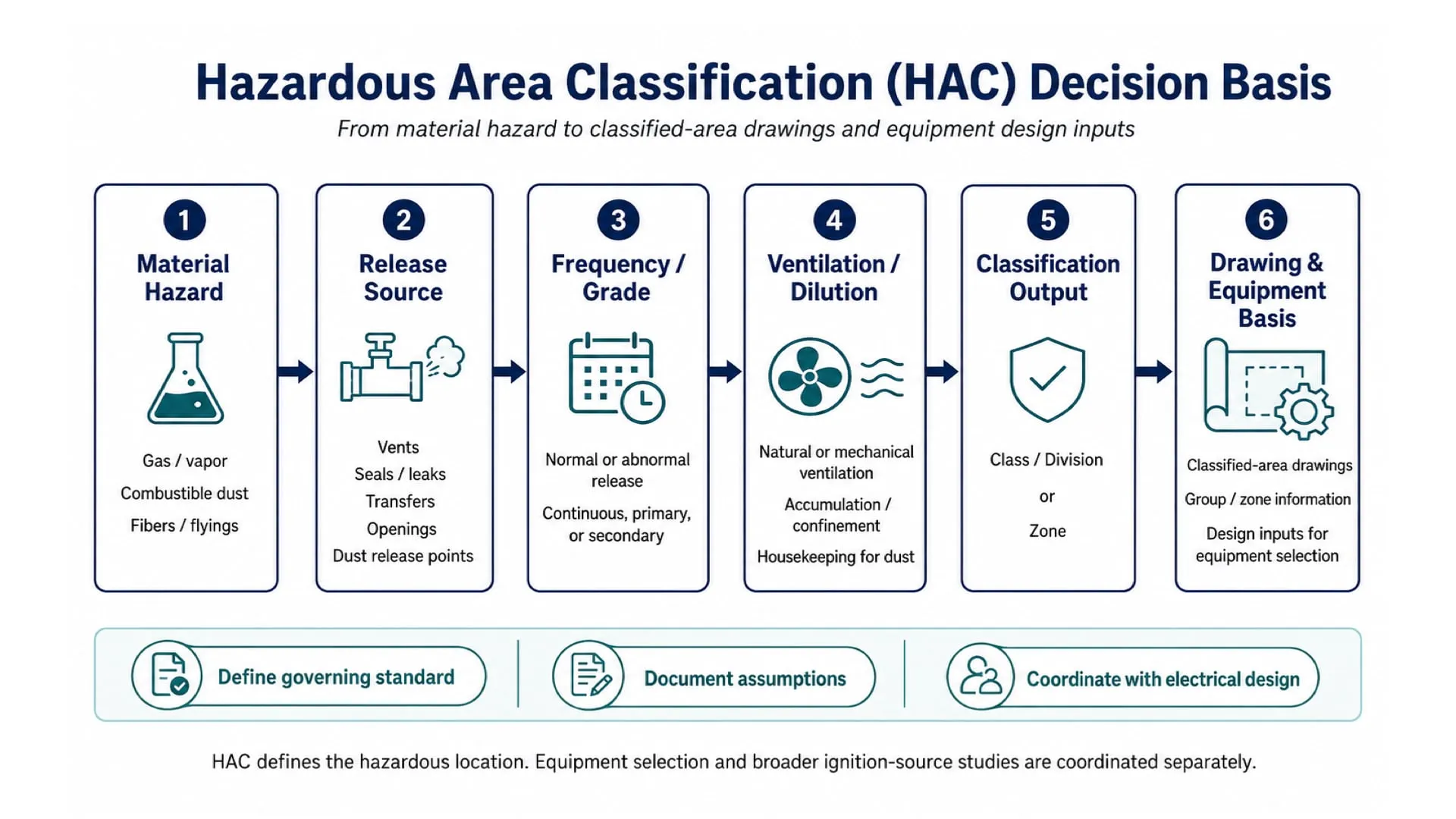
1. Define the governing basis — Confirm project location, adopted codes/standards, owner requirements, electrical design basis, and whether Class/Division or Zone classification is required.
2. Build the material hazard basis — Review SDSs and available test data; identify the flammable gas/vapor or combustible dust properties that affect classification and equipment design.
3. Identify release sources — Walk the process from receipt through storage, transfer, reaction, drying, collection, packaging, and waste handling to identify credible release points.
4. Evaluate release conditions — Determine whether releases are expected in normal operation, intermittent operation, maintenance, or abnormal conditions, and quantify or characterize release severity where needed.
5. Evaluate ventilation and accumulation — Assess natural/mechanical ventilation, dilution, confinement, low/high points, local exhaust, dust containment, and housekeeping.
6. Assign classification and extent — Apply the selected NFPA/NEC or IEC methodology to establish Class/Division or Zone designations, material group information, and classified boundaries.
7. Document and coordinate — Prepare the classification report, release-source schedule, assumptions, and drawings; coordinate with electrical design and respond to reviewer/AHJ questions.
Typical Equipment and Areas We Evaluate
- Storage tanks, day tanks, totes, drums, reactors, mixers, vessels, pumps, compressors, valves, vents, drains, sampling points, and loading/unloading stations.
- Dust collectors, baghouses, filter receivers, cyclones, mills, grinders, dryers, blenders, sifters, screens, pneumatic conveying systems, hoppers, silos, feeders, packaging lines, and bag-dump stations.
- Battery rooms and energy-storage support processes, hydrogen systems, solvent rooms, laboratories, pilot plants, coating processes, spray operations, and specialty manufacturing equipment.
- Indoor process rooms, outdoor process areas, pits, trenches, enclosed equipment skids, utility rooms, and spaces with limited ventilation.
When Laboratory Data Strengthens the HAC Basis
Area classification is an engineering study, not automatically a laboratory test program. However, missing or assumed material data can drive conservative boundaries or weak equipment-selection decisions. Where data are needed, HazBasis can coordinate targeted testing instead of relying on unsupported assumptions.
| Hazard Type | Potential Supporting Data | Why It May Matter |
|---|---|---|
| Gas / vapor | Flash point; LFL/UFL; autoignition temperature; vapor pressure or physical-property data | Supports release/flammability basis and downstream equipment selection |
| Combustible dust | Explosibility screening; MIE; MIT cloud/layer; resistivity/conductivity; particle/moisture characterization | Supports dust hazard confirmation, ignition sensitivity, temperature/electrical considerations, and uncertainty reduction |
| Electrostatic | Volume/surface resistivity; charge decay; liquid conductivity; transferred charge | Supports separate electrostatic ignition-source evaluation where static hazards affect the project |
What You Receive
- Hazardous Area Classification technical report with governing basis, assumptions, material hazard basis, release-source evaluation, ventilation/housekeeping considerations, classification rationale, conclusions, and limitations.
- Classified-area drawings or marked-up drawings showing horizontal and vertical classification boundaries.
- Release-source / classification schedule identifying the source, hazard, classification, material group information, and boundary basis as applicable.
- Design notes for coordination with the electrical engineer, EPC, equipment vendor, facility team, insurer, and AHJ/reviewer.
- Technical response support for reasonable comments, clarification questions, and drawing revisions within the agreed scope.
Typical Engineering Questions We Help Answer
- Is the entire room classified, or only the area around specific release sources?
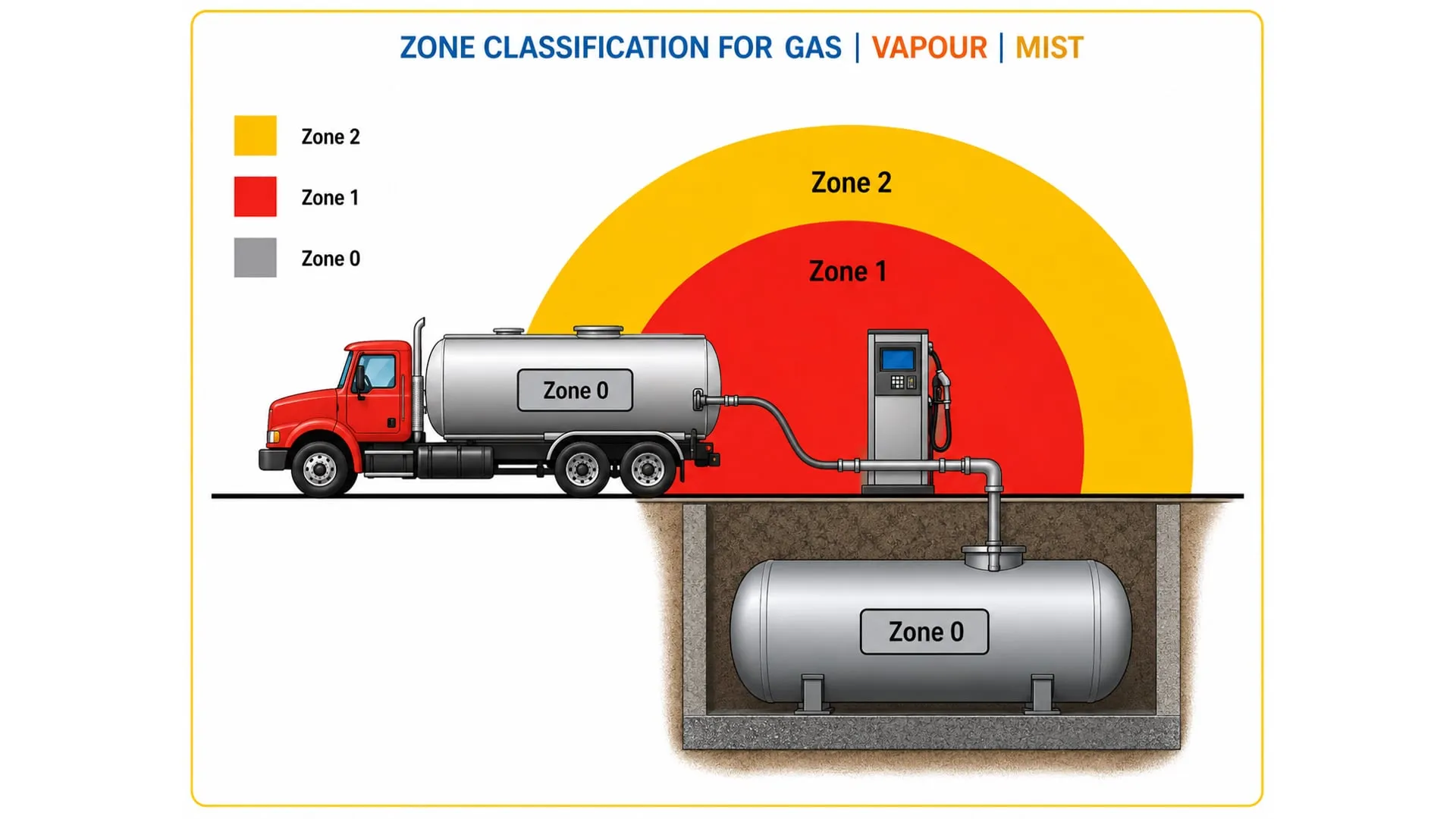
- Is this a Class I, Division 1 or Division 2 location—or an IEC Zone 0, 1, or 2 location?
- Does a dust collector, bag dump, mixer, mill, dryer, or packaging station create a Class II or Zone 20/21/22 area?
- What is the classified distance around a tank vent, pump seal, sampling point, open transfer, or relief discharge?
- How does mechanical ventilation change the classification basis?
- What gas/vapor or dust group should the electrical design use?
- Can existing ordinary-location electrical equipment remain outside the classified boundary?
- What does the AHJ or electrical engineer need to see in the report and drawings?
HazBasis Connects HAC to the Rest of the Hazard Basis
Hazardous-area classification is strongest when it is coordinated with the hazard studies and laboratory data that define the actual process. HazBasis can connect HAC findings to Dust Hazard Analysis, flammable liquid/gas fire and explosion analysis, combustible dust testing, flammability testing, Electrostatic Hazard Analysis, and Ignition Source Analysis.
- Dust Hazard Analysis (DHA): addresses combustible dust fire, flash-fire, and explosion scenarios beyond electrical classification.
- Ignition Source Analysis: evaluates whether electrical and non-electrical equipment can provide an effective ignition source.
- Electrostatic Hazard Analysis: evaluates charging, accumulation, discharge mechanisms, bonding/grounding, insulating materials, and static-sensitive operations.
- Combustible Dust Testing: supplies material-specific data when dust hazard or ignition sensitivity is uncertain.
- Gas & Vapor Testing: supplies flammability and ignition data where published information is inadequate or the process mixture is unique.
Why HazBasis
- Ability to investigate missing material data instead of automatically defaulting to assumptions.
- Process-safety-led classification rather than drawing-only zoning.
- Integrated gas/vapor, combustible dust, electrostatic, ignition-source, and laboratory-testing capability.
- Both NFPA/NEC and IEC/ATEX classification frameworks.
- Site-specific engineering judgment documented so reviewers can follow the basis.
- Deliverables built for electrical design, owner records, EPC coordination, insurer review, and AHJ discussion.
Our Services
NFPA 497 / NFPA 499 / NFPA 70 (NEC) Methodology
NFPA 497, NFPA 499 and NEC hazardous area classification for Class I, II and III locations. Division 1/2 studies, classified-area drawings and AHJ-ready documentation.
ATEX / IEC 60079-10-1 / IEC 60079-10-2 Methodology
ATEX and IEC 60079 hazardous area classification for Zone 0/1/2 and Zone 20/21/22. IEC 60079-10-1 gas/vapor and IEC 60079-10-2 combustible dust methodology.
FAQ
What is Hazardous Area Classification?
Hazardous Area Classification identifies locations where flammable gases, vapors, mists, combustible dusts, or ignitable fibers can create an ignition hazard and establishes a documented classification basis for electrical design and equipment selection.
What is the difference between Class/Division and Zone classification?
Class/Division is the traditional NEC framework widely used in the United States. The Zone system is used internationally through IEC 60079 and is also recognized in parts of the NEC. Both systems address the likelihood and extent of explosive atmospheres, but their terminology and methodology are not identical.
Do I need NFPA/NEC or IEC/ATEX classification?
The correct basis depends on project location, legally adopted code, client or owner engineering standard, equipment strategy, and authority requirements. HazBasis confirms the governing basis at the start of the study.
Can an entire room be unclassified if it contains flammable material?
Possibly, but the conclusion must be supported by containment, release scenarios, ventilation, material properties, and the governing methodology. The presence of a flammable material alone does not determine the boundary.
Does HAC replace a DHA or PHA?
No. HAC focuses on the probability and extent of explosive atmospheres for hazardous-location design. A DHA or PHA addresses broader fire, explosion, reactivity, release, and safeguard scenarios.
Does HAC determine whether installed equipment is acceptable?
HAC provides the location classification and associated design basis. Equipment suitability then has to be checked against the applicable electrical code/standard, equipment certification/marking, temperature limits, material group, protection concept, and installation requirements.
Can HazBasis update an existing HAC drawing?
Yes. HazBasis can review the previous basis, verify current process conditions, identify changed release sources or ventilation, and revise the report and drawings.
Can the study be performed remotely?
Some new-design and well-documented projects can be completed remotely. Existing or complex facilities usually benefit from a site walkdown so actual equipment configuration, releases, ventilation, housekeeping, and modifications are captured.