

Self-Heating Screening Testing for Powders & Granular Solids
Identify thermal instability early—before self-heating develops into smoldering, fire, product decomposition or a secondary dust explosion hazard.
HazBasis provides laboratory self-heating screening tests designed to reproduce three important process conditions: heated air flowing through powder, hot air moving over a powder layer or deposit, and material held in bulk. Selecting the configuration that resembles the plant condition gives a much more useful first indication of thermal instability than applying a single generic test to every powder.
Need Help Assessing Self-Heating Risk? Reach out and we’ll help.
Why the Test Configuration Matters
Self-heating begins when exothermic heat generation exceeds heat loss. The balance changes substantially with airflow, layer thickness, bulk size, geometry and exposure time. Bulk material can self-ignite at a lower temperature than the same material in a thin layer because the larger accumulation loses less heat per unit mass. Representative samples are also essential because moisture, additives, oils, impurities and prior processing can materially change self-heating behavior.
For screening, HazBasis separates the assessment into three process-relevant configurations:
- Bulk Powder Screening Test — powder is held as a bulk accumulation with no forced airflow through the bed.
- Aerated Powder Test — hot air passes through the material.
- Powder Layer Test — hot air flows over a layer or deposit.
1. Aerated Powder Test
Best fit: fluid-bed dryers and through-circulation / through-flow drying conditions.
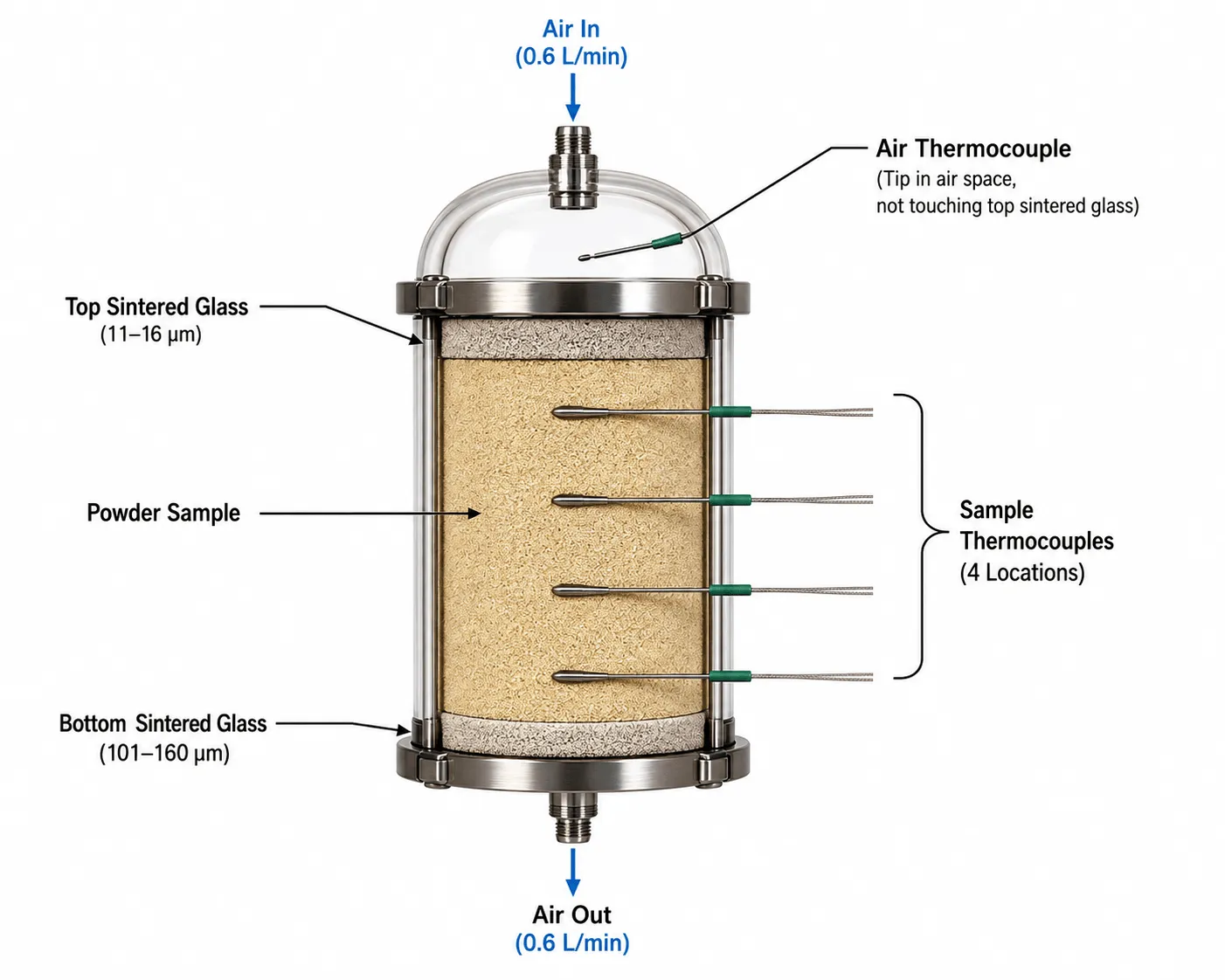
The aerated powder test simulates dryers in which a hot air stream passes through the material. The test cell is a glass cylinder approximately 80 mm long × 50 mm diameter. The bottom is closed with 101–160 µm sintered glass and the close-fitting top contains a second 11–16 µm sinter. Powder fills essentially the full space between the two sinters.
Heated air is passed downward through the sample at approximately 0.6 L/min at the same temperature as the surrounding oven. Air, oven and sample temperatures are monitored. Thermocouples within the sample detect the point at which the powder temperature begins to increase independently of the oven temperature.
| Primary screening result | TA — aerated-powder exotherm onset temperature | |
| Typical screening program | Oven and air increased at 0.5 °C/min over 20–400 °C | |
| Follow-up | Isothermal tests at progressively lower temperatures; process-cycle simulation when needed | |
| Interpretation | Provides guidance for thermal instability under aerated conditions; not a stand-alone plant safe temperature | |
Why follow-up matters: exothermic activity depends on both temperature and time. Chemical induction periods and autocatalytic behavior can make constant-temperature or realistic process-cycle testing necessary even when the initial ramp screening result appears favorable.
2. Powder Layer Test
Best fit: cross-flow, tray and band dryers, plus deposits on internal dryer surfaces.
A representative layer approximately 75 mm × 40 mm × 15 mm deep is placed on a metal tray. Heated air moves around/over the layer at approximately 4.5 m/min while thermocouples monitor the layer and air temperatures. The test can be used to evaluate whether self-heating progresses from detectable exothermic activity toward red heat or combustion.
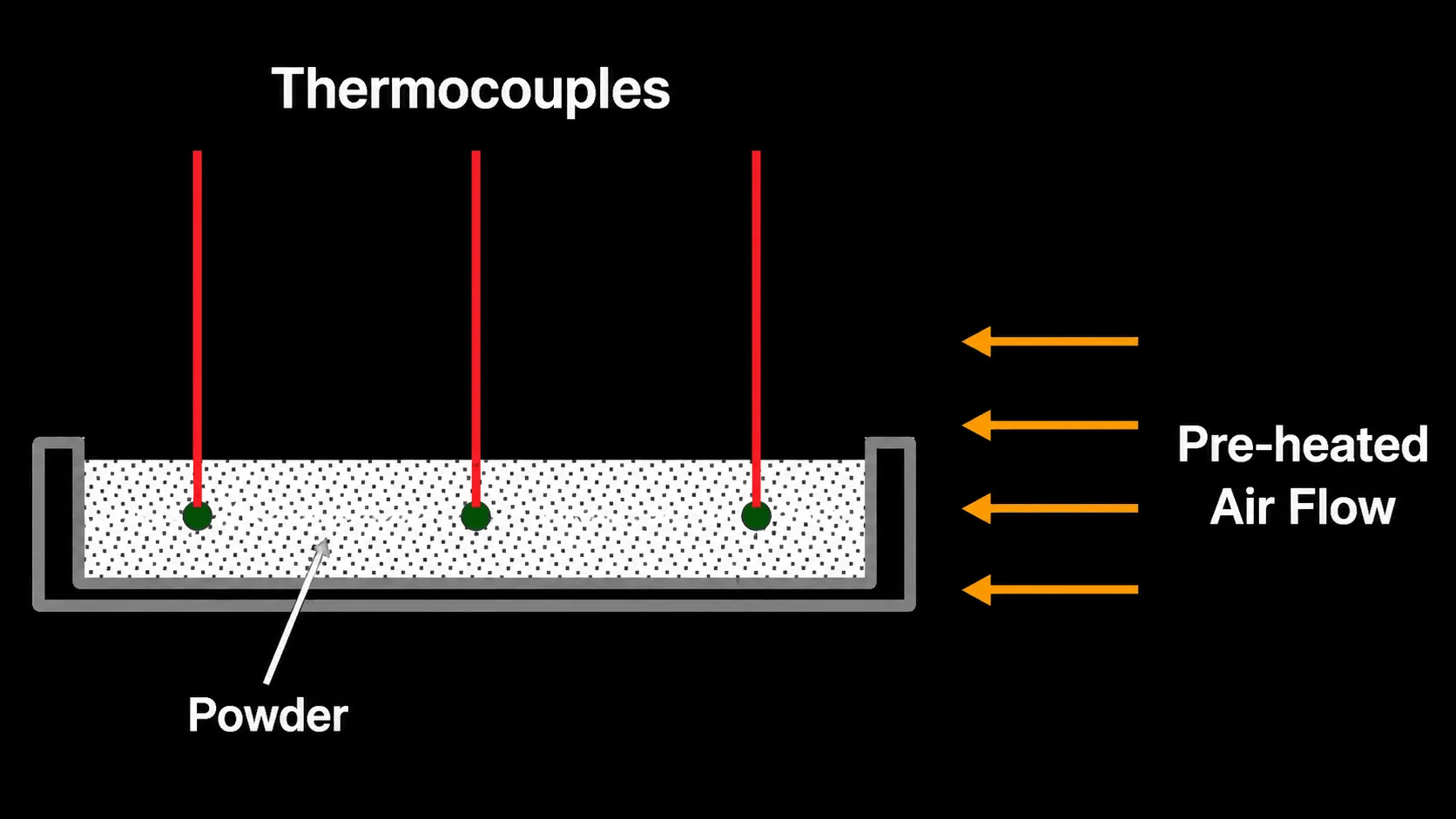
| Layer geometry | 75 mm × 40 mm × 15 mm deep | |
| Airflow | Approximately 4.5 m/min around/over the layer | |
| Initial screen | Optional 0.5 °C/min ramp over 20–400 °C to locate approximate exothermic activity | |
| Key layer result | TL — minimum temperature from which combustion develops in the representative layer | |
Layer depth is a critical variable. Deeper deposits generally have lower ignition temperatures because they retain heat more effectively. Extended isothermal testing is therefore more important than a simple ramp when long-lived dryer deposits are credible.
3. Bulk Powder Screening Test
Best fit: bins, hoppers, bags, drums, silos and bulk accumulations at the bottom of dryers.
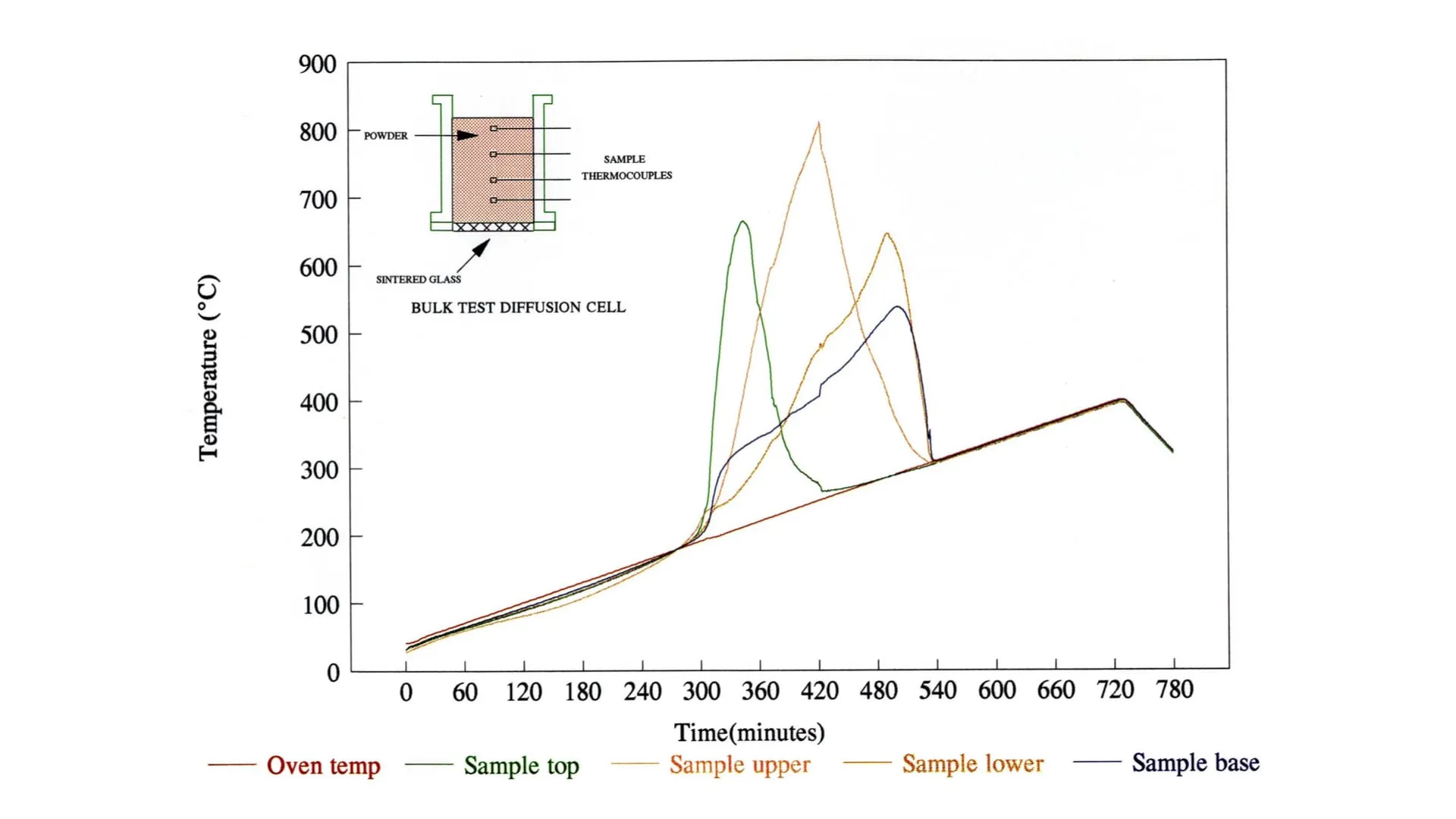
The bulk screening test uses an approximately 80 mm long × 50 mm diameter glass cylinder with 101–160 µm sintered glass at the base. The cylinder is almost filled with powder and placed in a fan-assisted oven. Unlike the aerated powder test, no controlled airflow is forced through the powder bed. The oven and sample temperatures are monitored to detect the temperature at which the bulk sample begins to heat independently of the external source.
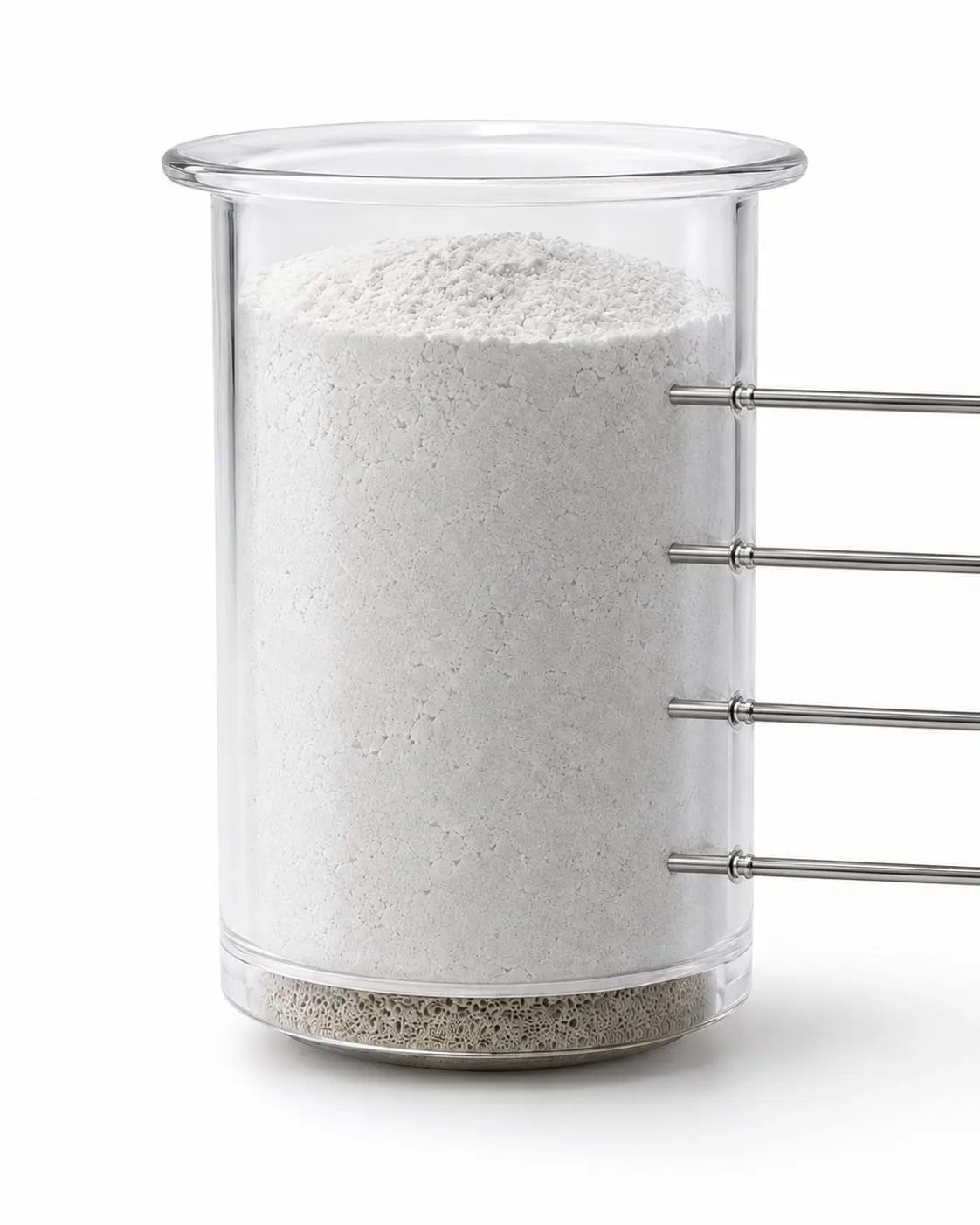
| Primary result | TD — minimum significant bulk exotherm onset temperature | |
| Typical screening ramp | 0.5 °C/min | |
| Scale limitation | Small samples lose heat faster than plant-scale bulk accumulations | |
| Important trigger | If TD is less than 50 °C above operating temperature, additional evaluation is indicated | |
| Additional triggers | Operating exposure exceeds screening time, or thermal instability begins below 200 °C | |
For the referenced bulk screening approach, if the measured exotherm onset is more than 50 °C above the operating temperature, dangerous exothermic decomposition is considered unlikely for bulk storage units up to about 1 tonne under the stated screening assumptions. This is a screening criterion—not a universal safe-temperature rule—and the method specifically calls for further tests when the margin is smaller, the process/storage time is longer, or instability starts below 200 °C.
Which Self-Heating Screening Test Should I Choose?
| Process condition | Recommended test | Air pattern | Primary result | Typical examples |
|---|---|---|---|---|
| Hot air through powder | Aerated Powder | Through bed | TA | Fluid-bed; through-circulation dryer |
| Hot air over layer | Powder Layer | Across surface | TL | Tray/band dryer; deposits |
| Material held in bulk | Bulk Powder | No forced through-flow | TD | Hopper; bin; drum; bag; silo |
From Screening to a Plant Operating Basis
Screening is intended to identify the approximate thermal-instability region efficiently. When the screening result is close to the actual process temperature, when exposure time is long, or when scale effects are important, HazBasis can progress the program through increasingly representative evaluations.
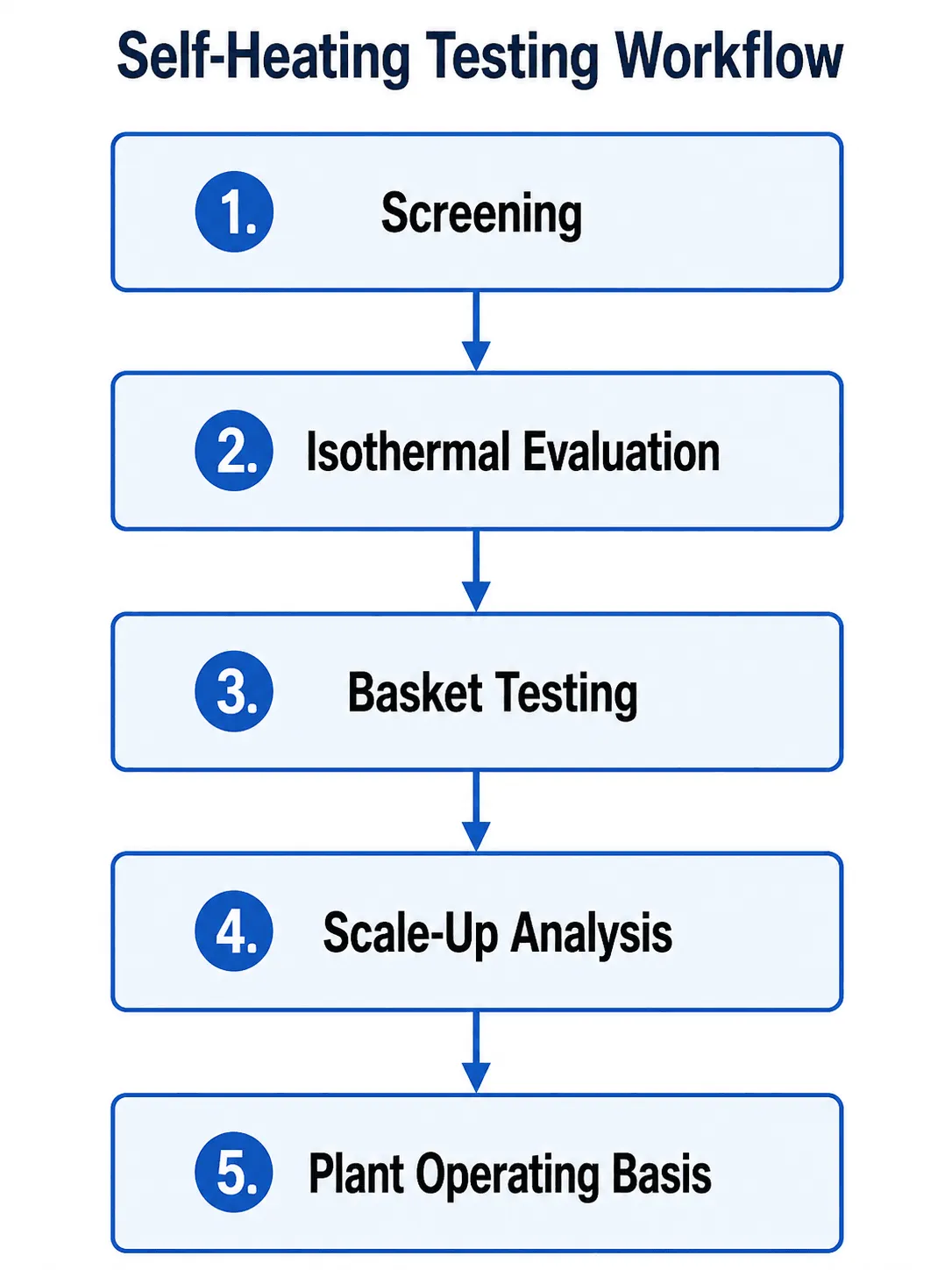
Recommended decision path:
- Screening — identify approximate onset behavior under the relevant process configuration.
- Isothermal Evaluation — determine whether time at temperature changes the thermal response.
- Basket Testing — establish self-ignition temperature as a function of accumulation size where bulk scale matters.
- Scale-Up Analysis — extrapolate laboratory data to the intended storage or equipment geometry.
- Plant Operating Basis — combine test results with process temperature, residence time, upset conditions and appropriate safety margins.
What Can Self-Heating Screening Testing Help Answer?
- Can this powder begin to self-heat at or near the dryer operating temperature?
- Is through-flow aeration more hazardous than a static or surface-heated condition?
- Could deposits on dryer walls or trays progress from self-heating to smoldering?
- Is hot product discharge into a drum, FIBC, hopper or silo likely to require additional bulk testing?
- Should the next step be isothermal testing, VSP low-heat-loss testing, basket testing or process-cycle simulation?
- Do start-up, shutdown or abnormal temperature excursions warrant specific simulation?
When Follow-Up Testing Is Especially Important
| Trigger | Recommended response |
|---|---|
| Screening onset is close to process temperature | Use extended isothermal testing and process-specific evaluation. |
| Drying/storage time is long | Hold at representative temperatures longer than the maximum expected exposure. |
| Bulk storage or scale-up is important | Use low-heat-loss / Dewar testing and/or EN 15188 basket scale-up testing. |
| Autocatalytic or multi-stage decomposition is credible | Simulate realistic temperature/time cycles rather than relying only on a programmed ramp. |
| Deposit thickness can exceed the screening layer | Evaluate representative deeper layers; ignition temperature can decrease with depth. |
| Oil contamination or formulation changes are possible | Test the representative contaminated/modified material where credible. |
Why Choose HazBasis
- Process-condition-based test selection — the test is matched to how the material is actually dried, deposited or stored.
- Testing plus interpretation — results are connected to temperature, time, scale, equipment geometry and credible upset conditions.
- A staged testing strategy — screening is used to avoid unnecessary advanced testing while still identifying when more rigorous work is justified.
- Process-safety integration — findings can support dryer safety reviews, combustible dust hazard analyses, management of change and operating procedures.
FAQ
What is a self-heating screening test?
It is a small-scale laboratory evaluation used to identify the approximate temperature region where a material begins to generate heat independently of the external heat source. The appropriate configuration depends on whether the plant condition is aerated, layered or bulk.
What is the difference between TA, TL and TD?
TA is the aerated-powder exotherm onset temperature. TL is the minimum temperature from which combustion develops in the tested powder layer. TD is the minimum significant exotherm onset temperature for the bulk-powder screening configuration.
Does the screening result equal the maximum safe operating temperature?
No. Screening identifies the approximate hazard region. Safe plant limits require consideration of time, scale, geometry, process cycles, uncertainty and suitable engineering safety margins.
Why can bulk powder be more hazardous than a thin layer?
A large bulk accumulation generally loses less heat per unit mass. As the accumulation becomes larger, internally generated heat is retained more effectively and the self-ignition temperature can decrease.
When should EN 15188 basket testing be added?
Basket testing is appropriate when the objective is to quantify how self-ignition temperature changes with accumulation size and then scale the data toward drums, FIBCs, hoppers, bins or silos.
Can one test cover every dryer and storage condition?
No. Through-flow aeration, surface-heated layers and static bulk storage create different heat- and mass-transfer conditions. Test selection should reflect the actual process.