

NFPA standards often define the engineering framework
NFPA documents are central to many U.S. fire and explosion safety projects, but the practical challenge is deciding which document applies and how it connects to the required material data. HazBasis uses NFPA guidance as part of an engineering basis that also considers the process, operating conditions, equipment, laboratory test data, adopted codes and Authority Having Jurisdiction requirements.
Need an NFPA-based engineering review? Reach out and we’ll help.
NFPA 660: the consolidated combustible dust framework
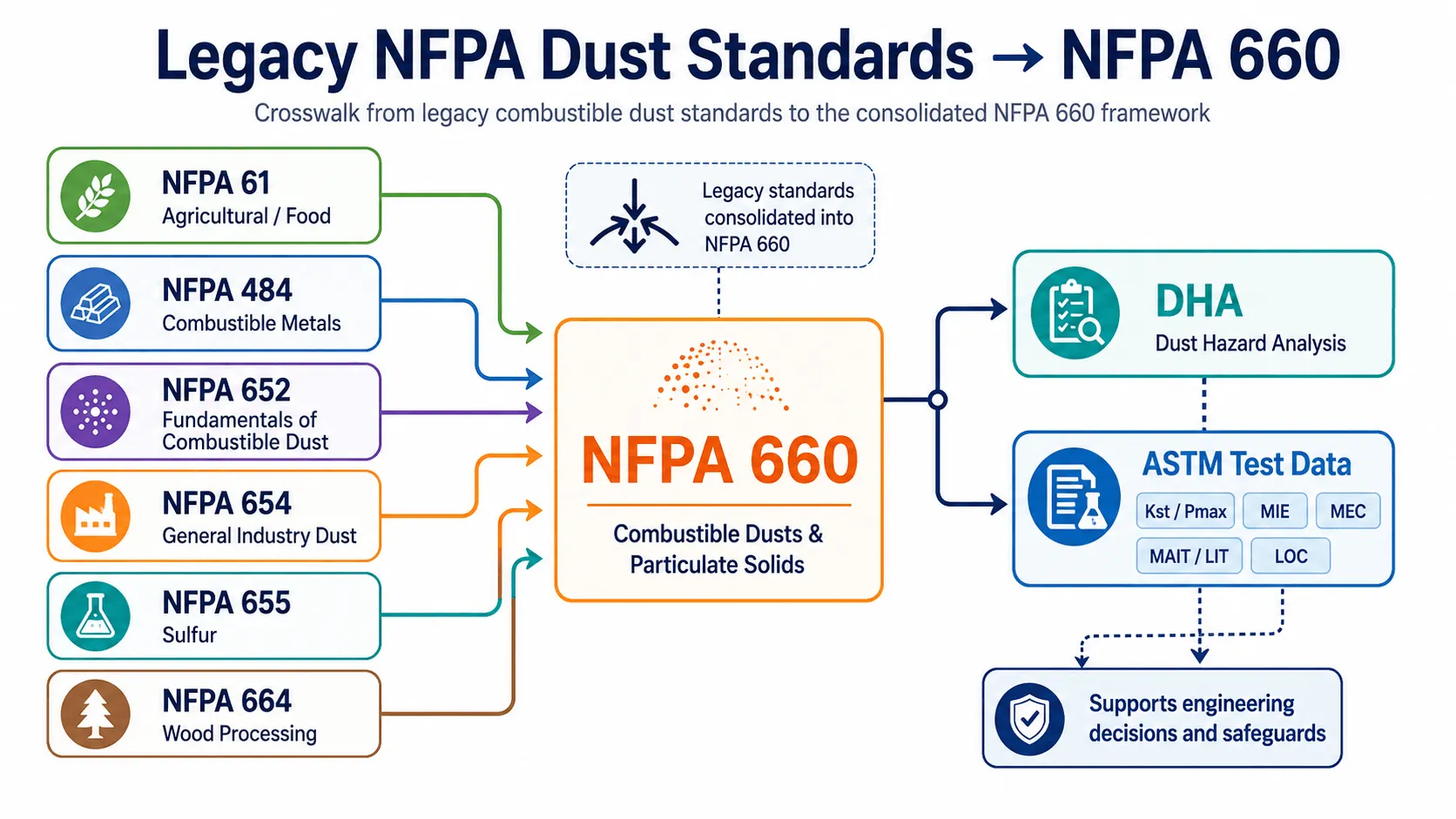
NFPA 660, Standard for Combustible Dusts and Particulate Solids, consolidates six previous combustible-dust standards into one document. For new combustible-dust guidance, NFPA 660 should be the primary resource to understand the combined framework. Legacy standard numbers remain important because existing facilities, older DHAs, specifications, insurance documents and adopted code editions may still cite them.
| Legacy standard | Historic focus | NFPA 660 relationship | Why the legacy number still matters |
|---|---|---|---|
| NFPA 652 | Fundamentals of combustible dust | General combustible-dust fundamentals now consolidated within NFPA 660 | Older DHA / corporate standards / adopted-edition references |
| NFPA 61 | Agricultural and food processing facilities | Industry-specific agricultural/food requirements incorporated into NFPA 660 | Food, grain, agricultural processing |
| NFPA 484 | Combustible metals | Metal-specific combustible dust requirements incorporated into NFPA 660 | Aluminum, magnesium and other combustible-metal operations |
| NFPA 654 | General manufacturing/processing/handling of combustible particulate solids | General industrial combustible-dust requirements incorporated into NFPA 660 | Chemical, polymer, pharmaceutical and general powder handling |
| NFPA 655 | Sulfur fires and explosions | Sulfur-specific requirements incorporated into NFPA 660 | Sulfur processing and handling |
| NFPA 664 | Wood processing and woodworking | Wood/cellulosic requirements incorporated into NFPA 660 | Wood processing and woodworking facilities |
NFPA 660 in a practical dust-hazard workflow
1. Determine whether the material can present a combustible-dust hazard and define representative sample conditions.
2. Develop the required explosion-severity and ignition-sensitivity data, such as Kst/Pmax, MEC, MIE, MAIT/LIT and LOC where needed.
3. Perform or update the Dust Hazard Analysis for the actual equipment and process.
4. Evaluate ignition sources, dust releases, accumulation, housekeeping, ventilation and equipment design.
5. Select prevention and protection measures appropriate to the scenario, process and adopted code basis.
6. Document assumptions, data, recommendations and revalidation/MOC triggers.
NFPA 30: Flammable and Combustible Liquids Code
NFPA 30 provides safeguards for the storage, handling and use of flammable and combustible liquids. For HazBasis clients, the code is particularly relevant when evaluating liquid classification, storage arrangements, transfer operations, process areas, tanks and containers, ventilation, ignition control, fire protection and facility interfaces.
NFPA 30 is stronger when the material basis is clear. Flash point, flammability limits, autoignition temperature and related physical-property data can affect how a liquid hazard is understood and how the facility evaluates storage, handling and ignition scenarios.
Related HazBasis service: Flammable Liquid Fire & Explosion Analysis
Related HazBasis testing: Flash Point and Fire Point Testing
Related HazBasis testing: Lower and Upper Flammability Limits (LFL/UFL) Testing
Related HazBasis testing: Autoignition Temperature (AIT) Testing
Other NFPA standards commonly connected to process-safety work
| Standard | Main topic | Practical use | HazBasis connection |
|---|---|---|---|
| NFPA 77 | Static electricity | Bonding, grounding, charge generation/accumulation and electrostatic ignition control | Electrostatic Hazard Analysis & Testing |
| NFPA 68 | Deflagration venting | Explosion venting as a mitigation strategy where applicable | Dust Explosion Protection / DHA |
| NFPA 69 | Explosion prevention systems | Inerting, suppression, isolation and other explosion-prevention/protection concepts | DHA / Explosion Protection |
| NFPA 70 / NEC | Electrical hazardous locations | Electrical equipment suitability and classified-location requirements | Hazardous Area Classification – NFPA/NEC |
| NFPA 497 / NFPA 499 | Area classification guidance | Classification guidance for flammable gases/vapors and combustible dusts | Hazardous Area Classification |
When legacy NFPA dust standards and NFPA 660 appear together
Do not automatically treat an older standard number in a report as an error. A facility may have been designed or reviewed under an earlier adopted edition. The better approach is to establish the governing project basis, identify what the older document required, understand how that requirement is organized in NFPA 660, and document any gap or transition decision.
FAQ
Did NFPA 660 replace NFPA 652?
NFPA 660 consolidates NFPA 652 together with five other combustible-dust standards. Legacy references can still matter for older adopted editions and historical project documents.
What happened to NFPA 654?
NFPA 654 was one of the six standards consolidated into NFPA 660. Searches for NFPA 654 should be redirected to the current NFPA 660 framework while preserving the legacy context.
What does NFPA 30 cover?
NFPA 30 addresses safeguards associated with storage, handling and use of flammable and combustible liquids.
Is NFPA 77 a testing standard?
NFPA 77 is a recommended practice for static electricity. Specific resistance, conductivity, charge or ignition measurements may use ASTM, IEC or other appropriate test methods.
Which NFPA edition should I use?
Use the edition required by the adopted code, project specification, contract or AHJ. A newer publisher edition does not automatically replace the legally adopted edition for a specific facility.