
NFPA 497 / NFPA 499 / NEC Hazardous Area Classification
Class I, Class II, Class III and Division 1/Division 2 area classification built from actual release sources, material properties, ventilation, operating conditions, and the adopted electrical code basis.
HazBasis performs U.S. Hazardous Area Classification studies using the applicable National Fire Protection Association guidance and National Electrical Code requirements. The methodology typically combines NFPA 497 for flammable gases and vapors, NFPA 499 for combustible dusts and ignitable fibers/flyings, and NFPA 70 (NEC) for the hazardous (classified) location framework used by electrical designers and inspectors.
The result is a traceable engineering basis for where hazardous electrical requirements apply, where ordinary-location equipment can remain, and how the classified boundary should be represented on project drawings.
Have an existing Class/Division drawing that is outdated, too conservative, or unsupported? Send it with the current process layout, SDSs, and ventilation information. HazBasis can determine what must be revalidated and what can remain.
How the NFPA / NEC Documents Work Together
| Document | Role in HAC | Typical Application |
|---|---|---|
| NFPA 70 (NEC) | Code framework for hazardous (classified) electrical locations and equipment/installation requirements. | 500-series hazardous-location concepts including Class/Division and Zone systems. |
| NFPA 497 | Recommended-practice methodology and examples for flammable liquids, gases, and vapors in chemical process areas. | Class I gas/vapor classification and extent. |
| NFPA 499 | Recommended-practice methodology and examples for combustible dusts and ignitable fibers/flyings. | Class II / Class III and dust/fiber hazardous-location classification. |
Edition control matters. The newest national publication is not automatically the edition enforced at a specific site. HazBasis identifies the AHJ-adopted NEC edition and the project-specified NFPA references before finalizing the classification basis.
NEC Hazardous Location Framework
For U.S. projects using the traditional Class/Division system, the first question is the nature of the ignitable material. The second is how often an ignitable concentration can reasonably be expected at a location.
| Classification | Hazard | Typical Process Examples |
|---|---|---|
| Class I | Flammable gases or vapors | Solvents, fuels, hydrogen, natural gas, flammable-liquid handling and vapor release points |
| Class II | Combustible dust | Dust collectors, mills, powder transfer, dryers, bag dumps, hoppers, silos, packaging |
| Class III | Ignitable fibers/flyings | Processes generating fibers or flyings that can create a fire hazard and require classified electrical consideration |
Division 1 vs. Division 2 — Engineering Meaning
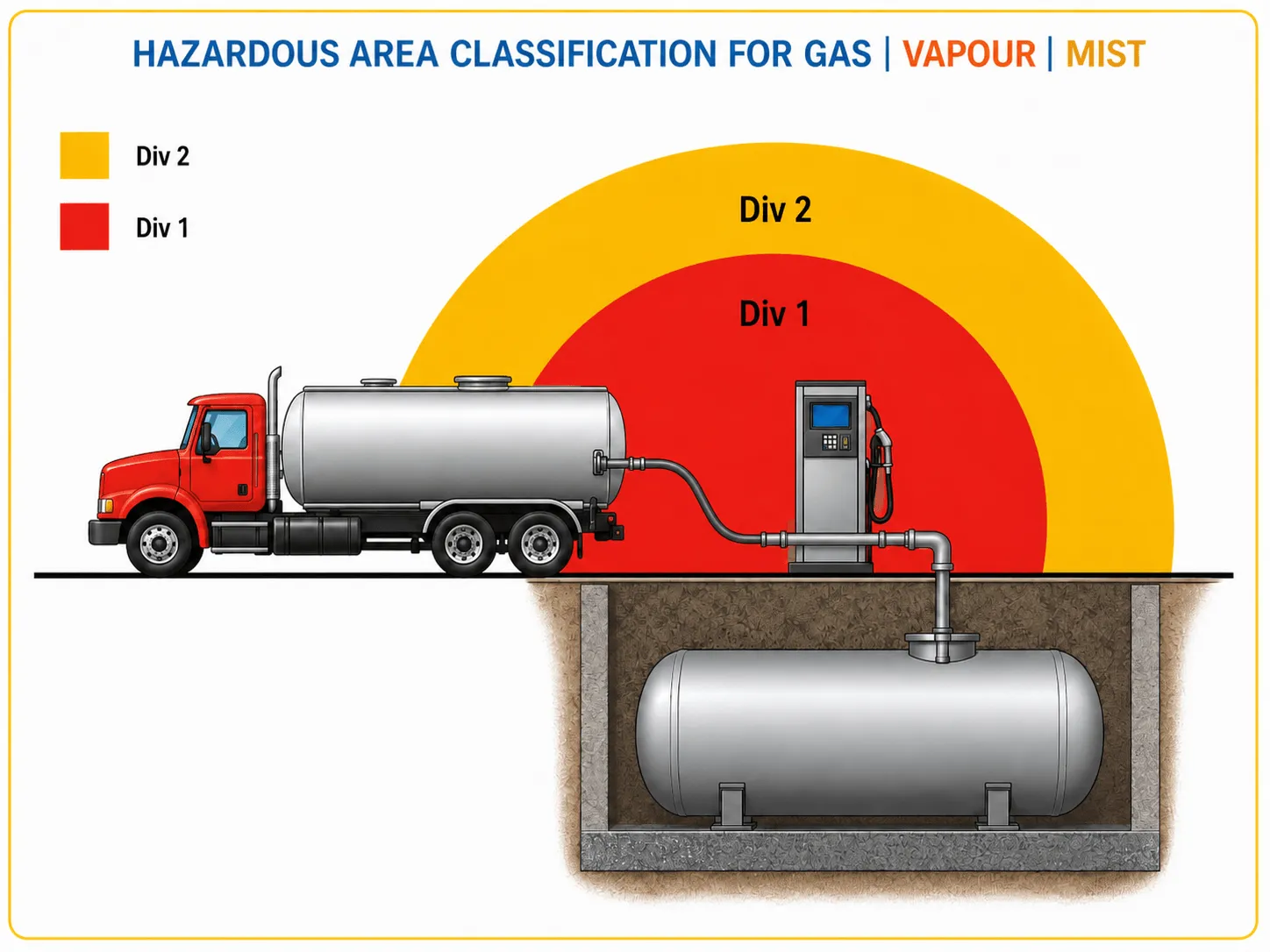
Division designation is not a label selected only from the material. It depends on the expected presence of an ignitable atmosphere at the specific location and the conditions under which a release can occur.
| Division | General Engineering Meaning | Examples of Questions HazBasis Resolves |
|---|---|---|
| Division 1 | Ignitable concentrations can be expected under normal operating conditions, may exist frequently, or can be created by recurring process/maintenance conditions addressed by the adopted code basis. | Is vapor routinely released at the vent? Is dust released during normal filling? Is the inside of the equipment normally hazardous? |
| Division 2 | Ignitable concentrations are not normally expected, but could occur because of abnormal equipment failure, leakage, rupture, ventilation failure, or other conditions recognized by the adopted methodology. | Could a seal leak or hose failure create a temporary ignitable cloud? Is the room normally controlled but vulnerable to an abnormal release? |
HazBasis NFPA/NEC Methodology
Step 1 — Establish the governing code basis — Confirm jurisdiction, adopted NEC edition, project specifications, owner standards, and whether the traditional Class/Division framework or NEC Zone framework is required.
Step 2 — Determine the material hazard class — Identify whether the process presents Class I gas/vapor hazards, Class II combustible dust hazards, Class III fiber/flying hazards, or overlapping hazards.
Step 3 — Assemble the material data — For gases/vapors, review flash point, vapor pressure, boiling behavior, LFL/UFL, relative vapor density, process temperature/pressure, and gas group information. For dusts, establish combustibility/explosibility, dust type/group information, cloud/layer behavior, and relevant ignition-temperature data as needed.
Step 4 — Identify credible sources of release — Map vents, seals, sampling points, drains, open transfers, tank openings, relief discharges, bag dumps, dust-collector discharges, mill openings, filter leaks, packaging points, and other sources.
Step 5 — Characterize normal vs. abnormal release conditions — Determine whether the release can occur in normal operation, recurring operation, maintenance, or only because of abnormal failure; document duration, quantity/rate, pressure, temperature, and physical state.
Step 6 — Evaluate ventilation and accumulation — Assess natural/mechanical ventilation, room enclosure, pits/trenches, low points for heavy vapors, high points for light gases, local exhaust, dust containment, and housekeeping.
Step 7 — Assign Class, Division, Group, and extent — Apply NFPA 497 or NFPA 499 guidance together with NEC requirements to determine the classification and horizontal/vertical extent around each source.
Step 8 — Resolve interfaces and document the basis — Address overlapping sources, adjacent classifications, openings between rooms, outdoor/indoor transitions, and equipment boundaries; prepare drawings, schedules, assumptions, and conclusions.
NFPA 497 Methodology for Flammable Gas and Vapor Areas
NFPA 497 provides recommended-practice guidance for classifying flammable gas and vapor hazards in chemical process areas. The published figures and examples are useful starting points, but their assumptions still have to be checked against the actual release mechanism, material, temperature, pressure, ventilation, and geometry.
- Identify the flammable gas, vapor, or ignitible liquid and confirm whether process conditions can generate an ignitable mixture in air.
- Evaluate release points such as vents, pump/compressor seals, open sampling, open transfer, tank filling, relief discharges, drains, and equipment openings.
- Determine whether each source is associated with normal operation, recurring operation, or abnormal leakage/failure.
- Evaluate vapor generation or gas-release severity using process pressure, temperature, opening size, vapor pressure/boiling behavior, and other relevant parameters.
- Evaluate indoor vs. outdoor service and whether ventilation can prevent significant accumulation or reduce the extent of classification.
- Consider vapor/gas density when determining where released material may travel or accumulate.
- Assign the Class I Division designation and material group information required for electrical design.
- Establish the horizontal and vertical classification boundary and document deviations from generic example figures when site-specific engineering supports them.
NFPA 499 Methodology for Combustible Dust Areas
NFPA 499 addresses the classification of locations where combustible dusts or ignitable fibers/flyings are produced, processed, or handled. The analysis must distinguish between dust contained inside equipment, dust clouds released into the surrounding area, and dust layers that can accumulate and later become dispersed.
- Confirm that the particulate material is combustible/explosible or otherwise within the applicable NFPA 499 scope.
- Identify dust-producing operations and release sources: mills, grinders, screens, dryers, mixers, transfers, dust collectors, filter receivers, bag dumps, packaging, and cleanout points.
- Evaluate whether an explosible dust cloud can exist in normal operation, is expected only under abnormal conditions, or is limited to the inside of equipment.
- Evaluate the potential for dust layers on floors, beams, cable trays, equipment, luminaires, and elevated surfaces; housekeeping quality is an input, not a substitute for sound containment.
- Determine Class II Division 1/2 or Class III implications and the applicable dust/fiber material group information for the electrical design basis.
- Establish the extent around openings, vents, transfer points, collector discharges, and other sources using the adopted NFPA guidance and site geometry.
Material Group and Temperature Information
Area classification drawings should provide enough information for the electrical designer to select equipment, but classification and equipment selection remain separate engineering steps.
| Hazard | Classification Information | Downstream Equipment Considerations |
|---|---|---|
| Class I gas/vapor | Class, Division and applicable gas/vapor group | Equipment approval/marking, protection method, temperature class / maximum surface temperature, installation requirements |
| Class II dust | Class, Division and applicable dust group | Dust-suitable equipment, group suitability, surface-temperature limits, ingress and installation requirements |
| Class III fibers/flyings | Class III and Division as applicable | Equipment/installation suitable for fibers and flyings under the adopted NEC basis |
Classification Extent: Why Generic Distances Are Not Enough
One of the most common HAC errors is to copy a typical figure without checking whether the release source and assumptions match the facility. A defensible extent should consider the actual source strength, operating pressure and temperature, material volatility, gas/vapor density, dust release behavior, ventilation, enclosure, and nearby barriers or openings.
HazBasis uses published NFPA guidance as the code-based starting point and then documents the site-specific factors that support the selected boundary. Where the process does not match a standard example, the report should say why and identify the engineering basis used.
Typical NFPA/NEC Classification Scenarios
| Scenario | Primary Hazard | Key Classification Inputs | Related HazBasis Work |
|---|---|---|---|
| Solvent tank / vent | Class I vapor | Liquid properties, fill/vent mode, temperature, vent discharge, outdoor/indoor conditions | Flammable liquid analysis; flash point/LFL data |
| Pump or compressor | Class I gas/vapor | Seal type, leakage assumptions, process pressure, ventilation, equipment layout | Ignition Source Analysis |
| Hydrogen process skid | Class I gas | Release rate, buoyancy, ventilation, roof/ceiling accumulation, venting | Gas flammability / consequence support as needed |
| Dust collector | Class II dust | Dust explosibility, internal dust cloud, clean/dirty side releases, collector openings, housekeeping | DHA; Kst/Pmax; MIE; MIT |
| Bag dump / powder charging | Class II dust | Frequency of open transfer, dustiness, local exhaust, release quantity, enclosure | DHA; dust testing |
| Fibrous material handling | Class III fibers/flyings | Material form, accumulation, release frequency and equipment arrangement | Ignition Source Analysis where needed |
What the NFPA/NEC HAC Report Should Contain
- Applicable codes, recommended practices, editions, project specifications, and jurisdiction/AHJ basis.
- Process and equipment description and classification scope boundary.
- Material hazard table with relevant gas/vapor or dust properties and source of data.
- Release-source register with normal/abnormal release basis.
- Ventilation, enclosure, dilution, dust containment, and housekeeping assumptions.
- Classification decision for each source: Class, Division, Group and boundary extent as applicable.
- Classified-area drawings with plan and elevation information where vertical extent matters.
- Electrical-design coordination notes and clearly stated limitations.
HAC Is Not the End of Ignition Hazard Control
NFPA/NEC HAC identifies locations where hazardous-location electrical requirements apply. A facility can still have credible ignition sources outside that scope—including static electricity, hot surfaces, mechanical sparks, friction, open flames, hot work, self-heating, or process reaction hazards. HazBasis can coordinate HAC with Ignition Source Analysis, Electrostatic Hazard Analysis, DHA, and other process-safety studies.
FAQ
What NFPA standard is used for hazardous area classification?
For U.S. chemical-process work, NFPA 497 is commonly used for flammable gas/vapor areas and NFPA 499 for combustible dust/fiber areas, together with the adopted NFPA 70 (NEC) hazardous-location requirements.
Is NFPA 497 a code?
NFPA 497 is a recommended practice. NFPA 70 is the electrical code framework. The enforceable project basis depends on local adoption, project specifications, and AHJ requirements.
What NEC articles address hazardous locations?
The NEC 500-series articles address hazardous (classified) locations. The exact article applied depends on the Class/Division or Zone system and the material hazard. HazBasis identifies the applicable project basis rather than assuming one framework fits every site.
Does Division 2 mean the area is safe?
No. Division 2 is still a hazardous (classified) location. It generally reflects a lower likelihood of an ignitable atmosphere during normal operation than Division 1, but electrical equipment and installation requirements still apply.
Can ventilation make an area unclassified?
Ventilation can materially affect classification, but only when its effectiveness and availability are sufficient for the specific release scenario and the adopted methodology. The conclusion should be documented rather than assumed.
Does a dust collector always require a Class II area outside the collector?
Not automatically. The classification depends on the dust, containment, normal/abnormal release potential, collector configuration, openings, discharge points, housekeeping, and the applicable NFPA 499 basis.
Can HazBasis classify a mixed gas and dust process?
Yes. The study can evaluate overlapping Class I and Class II/III hazards and document how the electrical design should address locations where more than one hazard can apply.
Can HazBasis support an electrical engineer or AHJ after the report is issued?
Yes. HazBasis can explain assumptions, respond to classification comments, revise boundaries when new information is provided, and coordinate the technical basis with the project electrical team.