

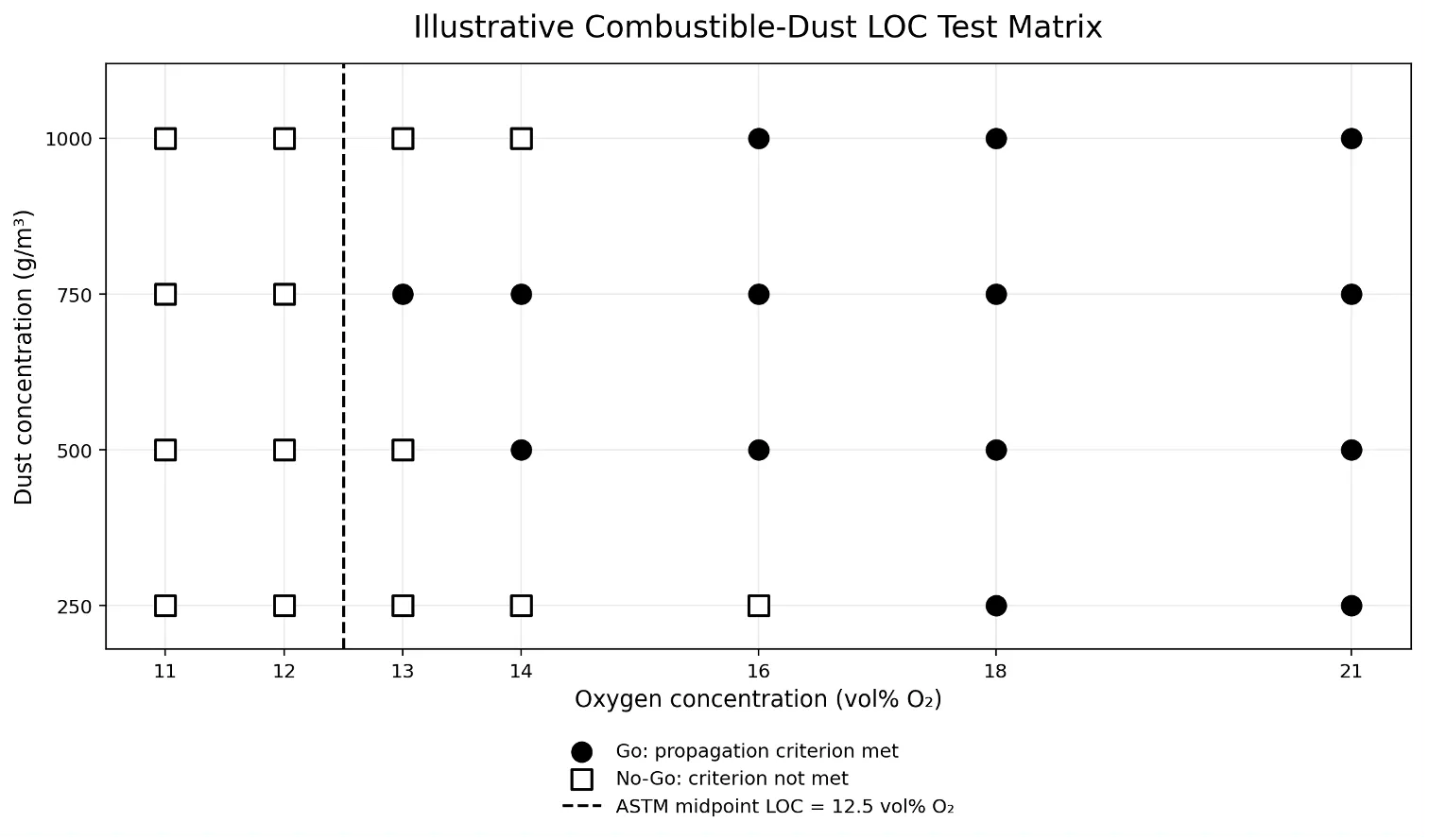
What Limiting Oxygen Concentration (LOC) Testing Answers
This test determines the oxygen concentration below which the tested dust cloud will not sustain a qualifying deflagration under the specified conditions. The result applies to the submitted sample, preparation, conditioning, and test conditions stated in the report. As with any single lab value, we’re careful not to generalize it as a universal property of the material, since particle size, moisture, temperature, pressure, geometry, and formulation can all shift the outcome.
Not sure if LOC testing fits your inerting question? Reach out and we’ll help you scope it.
Test Method and Standard
The dust is tested near an easily ignitable concentration while oxygen is progressively replaced by an inert gas, commonly nitrogen. Ignition and non-ignition points are repeated to establish the limiting concentration for the specific oxidant and inert gas system tested. Testing follows ASTM E2931, EN 14034-4, or an agreed project specific method, and the quotation identifies the governing method before work begins.
What You Receive
- LOC value for the specified dust and inert gas combination
- An ignition map across oxygen and dust concentration
- Test conditions needed for engineering interpretation
How the Data Supports Decisions
This result supports the design basis for nitrogen inerting and the selection of safety margins, informs startup, shutdown, pneumatic conveying, or vessel operating limits, and drives oxygen analyzer setpoints and protective interlocks.
When to Order This Test
- Inerting is proposed as an explosion prevention safeguard
- You need to validate an existing oxygen control basis
- Material or process changes may have altered the allowable oxygen concentration
Sample Submission Guidance
LOC programs require enough material for multiple oxygen and concentration combinations. HazBasis confirms the amount after reviewing available Kst/Pmax data and the inert gas being evaluated. Include the SDS, composition or trade name information, physical form, process description, and whether the sample should be tested as received or prepared to a different condition.
Why Choose HazBasis
- LOC is a test result, not an operating setpoint, and treating it as one is one of the more common mistakes we see. We help you understand the engineering margin an operating limit actually needs on top of the tested value, accounting for analyzer accuracy, mixing, response time, and process variability.
- The ignition map across oxygen and dust concentration gives your inerting design more to work with than a single threshold number, since real processes rarely operate at exactly one concentration.
- If you already have Kst/Pmax data on file, we use it to scope the LOC program more efficiently instead of starting the inert gas selection from zero.
FAQ
What does LOC testing measure?
Determines the oxygen concentration below which the tested dust cloud will not sustain a qualifying deflagration under the specified conditions.
Which standard will be used?
ASTM E2931; EN 14034-4. The final method depends on the sample, project objective, and any customer or regulatory requirements.
Is the LOC the operating setpoint?
No. LOC is a test result. The operating limit must include an engineering safety margin and account for analyzer accuracy, mixing, response time, and process variability.