

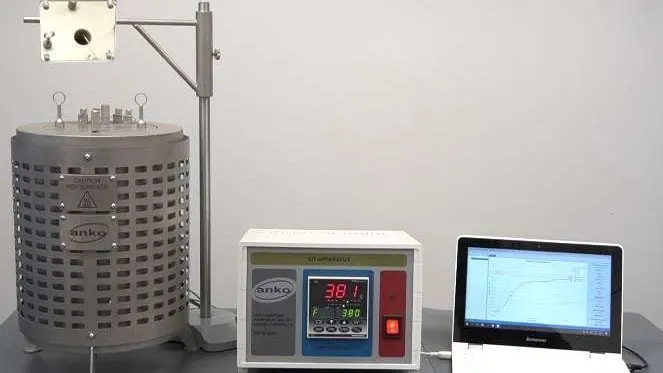
What Autoignition Temperature (AIT) Testing Answers
This test determines the lowest temperature at which a chemical vapor ignites in air, in a standardized heated flask, without an external spark or flame. The result applies to the submitted sample, preparation, conditioning, and test conditions stated in the report. As with any single lab value, we’re careful not to generalize it as a universal property of the material, since particle size, moisture, temperature, pressure, geometry, and formulation can all shift the outcome.
Not sure if published AIT data applies to your material? Reach out and we’ll help you scope it.
Test Method and Standard
Measured quantities of the substance are introduced into a temperature stabilized flask. Temperature, sample quantity, and ignition delay are varied to establish the lowest reproducible autoignition temperature under the method. Testing follows ASTM E659 or an agreed project specific method, and the quotation identifies the governing method before work begins.
What You Receive
- AIT and observed ignition delay
- Sample quantity and test condition record
- Interpretation for hot surface and equipment temperature hazards
How the Data Supports Decisions
This result sets safe temperature limits for equipment and process surfaces, informs ignition source assessment in a PHA, HAZOP, or incident investigation, and supports SDS and product hazard characterization.
When to Order This Test
- Reliable AIT data isn’t available for a chemical or mixture
- Composition, contamination, or pressure conditions may affect published values
- Hot equipment, heaters, compressors, or ovens are present in the process
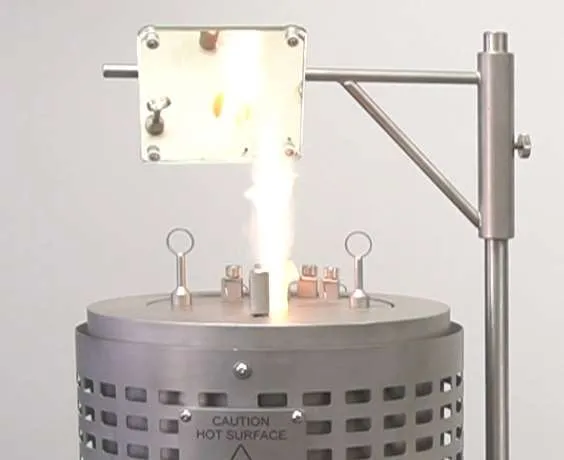
Sample Submission Guidance
A relatively small liquid quantity may be sufficient, though the final amount depends on volatility, repeat testing, purity, and safe handling requirements. Include the SDS, composition or trade name information, physical form, process description, and whether the sample should be tested as received or prepared to a different condition.
Why Choose HazBasis
- Published AIT values are usually measured on a pure, uncontaminated substance, and trace contamination or a mixture composition can lower the actual autoignition temperature meaningfully, sometimes enough to change an equipment temperature decision. We flag that gap rather than treating a literature value as automatically applicable.
- Sample quantity and ignition delay both affect the measured result, so we run the method carefully enough to find the true minimum rather than reporting the first ignition observed.
- Where this result sets a hard limit on equipment surface temperature, we connect it explicitly to that decision, heaters, compressors, ovens, so the number lands somewhere useful rather than sitting alone in an SDS field.
FAQ
What does AIT testing measure?
Determines the lowest temperature at which a chemical vapor ignites in air in the standardized heated flask without an external spark or flame.
Which standard will be used?
ASTM E659. The final method depends on the sample, project objective, and any customer or regulatory requirements.
Is AIT a safe operating temperature?
No. AIT is a laboratory ignition property. Operating limits require a safety margin and consideration of pressure, residence time, surfaces, catalysts, contamination, and process geometry.