

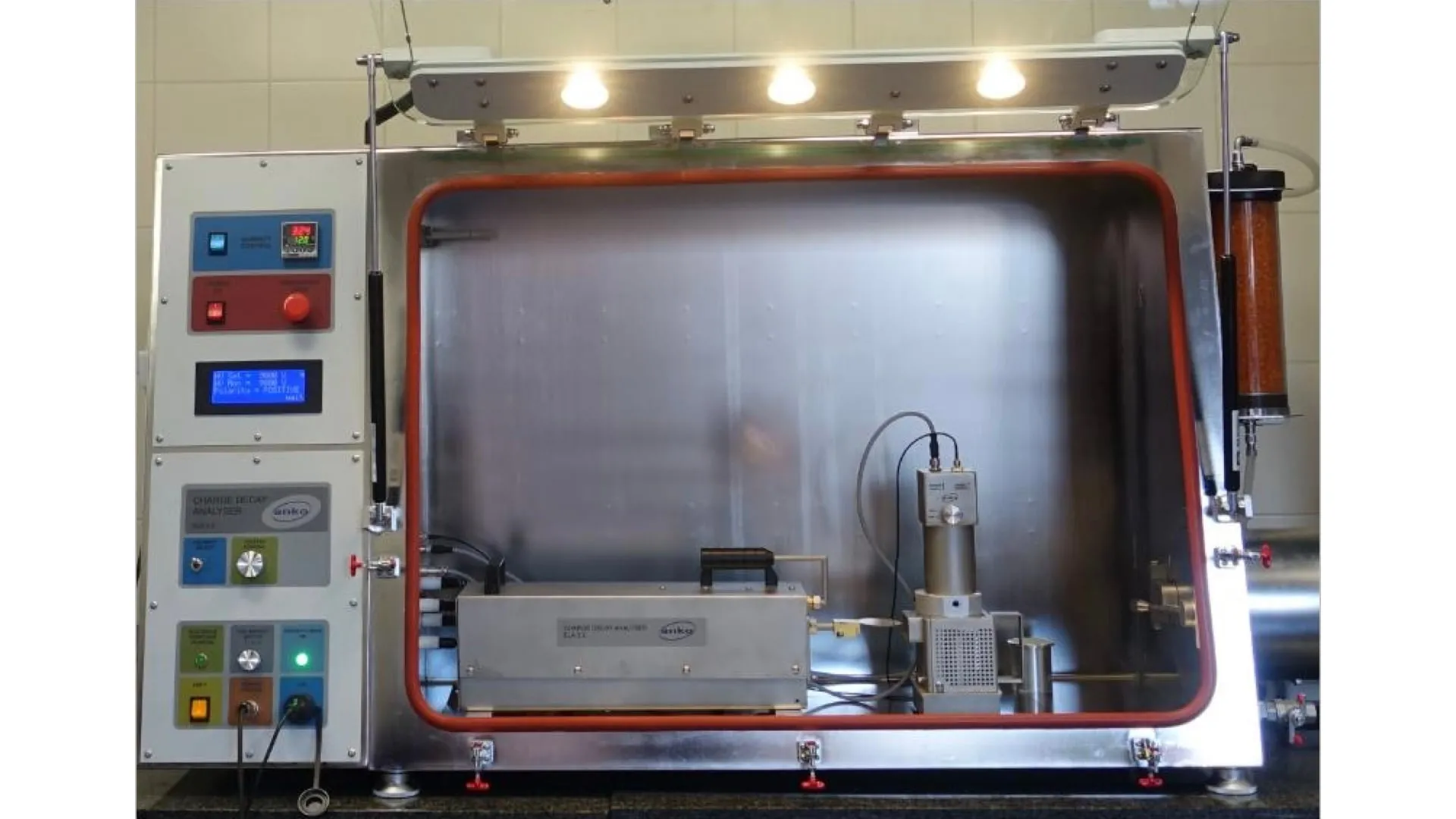
What This Test Answers
This test determines whether discharges from a highly charged insulating material can ignite a defined flammable test atmosphere. The result applies to the submitted sample, preparation, conditioning, and test conditions stated in the report. As with any single lab value, we’re careful not to generalize it as a universal property of the material, since particle size, moisture, temperature, pressure, geometry, and formulation can all shift the outcome.
Not sure if resistivity data is enough, or you need incendivity testing? Reach out and we’ll help you scope it.
Test Method and Standard
The insulating surface is charged under a defined worst case condition. Discharges are provoked toward an earthed ignition probe in a controlled gas mixture selected for the assessment objective, and repeated trials are observed for ignition. Testing follows IEC TS 60079-32-1 and a project specific incendivity methodology, or an agreed project specific method, and the quotation identifies the governing method before work begins.
What You Receive
- Ignition or non-ignition outcome under the specified test atmosphere
- Charging method, surface potential, probe geometry, and environmental conditions
- Limitations and application specific interpretation
How the Data Supports Decisions
This result informs whether insulating components can be used in a flammable atmosphere, clarifies whether conductive additives, coatings, thickness limits, or grounding features are needed, and supports qualification of products that can’t be assessed from resistivity alone.
When to Order This Test
- A charged plastic or composite surface sits near a flammable gas or vapor atmosphere
- Brush or propagating brush discharges are a credible concern for the material
- A product specific worst case incendivity demonstration is needed for qualification
Sample Submission Guidance
Provide actual production specimens or representative panels at the maximum thickness and surface finish used in the product. Multiple specimens may be required for conditioning and repeat trials. Include the SDS, composition or trade name information, physical form, process description, and whether the sample should be tested as received or prepared to a different condition.
Why Choose HazBasis
- Some insulating materials genuinely can’t be assessed by resistivity alone, a highly charged insulator can still be safe or still be dangerous depending on geometry and thickness in ways resistivity doesn’t capture. This test exists specifically for the cases where a resistivity number isn’t a sufficient answer, and we’ll tell you when that’s actually the case for your product.
- Worst case charging is the whole point of this test, so we work through the realistic charging scenario with you before running it, rather than defaulting to an arbitrary charging method that under or overstates the real risk.
- Because the atmosphere used in testing needs to represent what the product will actually encounter, we confirm the gas mixture against your application before committing to a test setup that might not answer the right question.
FAQ
What does Insulator Incendivity testing measure?
Determines whether discharges from a highly charged insulating material can ignite a defined flammable test atmosphere.
Which standard will be used?
IEC TS 60079-32-1 project-specific incendivity methodology. The final method depends on the sample, project objective, and any customer or regulatory requirements.
Why use a flammable test gas?
The objective is direct evidence of discharge incendivity under a controlled and known ignition sensitivity. The selected gas mixture must be appropriate to the intended assessment.