

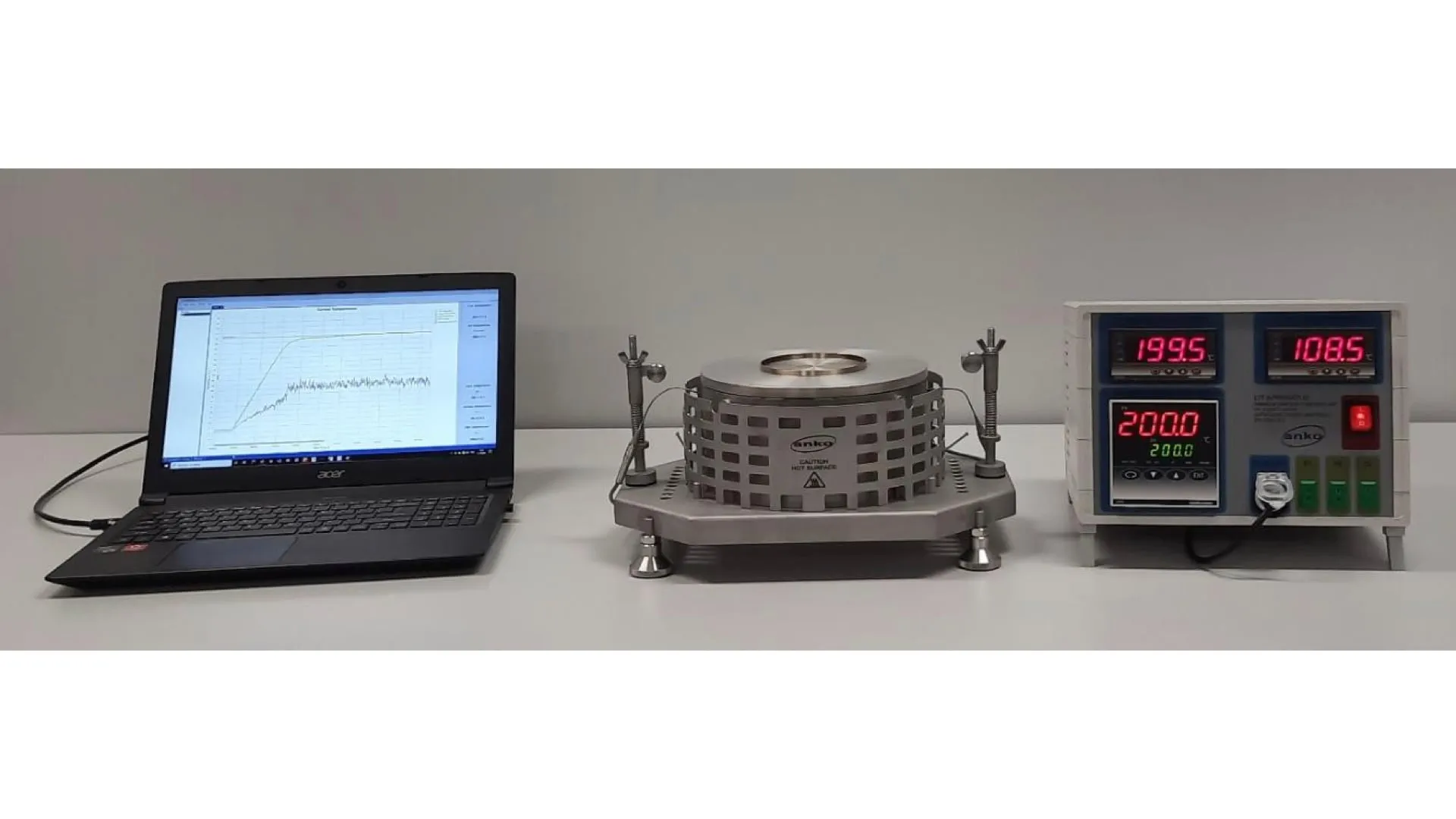
What Minimum Ignition Temperature (LIT) Testing Answers
This test determines the lowest hot surface temperature that ignites a defined layer of the tested dust. The result applies to the submitted sample, preparation, conditioning, and test conditions stated in the report. As with any single lab value, we’re careful not to generalize it as a universal property of the material, since particle size, moisture, temperature, pressure, geometry, and formulation can all shift the outcome.
Not sure how LIT applies to your equipment limits? Reach out and we’ll help you scope it.
Test Method and Standard
A defined dust layer is placed on a controlled hot plate and monitored with thermocouples. The surface temperature is reduced through successive fresh samples until ignition and non-ignition conditions are established using the standard criteria. Testing follows ASTM E2021 or an agreed project specific method, and the quotation identifies the governing method before work begins.
What You Receive
- LIT for the specified layer thickness
- Temperature-time records and the observed ignition mode
- Input for equipment surface temperature limits
How the Data Supports Decisions
This result supports selection and evaluation of electrical and non-electrical equipment, informs housekeeping standards and allowable dust layer thickness, and helps set safe temperatures for dryers, ducts, motors, bearings, and hot process surfaces.
When to Order This Test
- Dust layers can accumulate on warm or hot equipment in your process
- A DHA needs a defensible hot surface ignition basis
- Changes in particle size, moisture, or formulation may affect layer behavior

Sample Submission Guidance
Sample quantity depends on bulk density and the number of fresh layers needed. HazBasis confirms the quantity and whether the standard layer thickness represents your actual process condition. Include the SDS, composition or trade name information, physical form, process description, and whether the sample should be tested as received or prepared to a different condition.
Why Choose HazBasis
- A reported LIT isn’t the same thing as a maximum equipment temperature. Getting from one to the other requires code or standard derating, layer thickness considerations, and an engineering safety margin, and we walk through that gap explicitly rather than letting the raw number get used as a spec limit on its own.
- Layer thickness matters more than people expect, since a thicker accumulation insulates heat differently than the standard test layer, so we confirm whether the standard thickness actually represents what builds up in your process before testing begins.
- Where the result feeds into a DHA, we write the interpretation so it plugs directly into that hot surface ignition scenario instead of sitting as a standalone data point someone else has to connect.
FAQ
What does Dust Layer LIT testing measure?
Determines the lowest hot-surface temperature that ignites a defined layer of the tested dust.
Which standard will be used?
ASTM E2021. The final method depends on the sample, project objective, and any customer or regulatory requirements.
Can the reported LIT be used directly as the maximum equipment temperature?
Not by itself. Equipment limits require the applicable code or standard derating, layer-thickness considerations, and an engineering safety margin.