

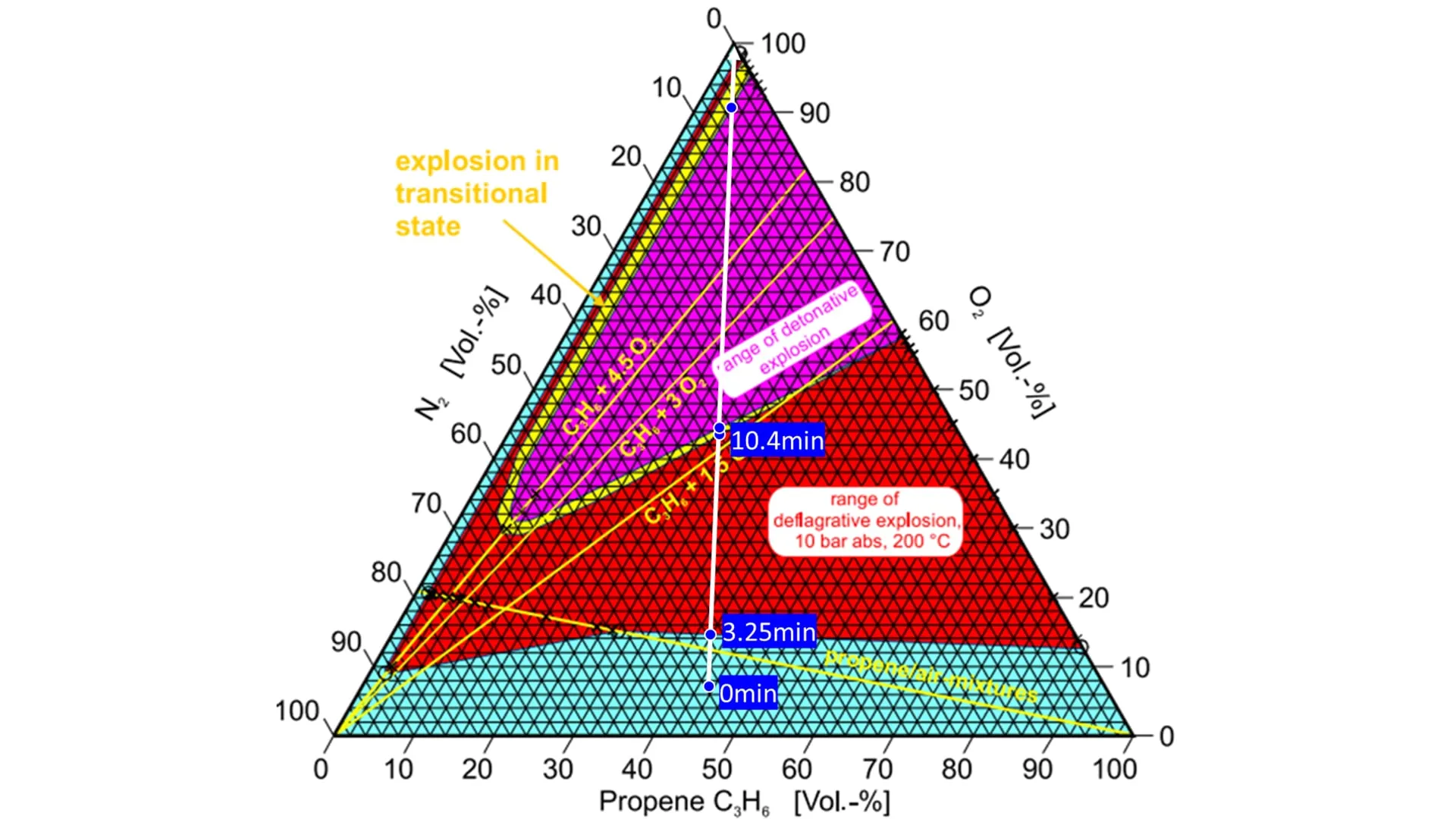
What Limiting Oxygen Concentration (LOC) Testing Answers
This test determines the lowest oxygen concentration at which flame propagation can still occur for a specified fuel, inert gas, and set of test conditions. The result applies to the submitted material, mixture composition, temperature, pressure, and inert gas stated in the report. LOC isn’t a universal constant for a material; it can shift with fuel composition, concentration, temperature, pressure, humidity, and which inert gas is used, so we define the test basis explicitly before testing begins rather than reporting a single number without context.
Not sure what oxygen limit your inerting system needs? Reach out and we’ll help you scope it.
Test Method and Standard
The gas or vapor mixture is prepared in an evacuated 20-L stainless steel spherical vessel using controlled partial pressure and, for suitable liquids, a heated vacuum evaporator. The vessel is brought to the specified temperature and mixed to promote a representative atmosphere, then tested across selected oxygen and fuel concentrations until the limiting boundary is established. Testing follows EN 1839 Method B for explosion limits and limiting oxygen concentration, and the vessel supports a temperature range of 20 to 120°C. The quotation identifies the governing method, inert gas, and test matrix before work begins.
What You Receive
- Limiting oxygen concentration (LOC) for the specified fuel, inert gas, and conditions
- Pressure-time data supporting the flame propagation determination
- Documented test conditions, mixture preparation basis, and inert gas used
How the Data Supports Decisions
This result supports selection of a safe maximum oxygen concentration for inerted operation, definition of oxygen alarm, trip, and interlock setpoints with an appropriate engineering margin, and evaluation of nitrogen, carbon dioxide, or other inerting strategies. It also informs purge and startup or shutdown procedure development, and helps assess whether a process change affecting fuel composition, temperature, pressure, or inert gas has shifted the safe operating range.
When to Order This Test
- Inerting is being considered or already used as an explosion prevention safeguard
- You need to validate an existing oxygen control basis against actual process conditions
- A change in fuel composition, temperature, pressure, or inert gas type may affect the allowable oxygen concentration
Sample Submission Guidance
Sample needs depend on material state, concentration matrix, vaporization efficiency, repeat testing, and the inert gas evaluated. HazBasis confirms sample quantity and handling requirements after reviewing the SDS and test scope. Include the SDS, composition and purity information, physical state and vaporization behavior, the operating temperature and pressure range, and the inert gas you intend to use.
Why Choose HazBasis
- LOC is a test result, not an operating setpoint on its own, and the gap between the two matters. We help translate the measured value into an actual operating limit that accounts for uncertainty, process variability, analyzer performance, response time, mixing, and sampling location, not just hand over a number.
- Nitrogen and carbon dioxide can produce genuinely different limiting behavior for the same fuel, so we confirm which inert gas your process actually uses before testing, rather than defaulting to whichever is more convenient in the lab.
- If your process temperature or pressure differs from standard reference conditions, we test at your actual conditions when that difference matters, since LOC measured at room temperature can understate the real risk at an elevated process temperature.
FAQ
What does LOC mean?
The limiting oxygen concentration is the lowest oxygen concentration at which flame propagation can still occur for the specified fuel, inert gas, and test conditions. Below that boundary, the tested mixture does not sustain the defined flame-propagation criterion.
Does LOC change with temperature or inert gas?
Yes. LOC can change with temperature, pressure, fuel composition, and the inert gas used. Nitrogen and carbon dioxide, for example, can produce different limiting behavior. The report must clearly state the test basis.
Can the results be used directly as an operating limit?
Not by themselves. Test results must be translated into design or operating limits using an engineering margin that addresses uncertainty, process variability, instrumentation, response time, mixing, and consequences.
Can liquids be tested?
Suitable liquids can be evaluated as vapors when they can be introduced, vaporized, and conditioned within the apparatus and method limitations. HazBasis reviews boiling point, vapor pressure, decomposition potential, and target temperature during scoping.
Can LEL and UEL testing be included?
Yes. The supplied 20-L sphere system is configured for lower and upper explosion limit testing as a related service. The recommended program depends on whether the project needs flammability limits, severity data, LOC, or a combination.
How much sample is required?
Sample quantity depends on material state, concentration matrix, vaporization efficiency, repeats, and requested endpoints. HazBasis confirms sample needs after reviewing the SDS and test scope.
How long does testing take?
Turnaround depends on sample receipt, material handling requirements, number of concentrations, test temperature, repeats, and the requested report. A schedule is provided with the quotation.