What Minimum Ignition Energy (MIE) Testing Answers
This test determines the lowest capacitive spark energy capable of igniting the tested dust cloud over the evaluated concentration range. The result applies to the submitted sample, preparation, conditioning, and test conditions stated in the report. As with any single lab value, we’re careful not to generalize it as a universal property of the material, since particle size, moisture, temperature, pressure, geometry, and formulation can all shift the outcome.
Not sure if MIE is the test you need? Reach out and we’ll help you scope it.
Test Method and Standard
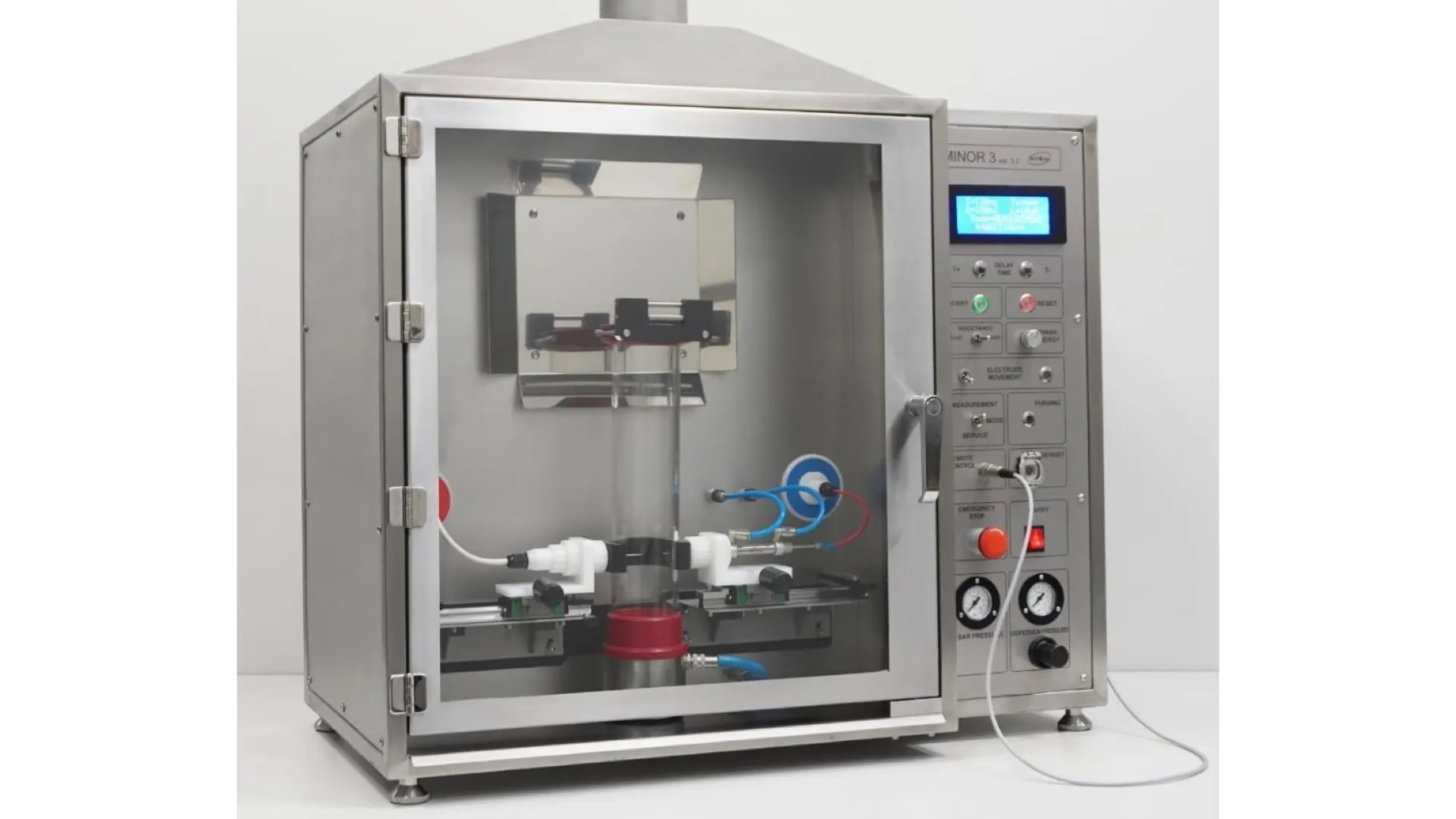
Dust is dispersed in a standardized ignition tube and exposed to sparks of controlled energy. Spark energy, dust concentration, and, when relevant, circuit inductance are varied to establish ignition and non-ignition bounds. Testing follows ASTM E2019 or an agreed project specific method, and the quotation identifies the governing method before work begins.
What You Receive
- The MIE result, or a bounded energy range
- Ignition behavior documented with the specified test circuit and sample condition
- Interpretation for electrostatic and mechanical or electrical spark hazards
How the Data Supports Decisions
This result helps determine whether common electrostatic discharges could be incendive, the level of rigor needed for bonding, grounding, conductive footwear, and material selection, and whether a more detailed electrostatic hazard assessment is warranted.
When to Order This Test
- Ignition source avoidance is a basis of safety in your process
- Powder transfer, mixing, filtration, filling, or emptying can generate static charge
- You’re assessing liners, containers, hoses, or personnel grounding
Sample Submission Guidance
Approximately 150 g is commonly requested, though more may be needed for sample preparation, low density powders, conditioning, or replicate testing. Include the SDS, composition or trade name information, physical form, process description, and whether the sample should be tested as received or prepared to a different condition.
Why Choose HazBasis
- MIE measures sensitivity to a standardized capacitive spark specifically, not every possible ignition source, so we’re upfront that hot surfaces, friction, smoldering particles, flames, and other discharge types need their own evaluation. A low MIE doesn’t mean every ignition question is answered, and we won’t imply that it does.
- Because MIE results feed directly into bonding, grounding, and equipment selection decisions, we write the interpretation to be usable by whoever is actually implementing the electrostatic controls, not just whoever ordered the test.
- If the result points toward a broader electrostatic hazard concern, we can carry it straight into a full Electrostatic Hazard Analysis instead of leaving you with a number and no next step.
FAQ
What does MIE testing measure?
Determines the lowest capacitive spark energy capable of igniting the tested dust cloud over the evaluated concentration range.
Which standard will be used?
ASTM E2019. The final method depends on the sample, project objective, and any customer or regulatory requirements.
Does MIE identify every ignition source that can ignite a dust?
No. MIE measures sensitivity to a standardized capacitive spark. Hot surfaces, friction, smoldering particles, flames, and other discharge types require separate evaluation.