

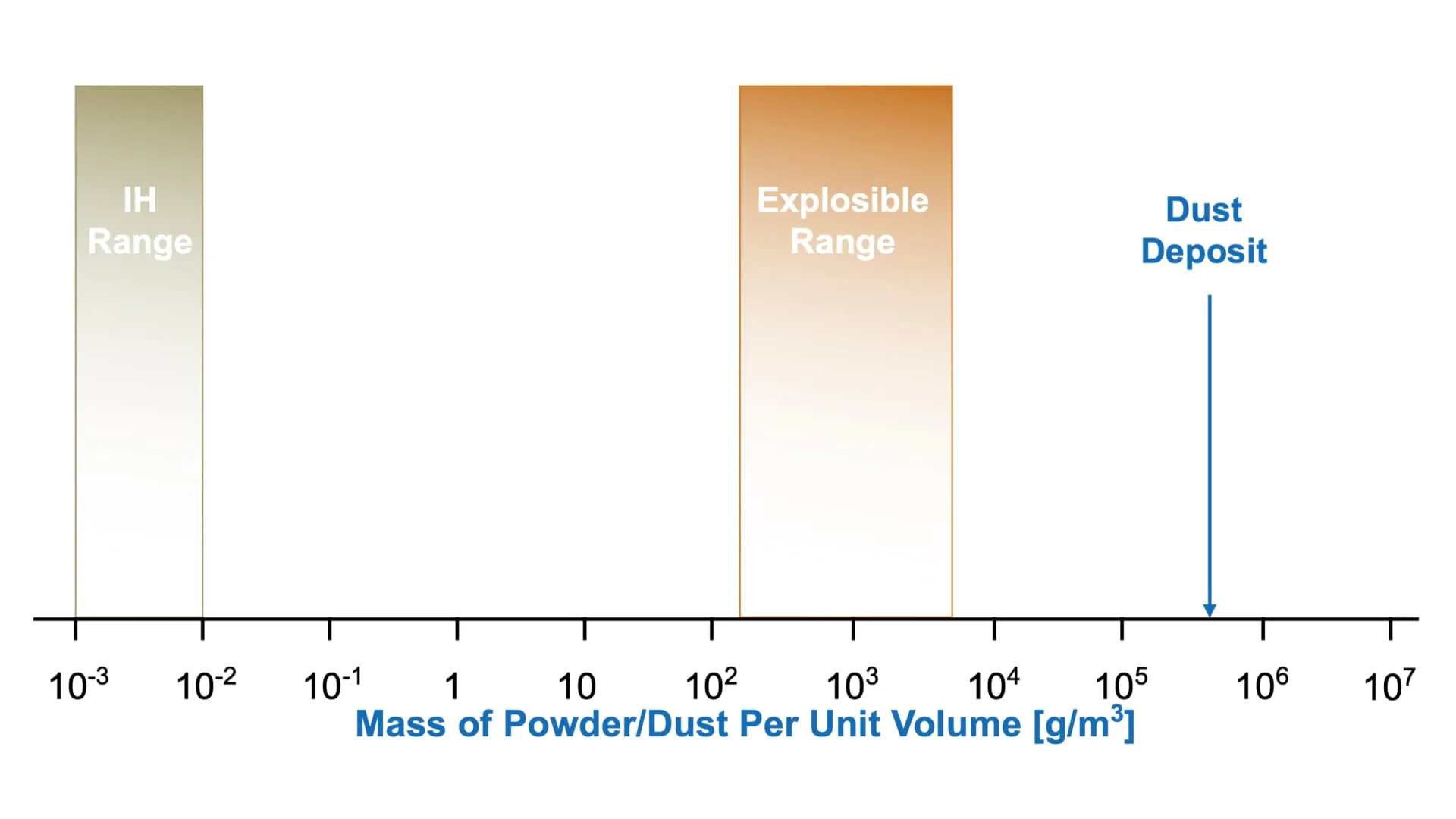
What Minimum Explosible Concentration (MEC) Testing Answers
This test determines the lowest tested dust concentration that propagates a deflagration in the standardized vessel. The result applies to the submitted sample, preparation, conditioning, and test conditions stated in the report. As with any single lab value, we’re careful not to generalize it as a universal property of the material, since particle size, moisture, temperature, pressure, geometry, and formulation can all shift the outcome.
Not sure if MEC is the right test for your question? Reach out and we’ll help you scope it.
Test Method and Standard
Dust-air mixtures are tested over a descending or ascending concentration series. Ignition and non-ignition results are repeated around the transition region, so the reported MEC is bracketed by reproducible test points rather than a single trial. Testing follows ASTM E1515, EN 14034-3, or an agreed project specific method, and the quotation identifies the governing method before work begins.
What You Receive
- Reported MEC in g/m3
- The ignition and non-ignition concentration bracket
- Sample condition and test condition documentation
How the Data Supports Decisions
This result supports ventilation and enclosure accumulation assessments, provides a basis for concentration monitoring or operating limits, and informs evaluation of credible dispersed dust scenarios in a DHA.
When to Order This Test
- You need a concentration threshold for a risk assessment
- Dust concentration may be controlled as a prevention layer in your process
- A process change affects dust loading, conveying, or enclosure volume
Sample Submission Guidance
The required mass depends on the concentration range and number of repeats. Submit representative material and allow additional quantity if grinding or sieving is requested. Include the SDS, composition or trade name information, physical form, process description, and whether the sample should be tested as received or prepared to a different condition.
Why Choose HazBasis
- MEC is often compared to a gas LFL, but a dust cloud is heterogeneous and transient in a way a gas mixture isn’t, so we report the value tied specifically to the sample and dispersion conditions tested rather than implying it’s a fixed constant for the material.
- The transition region gets extra repeat testing specifically, since that’s where a single trial is most likely to mislead you about where the real threshold sits.
- If MEC is meant to become an operating limit or a monitoring setpoint, we’ll flag what margin makes sense given how the test bracketed the result, not just hand over a number and leave the margin decision to you.
FAQ
What does MEC testing measure?
Determines the lowest tested dust concentration that propagates a deflagration in the standardized vessel.
Which standard will be used?
ASTM E1515; EN 14034-3. The final method depends on the sample, project objective, and any customer or regulatory requirements.
Is MEC the same as a gas LFL?
It is analogous in purpose, but dust clouds are heterogeneous and transient. MEC applies to the specified dust sample and dispersion conditions and should not be treated as a universal constant.