

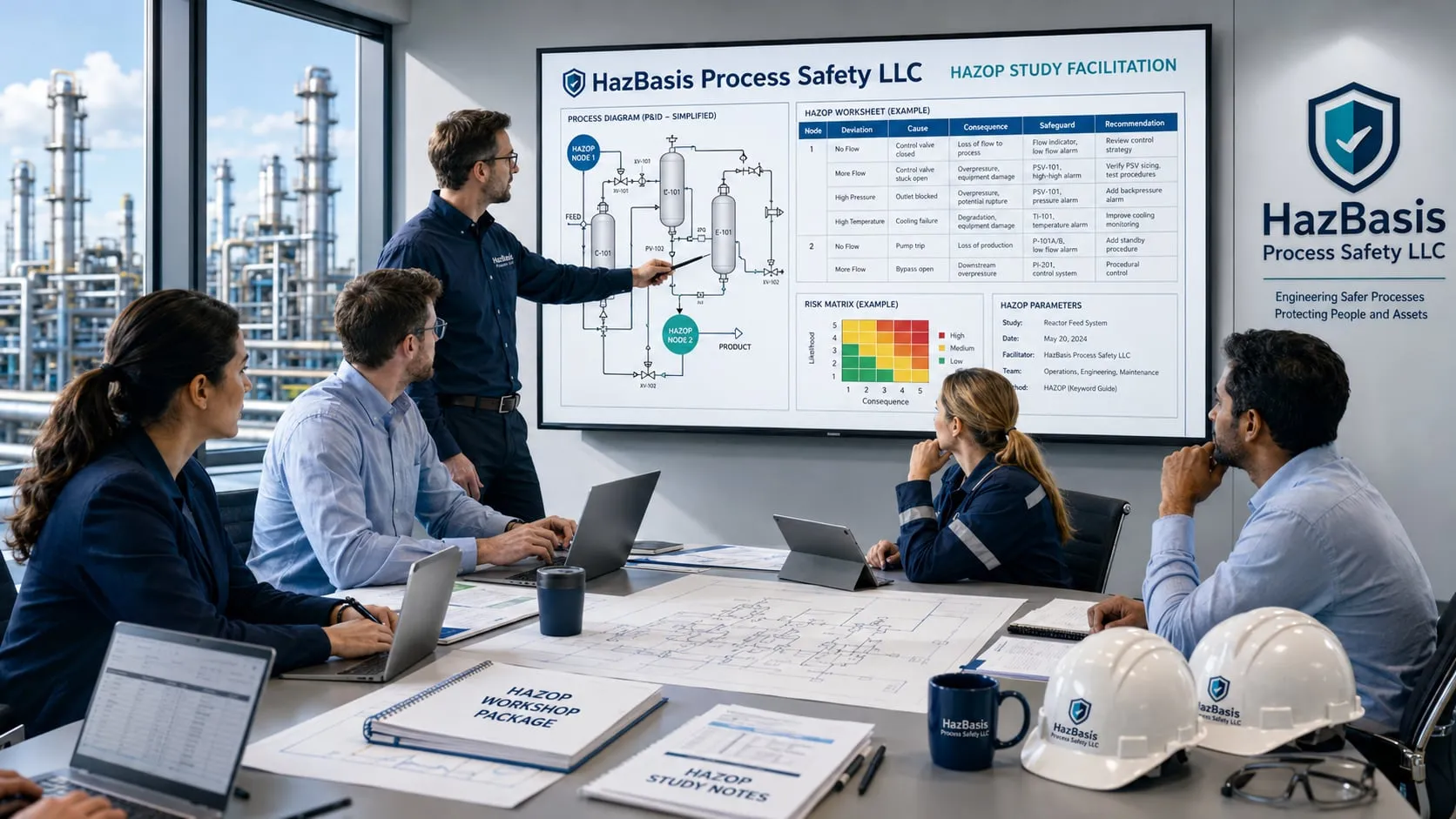
A Systematic Review of Deviations From Design Intent
A Hazard and Operability Study divides a process into logical sections or nodes and applies structured guidewords to relevant process parameters. The team uses the resulting deviations to identify credible initiating causes, potential consequences, existing safeguards, risk concerns, and recommendations. The core logic runs in sequence: design intent, deviation, cause, consequence, safeguard, risk ranking, recommendation.
Ready to scope a HAZOP study? Reach out and we’ll help.
Typical HAZOP Parameters and Deviations
- Flow. No flow, low flow, high flow, reverse flow, wrong destination
- Pressure. High pressure, low pressure, vacuum, pressure imbalance
- Temperature. High temperature, low temperature, rapid temperature change
- Level. High level, low level, overfill, loss of inventory indication
- Composition. Wrong material, contamination, off-specification concentration, two-phase behavior
- Reaction. No reaction, incomplete reaction, accelerated reaction, decomposition, polymerization
- Utilities. Loss of cooling, steam, power, instrument air, nitrogen, ventilation, agitation
- Sequence and timing. Step omitted, step performed early or late, excessive duration, wrong order
- Containment. Leak, rupture, seal failure, open drain, hose disconnection, line break
What a HazBasis HAZOP Can Evaluate
- Continuous and batch chemical processes
- Reactors, pressure vessels, distillation, filtration, drying, and separation systems
- Raw material receipt, storage, blending, transfer, and loading operations
- Utility, inerting, refrigeration, thermal fluid, ventilation, and flare systems
- Combustible dust handling, pneumatic conveying, dust collection, milling, and drying
- Battery, hydrogen, semiconductor, pharmaceutical, and advanced manufacturing systems
- Startup, shutdown, cleaning, sampling, maintenance, and abnormal operating procedures
- Control logic, alarms, trips, shutdown functions, relief systems, and operator response
HAZOP Services
New Design HAZOP. Review process design before construction or startup, when recommendations can be incorporated efficiently.
Detailed Design HAZOP. Evaluate mature P&IDs, control philosophy, relief provisions, procedures, and package system interfaces.
Existing Facility HAZOP. Evaluate the actual installed process, operating experience, field conditions, and current safeguards.
Five Year HAZOP Revalidation. Update and revalidate a previous study using process changes, incidents, management of change history, and safeguard status.
Management of Change HAZOP. Focus on hazards introduced by a specific process, equipment, control, or operating change.
Batch and Procedural HAZOP. Evaluate deviations in recipe steps, charging order, timing, cleaning, and operator actions.
HAZOP Action Review Workshop. Clarify recommendations, evaluate proposed responses, and support technically defensible closure decisions.
Our HAZOP Facilitation Process
Step 1: Define the Study Basis. Confirm objectives, battery limits, node strategy, risk matrix, consequence categories, safeguard credit rules, and recommendation conventions.
Step 2: Prepare the Study. Review P&IDs, process descriptions, operating limits, chemical and reaction data, relief documentation, procedures, control narratives, previous studies, and incident history.
Step 3: Select the Team. Include personnel with process engineering, operations, maintenance, controls, safety, and methodology knowledge appropriate to the scope.
Step 4: Facilitate the Workshop. Apply deviations consistently, distinguish causes from consequences, challenge safeguard assumptions, document risk, and keep the team focused.
Step 5: Review Study Quality. Check node coverage, duplicated or missing scenarios, safeguard independence, recommendation wording, and risk ranking consistency.
Step 6: Issue the Report. Provide complete worksheets, recommendation register, assumptions, team information, and a clear executive summary.
Typical HAZOP Deliverables
- HAZOP basis, scope, methodology, and node list
- Team roster and workshop attendance record
- Risk ranking matrix and consequence definitions
- Detailed deviation worksheets with causes, consequences, safeguards, and recommendations
- Assumptions, unresolved technical questions, and information gaps
- Risk ranked recommendation register
- Executive summary of major themes and priority actions
- Editable report and PDF deliverable, as agreed
Why Choose HazBasis
A HAZOP is only as good as the person running the room. We keep the workshop moving at a pace that respects everyone’s time without rushing past a scenario that deserves real discussion, and we’re comfortable pushing back when a safeguard gets waved through without the specificity it actually needs, even when that means a longer conversation than the team expected.
Our facilitators bring process safety engineering judgment into the room, not just a trained process for asking guideword questions. That matters most in the scenarios that don’t fit neatly into a template, a reactive chemistry concern, a combustible dust interface, a battery hazard, where a facilitator without the underlying technical background can miss that a deviation actually needs deeper follow-up. And where a HAZOP surfaces a question it can’t fully resolve on its own, we can carry that question directly into LOPA, consequence modeling, or the relevant testing, rather than leaving it as an open item with no clear next step.
FAQ
When should a HAZOP be performed during design?
A preliminary hazard review can begin early, but the main HAZOP is usually most effective when P&IDs, equipment design, control philosophy, relief provisions, and operating concepts are sufficiently developed for meaningful evaluation. A follow-up review may be needed if the design changes materially after the workshop.
How is a HAZOP node selected?
Nodes are selected to represent a clear design intent and manageable set of process parameters. Poorly chosen nodes may be too broad to analyze systematically or so narrow that the workshop becomes inefficient.
Who should attend a HAZOP?
The team should include people knowledgeable in process engineering and operations, plus relevant expertise such as controls, maintenance, mechanical integrity, reaction hazards, relief systems, or facility siting. At least one participant should understand the HAZOP methodology.
Can HAZOP be used for batch processes?
Yes. Batch HAZOPs often combine equipment-node analysis with review of procedural steps, charging order, timing, temperature control, agitation, sampling, cleaning, and abnormal recovery actions.
What is the difference between a HAZOP and a design review?
A design review confirms that the design meets project and engineering requirements. A HAZOP systematically asks how deviations from the intended design or operation could create hazardous consequences. The activities are complementary but not interchangeable.
Can HazBasis support recommendation closure?
Yes. HazBasis can review proposed responses, facilitate action-resolution workshops, evaluate whether an alternative safeguard addresses the documented risk, and help improve closure documentation.