

Understand How Self-Heating Risk Changes from a Lab Sample to a Full-Scale Silo
A powder that appears thermally stable in a small laboratory sample may behave very differently when stored in a drum, FIBC, hopper or silo. As the accumulation becomes larger, heat generated by oxidation or other exothermic reactions can become increasingly difficult to dissipate. If internal heat generation exceeds heat loss to the surroundings, the material temperature can continue to rise and ultimately result in self-ignition, smoldering, fire or secondary dust-explosion hazards.
HazBasis provides Basket Self-Heating & Scale-Up Testing based on EN 15188 to determine the relationship between self-ignition temperature, accumulation size and storage geometry.
Need to Determine the Safe Storage Basis for Your Powder?
What Is EN 15188 Basket Self-Heating Testing?
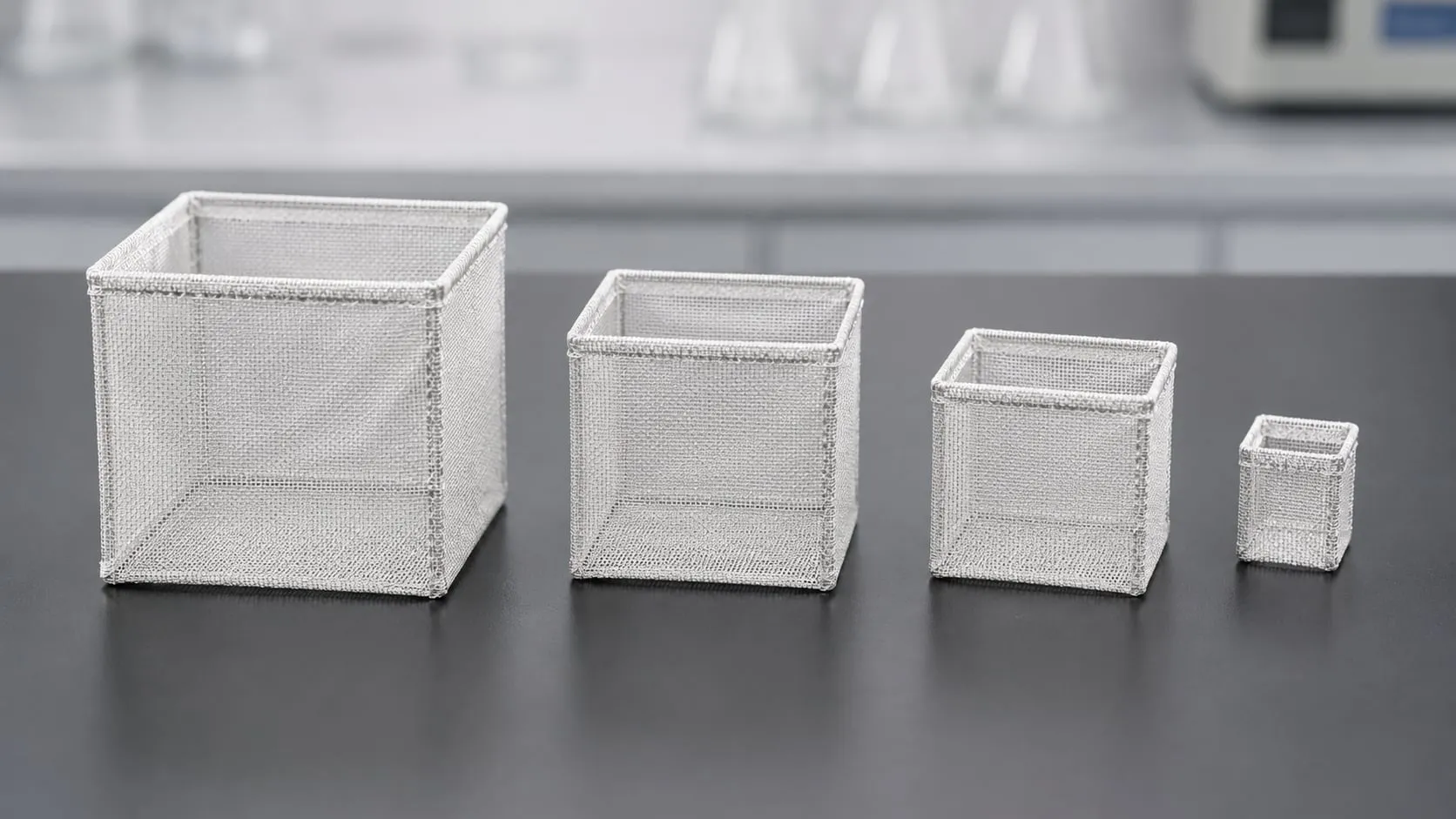
EN 15188 evaluates the spontaneous ignition behavior of bulk powders and granular solids by placing representative material into mesh-wire baskets of different sizes and exposing each basket to controlled, constant-temperature conditions in an oven.
For scale-up assessment, multiple basket volumes are tested. A typical four-size cube series is approximately 5 cm, 6 cm, 8.5 cm, and 10 cm.
For each basket size, testing brackets the transition between stable, non-igniting behavior and runaway self-heating or self-ignition. The resulting parameter is the size-dependent Self-Ignition Temperature (TSI).
Why Storage Size Matters
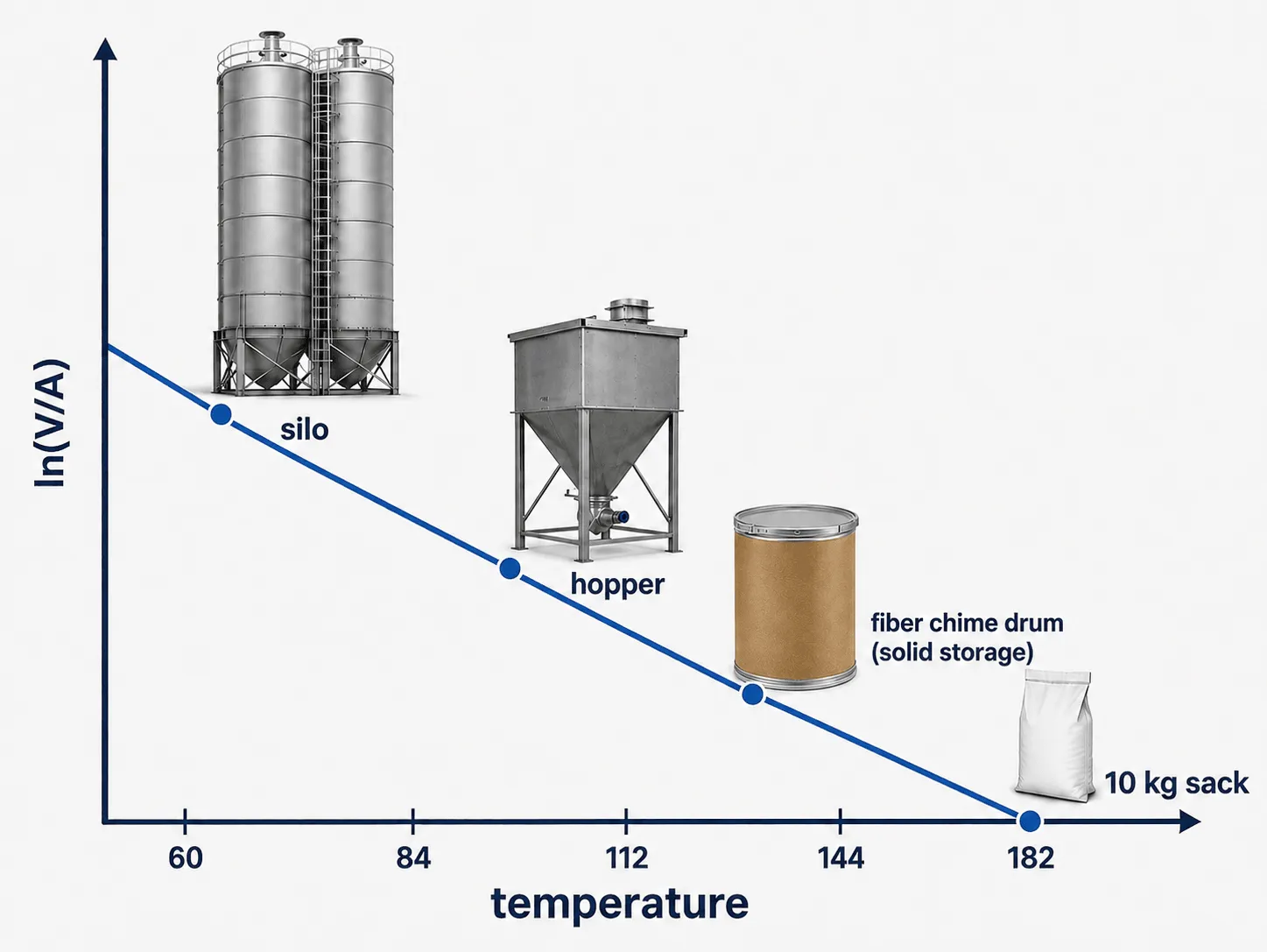
Self-heating is fundamentally a competition between heat generation inside the powder and heat loss from the powder to its surroundings. Small accumulations usually dissipate heat more effectively. As storage volume increases, heat retention increases and the critical self-ignition temperature can decrease.
| 10 kg Sack | Fiber Drum | FIBC / Hopper | Silo |
| Smallest scale | Intermediate scale | Larger bulk | Largest bulk |
Key implication: a temperature acceptable for a small package cannot automatically be assumed safe for a full-scale hopper or silo.
From Laboratory Basket Data to Plant-Scale Storage
The value of EN 15188 testing goes beyond determining whether a laboratory basket ignites. Data from multiple basket sizes establish how TSI changes with accumulation scale and can then be evaluated for larger storage volumes and different geometries.
A technically meaningful scale-up considers:
- Relevant normal and abnormal plant conditions
- Measured TSI values for multiple basket sizes
- Storage volume and characteristic dimensions
- Container or accumulation geometry
- Surface-area-to-volume relationship (V/A)
- Representative bulk density
- Heat-transfer and boundary conditions
- Operating/storage temperature and duration
What Questions Can Basket Scale-Up Testing Help Answer?
- How does silo, hopper or bin geometry affect the scale-up assessment?
- Can warm powder be discharged directly from a dryer into an FIBC or storage hopper?
- What self-ignition temperature is expected for a larger storage volume?
- Does moving from a fiber drum to a supersack significantly increase the self-heating hazard?
- At a specified storage temperature, what accumulation size may become thermally unstable?
- Would product cooling before bulk storage materially reduce the self-heating risk?
EN 15188 Test Method
A representative powder or granular-solid sample is prepared at a bulk density representative of the intended plant condition. Each basket is filled to the controlled settled bulk density and placed in a constant-temperature oven. A thermocouple at the center of the sample measures the sample temperature, while additional thermocouples monitor the surrounding oven temperature.
- Prepare and characterize a representative sample.
- Fill the selected mesh basket at controlled bulk density.
- Place the basket in the controlled hot-storage oven.
- Continuously record sample-center and oven temperatures.
- Determine the ignition/no-ignition boundary for that basket volume.
- Repeat using additional basket sizes.
- Use the multi-size TSI dataset for scale-up evaluation.
Near the final TSI determination for each basket size, the test program brackets the ignition boundary closely so that the size-specific TSI can be established with the precision required by the standard.
EN 15188 Scale-Up Analysis
Frank-Kamenetskii Thermal Explosion Theory
The Frank-Kamenetskii approach relates self-ignition temperature to a characteristic dimension of the accumulation and represents the balance between internal reaction heat generation and heat removal. Geometry is explicitly important; characteristic dimensions differ for cubes, cylinders and slab-like accumulations.
Thomas Correction for Realistic Heat Transfer
The classical Frank-Kamenetskii solution idealizes the external boundary. For more realistic surface heat transfer, the Thomas correction incorporates finite heat-transfer effects through the Biot number. This can be important when translating laboratory basket behavior to actual equipment.
Pseudo-Arrhenius Scaling Plot
For suitable applications, EN 15188 also describes an empirical scaling relationship based on log(V/A) versus reciprocal TSI. The experimental TSI points establish a boundary between stable behavior and self-ignition. Because the method is empirical, extrapolation should remain within the limits and uncertainty framework of the standard.
Typical Applications
Basket self-heating and scale-up testing is relevant to powders and granular materials stored or accumulated in silos, hoppers, bins, FIBCs (supersacks), fiber drums, bags, dryer discharge hoppers, intermediate storage areas, bulk warehouses, powder vessels, day bins, and process accumulations.
Industries may include chemical manufacturing, pharmaceuticals, food and ingredients, agricultural products, polymers, specialty chemicals, recycling, biomass, and other powder-processing operations.
What You Receive from HazBasis
Measured basket TSI data: Self-ignition temperature results for the selected basket volumes, with temperature-time behavior and relevant induction-time observations.
Scale-up evaluation: Analysis connecting laboratory measurements with larger accumulation sizes and the intended storage configuration.
Plant-specific interpretation: Consideration of storage geometry, operating temperature, bulk density, storage duration and relevant process conditions.
Engineering conclusions: Practical guidance supporting decisions on cooling, storage configuration, allowable temperature basis, need for additional testing, or further process-safety analysis.
Uncertainty awareness: Where extrapolation is used, the interpretation addresses the uncertainty associated with applying laboratory data to larger storage volumes.
Basket Testing vs. Self-Heating Screening Testing
These tests address different physical conditions and should not be treated as interchangeable.
| Test | Condition Represented | Primary Use |
|---|---|---|
| Aerated Powder Test | Heated air flowing through powder | Through-flow / fluid-bed-type dryer screening |
| Powder Layer Test | Hot air over a deposited layer | Dryer layers and internal deposits |
| Bulk Powder Screening | Small bulk accumulation | Initial indication of bulk thermal instability |
| EN 15188 Basket Test | Isoperibolic hot-storage of multiple volumes | Quantitative TSI-versus-size relationship and scale-up |
Representative Samples Matter
Self-heating behavior depends not only on chemical identity but also on the physical condition of the product. For meaningful plant interpretation, the tested sample should reflect the material that will actually be stored or handled.
- Particle-size distribution
- Moisture content
- Bulk density
- Formulation and additives
- Drying or thermal history
- Expected storage configuration
- Possible contamination or process carryover
Testing a non-representative sample can produce a TSI relationship that does not adequately describe the real process.
From Test Data to a Safer Storage Basis
The final engineering objective is not merely to report the temperature at which a laboratory basket ignited. The more useful question is how the measured thermal behavior translates to the proposed plant scale and operating conditions.
HazBasis combines controlled laboratory testing with process-safety interpretation to help connect EN 15188 data with dryer discharge, intermediate storage and bulk solids handling decisions.
FAQ
What is EN 15188 testing?
EN 15188 is a hot-storage test method for determining the spontaneous self-ignition behavior of combustible dusts and granular materials as a function of accumulation volume.
What does TSI mean?
TSI is the Self-Ignition Temperature associated with a specified accumulation size under the test conditions.
Why are several basket sizes required?
Multiple volumes establish how TSI changes with accumulation scale, providing the data needed for extrapolation to larger storage conditions.
Can EN 15188 results be scaled to a silo?
Yes, within the assumptions and limits of the selected EN 15188 extrapolation method. Geometry, volume, bulk density, heat transfer and uncertainty should be considered.
Is storage mass alone sufficient for scale-up?
No. Scale-up is fundamentally related to volume, dimensions, surface area, geometry and heat-transfer behavior. Bulk density is needed to translate mass into volume.
Is EN 15188 appropriate for a fluid-bed dryer?
No. Strongly aerated powder conditions are represented more appropriately by aerated-powder testing rather than EN 15188 hot-storage basket testing.
Is extrapolated TSI the same as the maximum safe operating temperature?
Not automatically. An operating limit requires consideration of uncertainty, process duration, geometry, actual boundary conditions, abnormal operation and an appropriate engineering safety margin.