
Move Beyond a Qualitative Risk Matrix
LOPA is a semi-quantitative method for evaluating a defined hazardous scenario. It’s commonly used when a HAZOP identifies a scenario whose risk can’t be resolved confidently through qualitative ranking alone, or when a project needs to determine whether an additional independent protection layer or safety instrumented function is required.
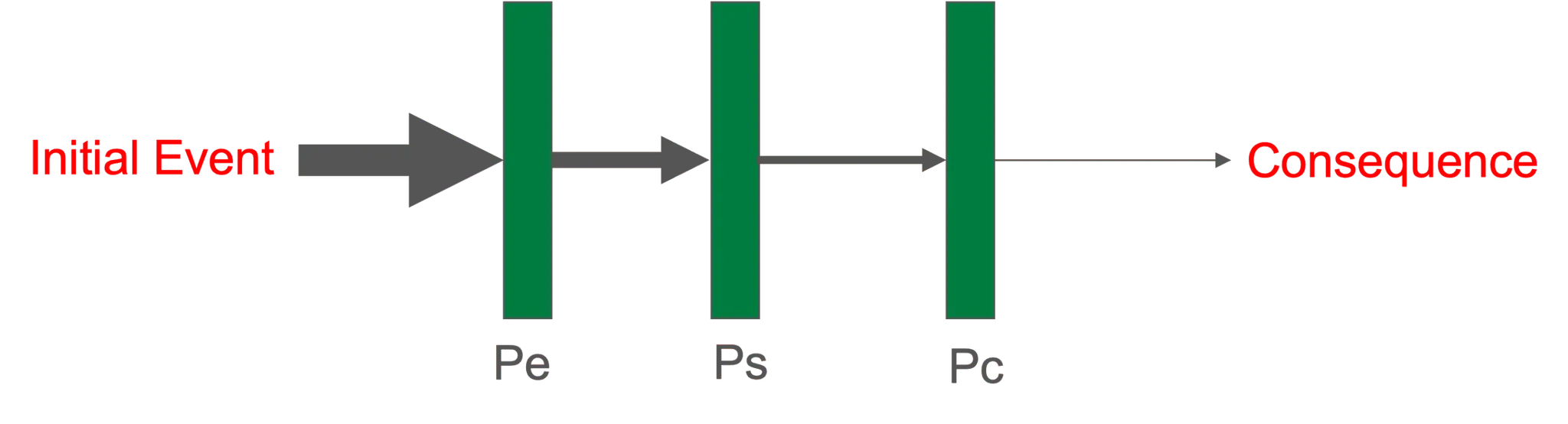
The core question LOPA answers: given this initiating event and consequence, do the qualifying independent protection layers reduce the scenario frequency to the organization’s risk criterion?
Have a scenario that needs LOPA? Reach out and we’ll help.
Typical LOPA Inputs
Scenario definition. A clearly defined initiating cause, hazardous consequence, and point at which the consequence is evaluated.
Initiating event frequency. A frequency selected from approved company data, recognized industry data, or a documented project specific basis.
Enabling conditions. Conditions that must be present for the initiating event to progress to the scenario.
Conditional modifiers. Factors such as ignition probability, occupancy probability, or probability of a particular outcome, when permitted by the selected methodology.
Independent protection layers. Safeguards that meet the project criteria for independence, specificity, effectiveness, and auditability.
Risk criterion. The target frequency or tolerable risk criterion against which the calculated scenario frequency is compared.
LOPA Workflow
Step 1: Confirm the Scenario. Establish a single initiating event and a specific consequence. Avoid combining several different causes or consequence endpoints in one calculation.
Step 2: Assign the Initiating Event Frequency. Select a value supported by the approved data source and confirm that the event definition matches the data category.
Step 3: Evaluate Enabling Conditions and Modifiers. Credit only those factors allowed by the organization’s LOPA procedure and supported by a clear basis.
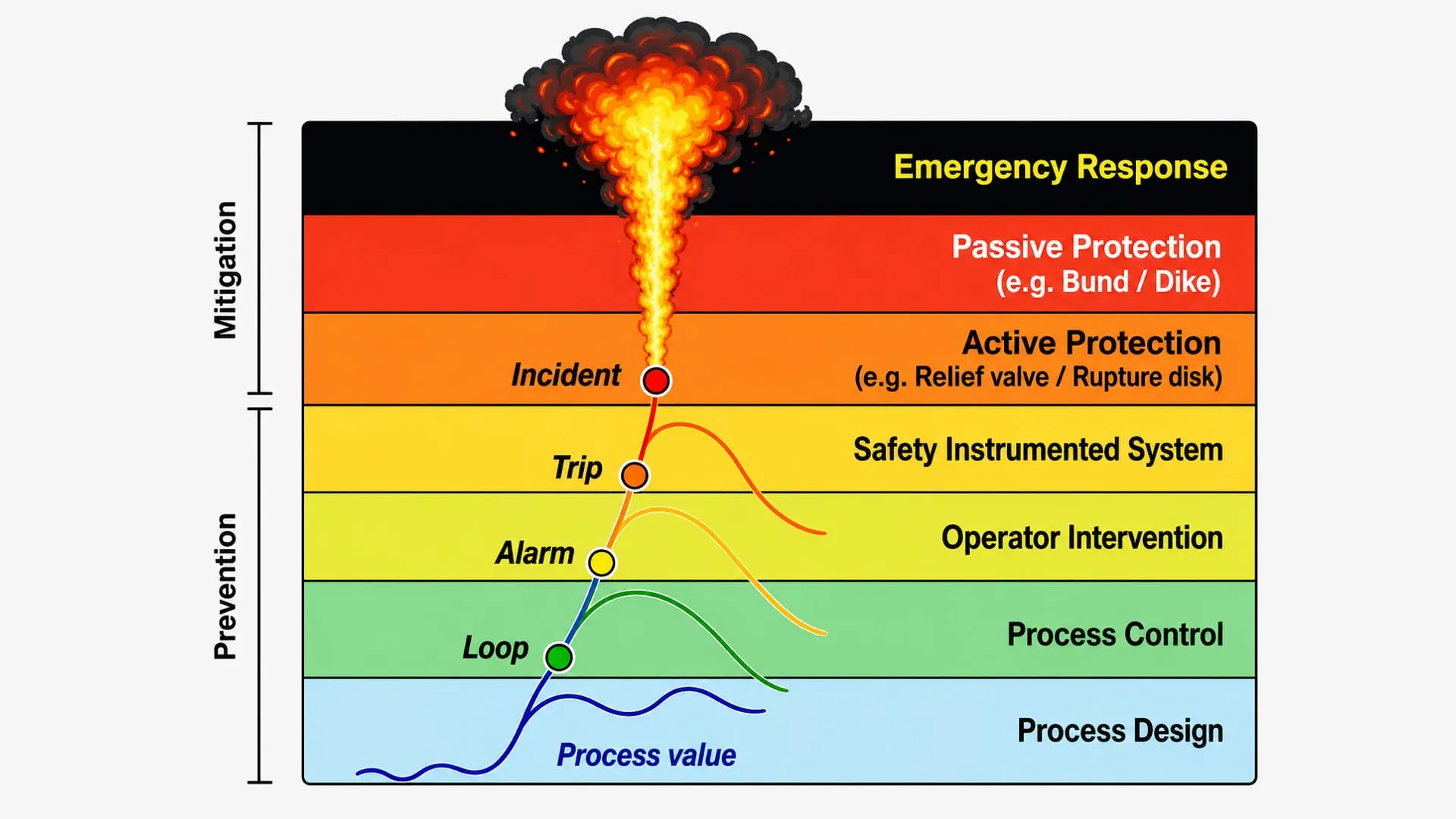
Step 4: Identify Candidate Safeguards. Review controls, alarms, operator actions, relief systems, containment, shutdown functions, and other safeguards documented in the PHA.
Step 5: Apply IPL Criteria. Confirm that each credited layer is independent of the initiating event and other credited layers, specific to the scenario, capable of performing the required function, and auditable through testing or management systems.
Step 6: Calculate Residual Frequency. Apply the approved probability of failure values and compare the result with the risk criterion.
Step 7: Define the Risk Gap. Determine whether additional risk reduction is required and document the required performance without prematurely selecting a specific design.
Step 8: Record Assumptions and Actions. Document uncertainties, dependencies, data sources, required validation, and recommendations.
When Is LOPA Most Useful?
- High severity HAZOP scenarios with disagreement about risk ranking
- Scenarios that rely on several alarms, interlocks, or operator actions
- Determining whether a safety instrumented function is required
- Verifying whether a proposed safeguard provides enough risk reduction
- Comparing alternative risk reduction strategies
- Supporting closure of a PHA recommendation with a documented risk basis
- Evaluating changes to an existing alarm, trip, relief, or shutdown function
- Identifying where a full QRA or more detailed consequence analysis is warranted
Typical LOPA Deliverables
- LOPA scope, methodology, risk criteria, and data source basis
- Defined scenario, consequence endpoint, and initiating event
- Initiating event frequency and supporting rationale
- Enabling conditions and conditional modifiers, where applicable
- Credited IPLs and documented qualification basis
- Calculated residual scenario frequency and risk gap
- Required additional risk reduction, when applicable
- Assumptions, uncertainties, validation items, and recommendations
- Workshop record and final LOPA report
HazBasis LOPA Support Options
Integrated HAZOP/LOPA. Facilitate LOPA immediately after selected HAZOP scenarios are identified, using a pre-agreed screening criterion.
Standalone LOPA Workshop. Evaluate a defined list of scenarios from an existing HAZOP or PHA.
LOPA Methodology Development. Support development or improvement of risk criteria, initiating event tables, IPL rules, and worksheet conventions.
Independent LOPA Review. Review calculations prepared by a project team, vendor, or engineering contractor for scenario definition, data selection, dependency, and IPL validity.
LOPA Action Resolution Support. Evaluate proposed safeguards and determine whether the required risk reduction has been demonstrated.
Why Choose HazBasis
HazBasis delivers practical, technically sound LOPA studies that provide a clear and defensible basis for risk-based decision-making. Our facilitators have extensive experience applying recognized LOPA methodologies across a wide range of process industries, ensuring each analysis is consistent, well-documented, and aligned with company standards and applicable industry guidance. We focus on clearly defining scenarios, applying appropriate initiating event data, and evaluating only those safeguards that meet the required criteria for independent protection layers.
Beyond the calculations, we work closely with project teams to identify realistic risk reduction opportunities and provide recommendations that can be implemented with confidence. Whether supporting a HAZOP follow-up, determining the need for a safety instrumented function, reviewing an existing LOPA, or facilitating a standalone workshop, HazBasis delivers clear documentation, transparent assumptions, and practical outcomes that support engineering decisions throughout the lifecycle of the facility.
FAQ
What is the difference between HAZOP and LOPA?
HAZOP is primarily a hazard-identification method. It identifies deviations, causes, consequences, safeguards, and recommendations. LOPA begins with a defined scenario and evaluates the frequency and effectiveness of independent protection layers more explicitly.
Does every HAZOP scenario need LOPA?
No. LOPA is normally reserved for scenarios that meet an agreed screening criterion, such as high consequence, uncertain qualitative risk, possible SIL requirement, or significant disagreement about safeguard adequacy.
Can an alarm and operator response be an IPL?
Potentially, but only when the alarm is independent of the initiating event and other credited layers, the operator has enough time to detect and respond, the action is clearly defined, and the function is supported by training, testing, and management systems.
Can a relief valve be credited in LOPA?
It may qualify when it is independent, reliable, correctly sized for the scenario, maintained and tested, and prevents the consequence being evaluated. If the selected consequence occurs after the relief device operates, the device may not eliminate that consequence.
What is the difference between LOPA and SIL verification?
LOPA can define the risk reduction required from a safety instrumented function. SIL verification evaluates whether the proposed hardware architecture, failure rates, diagnostics, test intervals, and other design factors achieve the required probability of failure.
Can HazBasis review an existing LOPA?
Yes. The review can address scenario definition, initiating-event data, enabling conditions, conditional modifiers, IPL independence, common-cause concerns, calculation consistency, and recommendation closure.