From a standard number to a usable safety basis
A real process-safety problem rarely belongs to one document. A combustible dust project can involve NFPA requirements, ASTM laboratory methods, electrical classification, electrostatic guidance and equipment protection standards at the same time. A flammable-liquid project may combine NFPA 30 with flash-point, flammability-limit and autoignition data. A European project can connect area classification with ignition source analysis and non-electrical equipment requirements.
HazBasis uses this resource center to explain the role of each standard, where it fits in the engineering workflow, and when additional testing or specialist interpretation is needed. The goal is not to reproduce copyrighted standards or replace the official current edition. The goal is to help engineers, EHS teams, project managers and facility owners identify the right technical path.
Need help identifying the right standard or test? Reach out and we’ll help.
Explore standards by organization and engineering problem
NFPA Codes & Standards
NFPA 660 combustible dust, NFPA 30 flammable liquids, NFPA 77 electrostatics, explosion protection and hazardous-area guidance.
ASTM Standards
Combustible dust testing, gas/vapor flammability, flash point, autoignition, electrical resistance, material resistivity and ASTM F150 floor resistance testing.
API Standards
Pressure-relief systems, petroleum/petrochemical equipment and related process-safety engineering practices.
IEC / EN / ISO Standards
Explosive atmospheres, hazardous-area classification, electrostatic hazards, ignition source analysis and non-electrical equipment.
VDI & EN 15188 Guidance
Dust fire/explosion hazard assessment, protection measures, venting, dryer applications and self-heating scale-up.
GB Standards
Chinese national standards relevant to hazardous materials, process safety, explosive atmospheres and testing for China/APAC projects.
Find the standard by the question you are trying to answer
| Engineering question | Standards direction | Related HazBasis path |
|---|---|---|
| Combustible dust: What framework governs the hazard assessment? | NFPA 660; legacy NFPA 61/484/652/654/655/664 references may still matter for older adopted editions or historical documentation. | Dust Hazard Analysis; Combustible Dust Testing |
| Flammable liquids: What controls storage, handling and use? | NFPA 30, supported by applicable flash point, LFL/UFL, AIT and other material data. | Flammable Liquid Fire & Explosion Analysis; Gas & Vapor Flammability Testing |
| What combustible-dust data do I need? | ASTM E1226, E1515, E2019, E1491, E2021, E2931 as applicable. | Kst/Pmax, MEC, MIE, MAIT/LIT, LOC Testing |
| What gas/vapor flammability data do I need? | ASTM E681, E659, E2079 and appropriate ASTM flash-point methods. | LFL/UFL, AIT, LOC, Flash Point Testing |
| Is static electricity a credible ignition source? | NFPA 77; IEC TS 60079-32-1; IEC 60079-32-2; ASTM resistance/resistivity methods as applicable. | Electrostatic Hazard Analysis & Testing; ASTM F150 Floor Resistance Testing |
| Can non-electrical equipment create an effective ignition source? | EN 1127-1; ISO 80079-36; ISO 80079-37. | Ignition Source Analysis |
| How should a European hazardous area be classified? | IEC 60079-10-1 for gas/vapor; IEC 60079-10-2 for dust. | Hazardous Area Classification – IEC |
| How does self-heating risk change with accumulation size? | EN 15188 hot-storage basket testing and scale-up; use different methods for strongly aerated conditions. | Basket Self-Heating & Scale-Up Testing |
| How should dust explosion protection be selected? | VDI 2263 family and, where venting is selected, VDI 3673; project basis may also involve NFPA or EN standards. | DHA; Explosion Protection Engineering |
How HazBasis connects standards to decisions
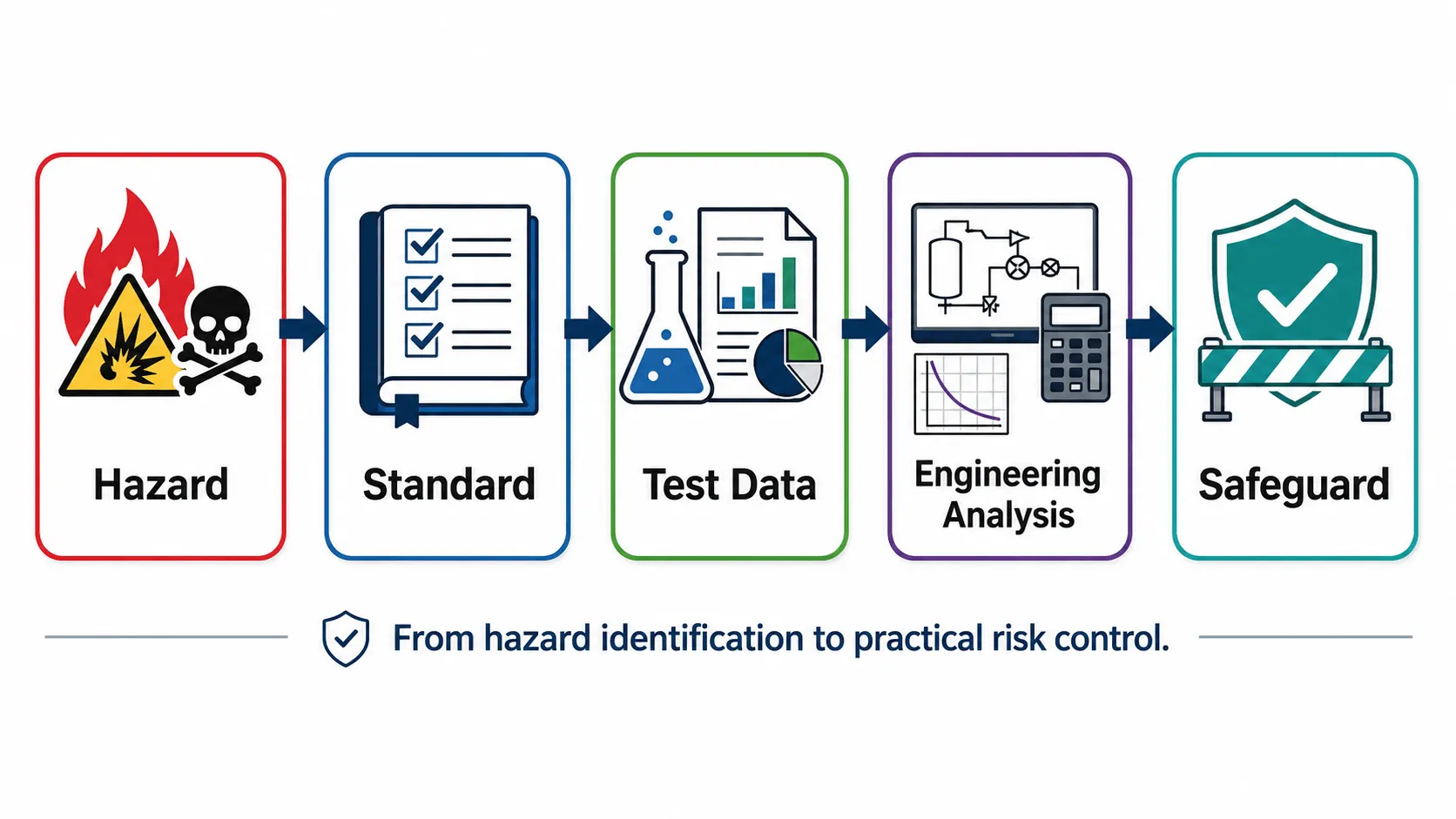
Hazard → Applicable standard → Required test data → Engineering analysis → Safeguard / operating basis
This sequence is the central organizing principle for the Codes & Standards hub. A standard is most useful when it is connected to the actual material, process conditions, equipment configuration and decision that the project must make.
FAQ
Does HazBasis provide copies of NFPA, ASTM, IEC, EN or VDI standards?
No. HazBasis summarizes practical application and directs users to the official publisher. The official current edition is the reference of record.
Which edition should my project use?
That depends on jurisdiction, contract requirements, adopted codes, equipment certification basis and AHJ expectations. Always verify the project-specific adopted edition.
Can one project require both NFPA and ASTM standards?
Yes. NFPA documents often define the safety framework, while ASTM methods generate the material data used to support hazard evaluation and safeguard design.
Can European standards be used on U.S. projects?
They can be relevant for international equipment, owner standards, ATEX/IECEx work or technical benchmarking, but the governing U.S. code and AHJ basis still need to be established.